



Table of Contents

147

7 min

23.07.2026
The Overhead That Quietly Ate 22% of a Builder's Margin
.avif)
Oleksandr Solovei
CEO & Co-founder Finmap
On paper, every object was profitable. The owner of a construction company running several parallel sites could tell you the margin on each one — materials in, payments out, a healthy number at the bottom. The business felt solid. So why was there never enough cash, and why did some months quietly end in the red?
The answer wasn't in any single object. It was in everything that sat between the objects: the office, the administrative staff, the machinery and its maintenance, the fuel, the software. Real costs that showed up in the bank but were never assigned to any project. When a financier finally spread them across the sites, the "healthy" margins dropped — and on this business, the hidden overhead was quietly eating about 22% of it.
Why per-object numbers lie by omission
Most builders track the obvious, object-level costs well: this site's materials, this site's subcontractors, this site's labor. Those are easy to attribute — they clearly belong to one job.
The problem is everything that doesn't obviously belong to one job:
- The office and admin team — accountants, estimators, a manager who serves every site.
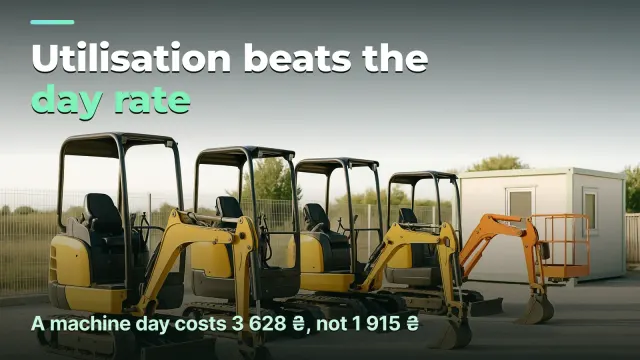
- Equipment and machinery — an excavator or a crew truck used across three objects this month.
- Fuel, software, insurance, depreciation — costs the whole company runs on.
Because these don't attach to a single object, owners leave them in a vague "general" bucket — or forget them entirely. Each object's report looks great, and the sum of great-looking objects still somehow loses money. The margin was never really there; it was borrowed from overhead nobody counted.
What allocating overhead revealed
The fix is deceptively simple: take the shared costs and split them across objects by a fair driver — revenue share, duration, or crew usage. Suddenly each object carries its true weight.
| Object | Margin before overhead | Margin after allocation |
|---|---|---|
| Site A (large) | 24% | 9% |
| Site B (medium) | 19% | 4% |
| Site C (small, short) | 21% | −3% |
The picture flipped. The small, fast object that "felt fine" was actually losing money once it carried its share of the office and equipment. The owner had been taking on jobs like Site C thinking they added to the bottom line — when each one quietly subtracted from it.
"I knew my costs on every site to the hryvnia. What I didn't know was that the office and the machinery were a cost too — one I'd never split. The day someone allocated it, three of my 'good' objects weren't good at all."
The decision it changes
This isn't an accounting nicety — it changes which jobs you say yes to. Once overhead is allocated, an owner can see the difference between an object that truly earns and one that only looks busy:
- Price differently. A short, overhead-heavy job needs a higher margin to survive, not the same markup as a long one.
- Choose differently. Say no to the "Site C"s — or restructure them — instead of collecting unprofitable work.
- See the real company margin. Not the flattering sum of per-object numbers, but the truth after everything is counted.
How a financier and Finmap do this together
This is exactly the kind of blind spot an outside financial view catches fast — and it's what a Finmap financial diagnostic looks for. The work is twofold: a financier sets up the logic — which shared costs exist and how to fairly split them across objects — and Finmap holds the structure, so overhead is allocated automatically as money moves, not reconstructed by hand each quarter.
In Finmap each object is a project; office, equipment and admin costs are captured and distributed across those projects by the rule you set. From then on, every object's margin is the honest one, the company total is real, and the question "which site actually feeds me" has an answer you can trust before you sign the next contract.
📌 Find out which of your objects truly earns — and which just looks busy. Book a Finmap financial diagnostic: a financier allocates your real overhead across projects, so you see the honest margin before you sign the next contract.
Share valuable content — become a source of insights






Frequently Asked Questions
How do I decide the "fair" way to split overhead?

Common drivers are revenue share, project duration, or crew/equipment usage. The exact method matters less than having one applied consistently — any reasonable allocation beats leaving overhead unassigned.
Isn't this over-engineering for a small builder?
The smaller the margins, the more overhead matters — a 22% hidden cost sinks a lean builder faster than a large one. If you run more than one object at a time, allocation is where your real profit hides.
Can't my accountant already tell me this?
Bookkeeping records the costs; it rarely allocates them to objects for management decisions. That allocation — turning raw costs into per-project truth — is the financier's job, not the accountant's.
What's a financial diagnostic, exactly?
A financier reviews your real numbers to find where money leaks and where the reporting misleads — like unallocated overhead — and shows what to fix first. It's the fastest way to see the margin you actually have.
Any questions left?
We are ready to answer them.


Finmap support