

Table of Contents

1.8k

5 min

13.10.2023
How Did a Service Business Owner Save $12 500

Sergiy Shuldik
Financial Expert at Finmap
Lack of control over finances and unforeseen expenses can be a real Achilles' heel for every entrepreneur, undermining financial stability and reducing profitability.
Finance has always been key for me. Excel, while useful, does not always meet modern business requirements. But when we started working with more professional money accounting tools for business, everything changed. — Dmytro Sheremeta, entrepreneur, owner of Сhystota.ua
How to save $12 500 on cost optimisation
Dmytro's company delivers equipment in the form of a vacuum cleaner or a ladder for each cleaning, if necessary, which is included in the service price. They used to use taxi services, which did not provide a consistent price for the transportation of equipment: it varied depending on the weather, days of the week, and the demand for taxis at that particular time.
After analysing the costs in Finmap, Dmytro saw that they were spending an unpleasantly high price on logistics. Together with the team, they started looking for ways to reduce these costs. Eventually, they decided to completely change the type of delivery. They found a partner who delivers on electric scooters. This improved the logistics time, removed the fuel variable, and made the price stable.
One round-trip delivery cost $9 for the company, and after cost optimisation, it was $2.5.
Thanks to Finmap, we saved $9 000 on optimising the cost of equipment delivery alone. In total, we optimised costs by more than $12 000 over the year. — Dmytro Sheremeta, entrepreneur, owner of Сhystota.ua
What Finmap features help you save money?
Dmytro uses Cashflow and P&L most often. He needs Cashflow on a monthly basis to analyse the company's expenses, to quickly assess what costs they incur and to make optimisation decisions easier.
Dmytro reviews the P&L regularly, comparing it to the previous two months to identify changes in different cost categories. If he notices an increase in expenses in a certain category, the team immediately analyses the reasons for this growth and considers optimisation opportunities.
Save $12 500 or lose money? What will you choose?
The answer is obvious. But how to do it?
In the Finmap service, you can allocate all your expenses and income to separate categories, contractors, and projects.
Let's look at how it works using the example of categories.
You have fixed costs that recur every month, such as rent, logistics, advertising, etc. In the Analytics section of the Profit report, you can use filters to analyse your expenses for each period and each category.
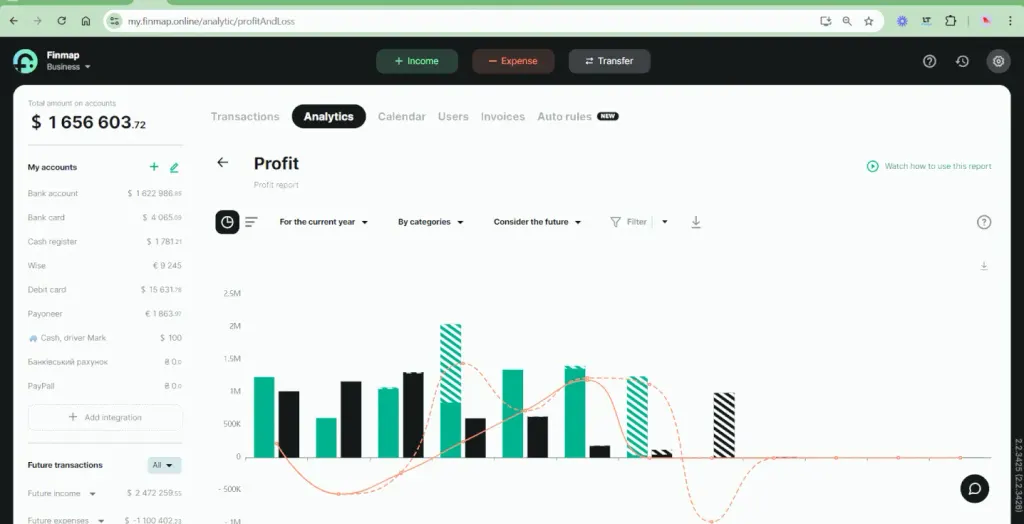
This way, you will see which expenses eat up a lot of your money every month. Understanding where exactly this weakness is in your budget, you can look for ways to optimise your expenses: change suppliers, give up a part of the office that is not used, etc. Thus, just by saving on expenses, you will already significantly improve the financial health of your business.
But uncontrolled expenses are not the only problem in the accounting of money for a modern entrepreneur.
What do entrepreneurs face every day?
A large number of business owners face the following problems:
- They do not see the real state of the business.
- They do not understand how much money is currently on each account and in the company as a whole, the data is available, but in a bunch of home-made tables that are difficult to analyse and almost impossible to bring together.
- They do not understand how much dividends they can withdraw without harming their business.
- Whether there will be enough money at the end of the month to pay salaries, rent and contractors.
How to solve it?
Thanks to Finmap, you can easily put your business's money in order and keep your finger on the pulse, because from now on:
- All your invoices are on one screen, clearly.
- All data gets into the service automatically, thanks to integration with banks and payment systems.
- Easy to analyse money (Cashflow), profit (P&L), projects, bills, debts: not in complex chaotic reports, but in visual charts.
- Thanks to the payment calendar, you can easily plan cash flow and prevent cash gaps.
- Delegate routines to employees, deciding who can see what and who can edit what.
- Also, you no longer need to search for invoice templates on the Internet: from now on, issue branded invoices directly in Finmap.
Don't wait until you start losing money. Try Finmap for free right now!
Share valuable content — become a source of insights




Frequently Asked Questions
How can analyzing expenses help a service business cut costs?

By categorizing every expense and reviewing it regularly, you can spot which categories quietly eat the most money. In this case the owner saw logistics costs were unpleasantly high, found a cheaper delivery partner, and cut a round-trip cost from $9 to $2.5. Seeing where the weak point sits in your budget is what makes targeted optimization possible.
Which reports are most useful for finding cost savings?
Cash flow and P&L are the workhorses here. Cash flow gives a monthly view of expenses so you can quickly assess what you're spending, while comparing the P&L against the previous two months reveals shifts in specific cost categories. When a category rises, that's the signal to investigate the cause and look for optimization.
What financial blind spots do most entrepreneurs face?
Many owners can't see the real state of the business: how much is on each account, how much can safely be withdrawn as dividends, or whether there will be enough at month-end for salaries, rent, and contractors. The data often exists but is scattered across home-made spreadsheets that are hard to analyze and almost impossible to combine. Consolidating it into one view is the first step to clarity.
How does a payment calendar help prevent cash gaps?
A payment calendar lays out scheduled receipts and expenses by date, so you can see in advance when money will be tight. That lets you plan cash flow and adjust before a shortfall hits, rather than discovering it when salaries or rent come due. Combined with automatic bank integration, it keeps your forecast accurate without manual entry.
Any questions left?
We are ready to answer them.


Finmap support