

Table of Contents

414

5 min

25.06.2026
Outsourced Finance Director: When You Actually Need One

Karine Shevchenko
Financial Expert at Finmap
"I knew our bookkeeping was clean. I knew our P&L every month. I had built the financial model. And I still couldn't tell you whether the deal we were considering would compound the business or quietly trap it."
A founder of a steady ₴8M services business described the moment of recognition. She had built a real management accounting practice. Clean bookkeeping. Monthly operating P&L segmented by client. Payment calendar. A 12-month financial model with three scenarios.
She had done the work. The numbers were good. The decisions she was making felt informed.
And in the middle of a year-end strategic conversation, considering whether to enter into a partnership with a complementary business, she realized she had run out of judgment. The numbers told her what was. They didn't tell her what to do. She needed someone with broader pattern recognition than she had — someone who had seen many similar businesses make this exact decision and could tell her what worked, what didn't, and why.
That someone is the role this article is about: the outsourced (or fractional) finance director. Not a bookkeeper. Not a CFO at enterprise scale. Someone in between — engaged for the strategic finance work that small business owners outgrow doing alone but can't yet afford to hire as a full-time executive.
This article is about when you actually need that role, when you don't, what to look for, and how to know it's working.
The Paradox: You Can Build the Numbers Without Having the Judgment
Most founders, when they hear "outsourced CFO," picture an expensive consultant who looks at their books and offers generic advice. They conclude the role is for businesses larger than theirs. They also conclude the role is unnecessary if they've already built management accounting themselves.
Both conclusions are sometimes right and often wrong. The role isn't about whether you have the numbers. It's about whether you have the judgment to act on them at the points where pattern recognition matters more than data.
Strategic finance work is mostly about interpretation, comparison, and risk assessment — not about producing reports. A finance director who has watched 60 small services businesses navigate hiring decisions, pricing changes, partnership structures, and capital raises develops pattern recognition that no single founder can match from their own experience alone. The value isn't the numbers (you have those). The value is the comparison set.
The four core artifacts of management accounting are introduced in the anchor article → Management Accounting Explained.
Six Signals That You Need a Finance Director
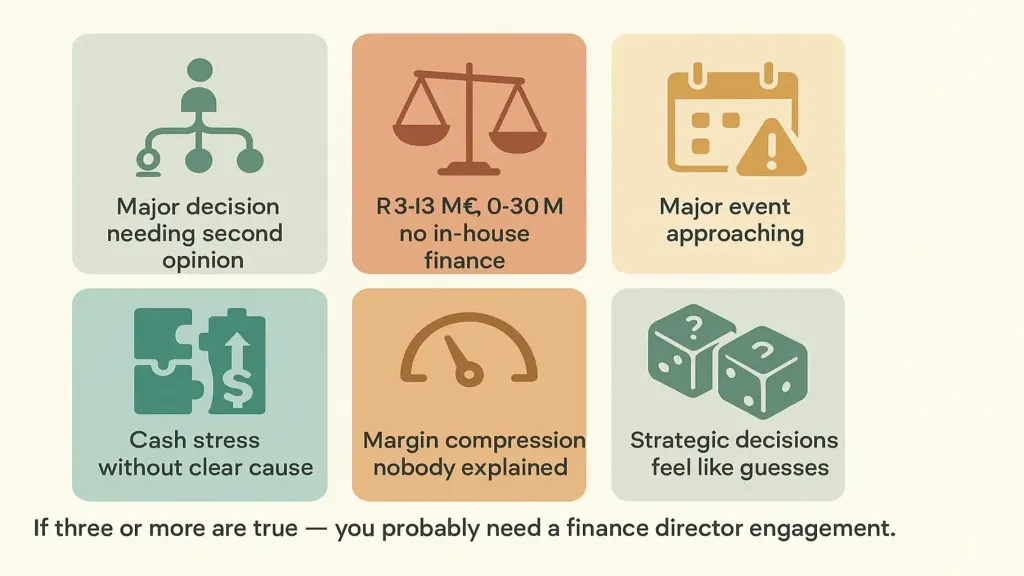
Two — Revenue is ₴3M–₴30M and you have no in-house finance leader. Below ₴3M, you can usually carry the strategic finance work as the owner. Above ₴30M, you typically need a full-time CFO. The middle band is where fractional finance directors deliver the most relative value — too much complexity for solo founder lift, too small for full-time.
Three — A major financial event is approaching. Capital raise, sale, lender conversation, significant supplier renegotiation, lease decision over ₴2M annual cost. Each of these is a moment where a finance director's prep work pays for the whole year of engagement. Going in alone is expensive.
Four — Cash flow stress that doesn't have a clean operational cause. When you've ruled out the obvious (slow client payments, supplier prices, seasonality) and the cash is still tighter than the P&L suggests it should be, you have a finance-structure problem. A finance director identifies what kind of problem — pricing, mix, working capital, capital structure — within the first month.
Five — Margin compression nobody internal can explain. Aggregate margin is moving by 1–3 points and the team has theories but not certainty. A finance director's first month with you usually surfaces the answer — and usually it's not what the team's theories suggested.
Six — Strategic decisions feel like guesses despite good data. This is the signal the founder from the opening had. The numbers exist. The decisions still feel underground. The gap is judgment, not data.
If three or more of these signals are true for your business right now, you probably need a finance director engagement of some kind.
Three Signals That You Don't Need One Yet
One — Revenue under ₴3M and operationally simple. One main service line, two or three accounts, predictable revenue rhythm. At this scale, the owner's judgment plus a good accountant covers the work.
Two — Bookkeeping is still chaotic. A finance director can't help if the underlying data isn't clean. Get the bookkeeping fixed first — that's a different role and a prerequisite. Article #2 → on bookkeeping vs management accounting
Three — You're in genuine survival mode and need cash, not advice. When the business is week-to-week, what's needed is an operations focus on collections, cost cuts, and supplier renegotiation — not strategic advisory. Bring in finance director help after stabilization.
What a Finance Director Actually Does (Versus What They Don't)
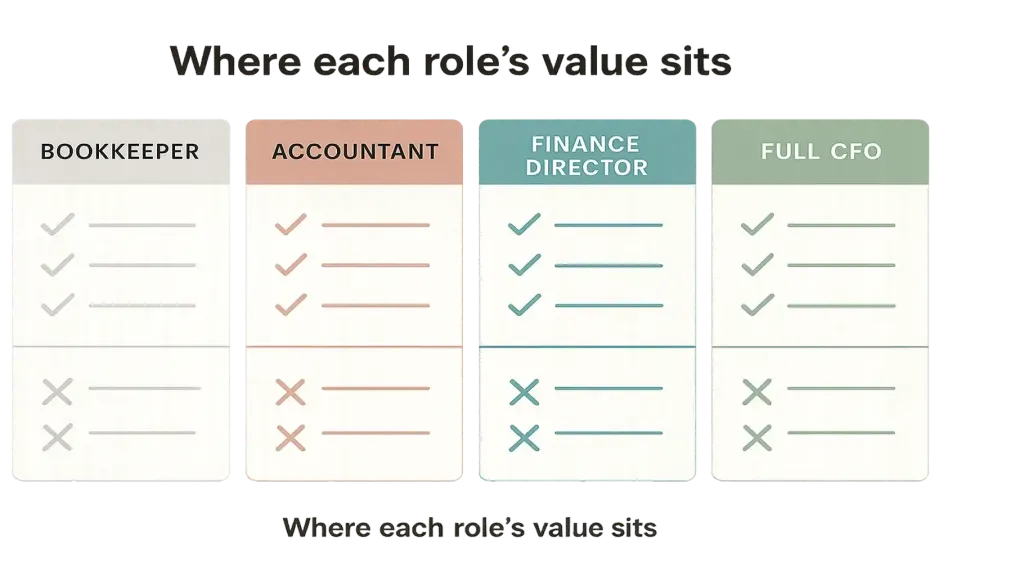
- Build and own the 12-month financial model
- Lead the monthly close and quarterly strategic review
- Run scenarios for major decisions before commitment
- Develop the case for pricing changes, hires, dropping clients
- Manage finance-side conversations with lenders, investors, advisors
- Translate operational decisions into financial implications
A finance director typically doesn't:
- Daily bookkeeping (that's the bookkeeper)
- Tax filings (that's the accountant)
- Operational execution (that's you and the team)
- Be available full-time (typically 2–4 days a month for a small business)
How to Engage One
Scope and cadence. Most outsourced finance director engagements run 2–4 days per month for a small business. The cadence: monthly close (half day), quarterly strategic review (full day), ad-hoc decision support (a few hours scattered). Pricing varies by market — usually a flat monthly retainer.
The first 90 days. Month one: they read your books, model, current decisions in play. They surface 1–2 things you didn't know. Month two: they own the monthly close cadence with you. Month three: they start surfacing strategic recommendations. By month three, you should know whether the engagement is working.
Signals it's working. You're making decisions you wouldn't have made before. You're not making decisions you would have made before that you now see were bad. The reports you receive are read by you and the leadership team, not filed. Conversations about money are structured and less anxious.
Signals it's not. They produce reports you don't read. They give generic advice that doesn't fit your business. They aren't curious about your operating reality. They don't push back on your assumptions. Walk before month six.
📌 See how Finmap supports the work of a finance director — model, scenarios, dashboard, monthly close — so the strategic conversation has the numbers it needs. Book a 20-minute Finmap demo. Book a Finmap demo →
Topic foundation: Financial Management for a Small Business: When You Outgrow Your Own Head
Share valuable content — become a source of insights





Frequently Asked Questions
How much does an outsourced finance director cost?

Varies by market and seniority. In Ukraine for a ₴5M–₴15M business, expect ₴30K–₴80K/month for 2–4 days. Less for junior fractional, more for senior with M&A experience.
Can I use my accountant for this?
Sometimes. Some accountants step into strategic finance work and do it well. Many don't — the skill set is different. The honest test: ask them "what are the three decisions I should be making this quarter based on these numbers?" The answer reveals whether they think strategically or recordingly.
Should I hire full-time eventually?
Usually at ₴30M+ revenue or significant complexity. Below that, fractional is more cost-effective and often higher quality (a fractional director with 8 clients sees more patterns than your in-house finance person seeing only yours).
What if the founder doesn't want to share full numbers with an outsider?
That's a deal-breaker. A finance director can't help without full visibility. If the trust isn't there, don't engage. Article #12 → on decision rights
Can a platform substitute for the role?
A platform handles the data work. It doesn't substitute for judgment. The best setup combines both: platform produces the views; the director interprets and recommends. Article #3 → on the platform
How does this relate to the four core artifacts?
A finance director typically owns the financial model and the strategic dashboard, contributes to the operating P&L review, and integrates the payment calendar into cash decisions. Anchor article #1 →
Any questions left?
We are ready to answer them.


Finmap support