
Table of Contents

93

15 min

23.07.2025
8 Financial Lessons from Losing R$648,000: How to Avoid Cash Flow Mistakes

Oleksandr Solovei
CEO & Co-founder Finmap
When there’s zero in the account, two reais in your pocket, and R$654,000 in debt on your shoulders. And this is despite having sales, a team, and customers.
I was standing in the kitchen with two reais in my pocket thinking: that’s it, there’s no way out. Three years later, I had paid off every cent of that debt. If I had tracked the numbers earlier, none of this would have happened. — Kateryna Vyshnevetska, entrepreneur, guest on the podcast “If Only I’d Known This Earlier”
Kateryna Vyshnevetska is a partner at Genius Space Teleport, co-founder of the international education project Proryv, and an entrepreneur who didn’t spot the cash gap in time. The result: minus R$700,000, creditors, panic, and a complete business reset. She rebuilt everything from scratch: slowly and painfully.
Today, Kateryna shares rules that work not only for project-based businesses, but for any entrepreneur who doesn’t want to lose everything.
This isn’t a finance lecture. These are real cases, mistakes, numbers, and specific actions that will help you:
- avoid falling into a debt hole,
- keep control of your money even if you’re not a finance expert,
- organize your budget without complicated Excel spreadsheets,
- and finally stop living from one launch to the next.
Keep reading — it will be honest, sometimes painful, but extremely useful.
Lesson 1. You are not an ATM for your business, and your business is not your personal wallet
Problem: mixed money = a ticking time bomb.
You estimate profit “by eye” and get excited about every new payment, but the very next day you spend that same money on personal needs. A month later, the accountant shows that you’re R$28,000 short for ads and salaries — and you have no idea how it happened.
We used the current month’s money to pay bills from three months ago because everything was in one basket — personal and business money together. It was a ticking time bomb. — Kateryna Vyshnevetska, entrepreneur
Why this is dangerous for your business
- Your view is distorted. You see R$42,000 in the account and think it’s net profit, when in reality R$35,000 is customer prepayments for work you still have to deliver.
- Working capital disappears. When the owner takes money out “to live on,” the business is left without cash to buy inventory, pay for services, or run ads.
- One slip — and you have a cash gap. Two payments are delayed, and suddenly you can’t pay last month’s bills because there’s no reserve.
Solution: create a financial “border” between you and the company.
The result after just one month:
- You clearly see the company’s net profit.
- You plan expenses and investments without fearing, “Will we be able to pay salaries?”
- Your personal money no longer depends on how many customers paid today.
- Your financial reporting becomes transparent — investors and partners trust numbers, not promises.
The main point: if you mix personal and business money, a cash gap is only a matter of time.
Draw the line now — and your business will be able to breathe, while you stop living in panic.
Lesson 2. How you waste 30% of your money every day without noticing
Problem: thousands of tiny transactions quietly steal your money.
You focus on the big bills — rent, purchases, salaries — while small expenses of R$14 to R$28 quietly “steal” your profit. Coffee, taxis, subscriptions, office supplies — all these little things add up to a serious loss. And at the end of the month, you look at the numbers and don’t understand:
Thousands of small transactions, each R$14 to R$28 — and in the end, a 30% hole called “miscellaneous.” That’s how money disappears without a trace. — Kateryna Vyshnevetska, entrepreneur
Why is this dangerous for your business?
- Small expenses scatter your attention and budget. You don’t notice this money, it doesn’t set off alarms, but little by little it “eats” your margin and makes the business less profitable.
- There’s no clear control. Without regular review, even small subscriptions or impulse expenses can pile up and create a “black hole” in the budget.
- Planning gets worse. When the “miscellaneous” category grows, forecasting expenses and profit becomes impossible.
Solution: the “10 minutes a week” practice for controlling small expenses.
The result after just one month
- You begin to understand where the money is really going and where you can cut back.
- Profit increases because you stop losing money through unnecessary “leaks.”
- Budget planning becomes more accurate and predictable.
- The business owner gains confidence and peace of mind because every expense is under control.
Remember: big money is made up of small money — if you don’t control the details, they become your biggest financial enemy.
Lesson 3. A budget with a +20% buffer is the financial cushion that saves your business from bankruptcy
Why +20% is not a luxury, but real insurance for your business
I multiply every expense amount by 1.2. If there’s money left over, it goes into the reserve; if not, I was already prepared. — Kateryna Vyshnevetska, entrepreneur
No one asks your permission before exchange rates jump or inflation spikes.
A marketing campaign may suddenly need extra money to perform well.
A customer may request a refund even after paying — and you need to account for that in advance.
Without a reserve, even a small surprise can turn into a cash gap that seriously hurts your business.
How to build a budget with a buffer in 4 steps
The result in the first month
- You stop fearing unexpected expenses and can respond quickly when surprises happen.
- You build a real financial cushion, without stress or panic.
- The business gains stability, and you gain confidence in the future.
Even if you don’t use the reserve, it gives you peace of mind. It’s like life insurance for your money.
Don’t wait for a crisis to catch you off guard. Learn to plan with a buffer — and your business won’t collapse at the first obstacle.
Lesson 4. A financial cushion is your crisis-proof vest in an unstable world
Why a cushion is not just about money, but about business survival
Our courses start every three months. If a launch “fails,” the company won’t survive until the next one without a cushion. — Kateryna Vyshnevetska, entrepreneur
In a project-based business, revenue comes in irregularly: one month there’s a launch, the next there’s silence. If you don’t have reserves, even a small delay or failure can kill the company.
No financial cushion means you’re forced to cover operating costs with loans or debt — a straight road to the edge.
The financial cushion formula
Result. You get a vest that absorbs the blows of unpredictable crises and gives you time to overcome them.
You gain confidence that even if something goes wrong, your business won’t sink.
This cushion is like a life jacket that helps you make it to the next successful launch. — Kateryna Vyshnevetska, entrepreneur
Lesson 5. Cash gap: your most painful — and most important — lesson
R$654,000 in debt, account balance zero. It hurt, but that’s how I learned to respect the numbers. — Kateryna Vyshnevetska, entrepreneur
Three signs that a crisis is already at your door
- You pay old bills with new sales — it’s like paying off debt with a credit card.
- Customer prepayments don’t go toward growth, but toward covering operating expenses.
- Salary payment dates keep getting pushed back, while overdue payments grow.
If this sounds familiar, it’s time to act.
The “Stop the Debt” algorithm — how not to lose your business during a crisis
Result. The crisis becomes a lesson — not the end of the business.
A clear action plan gives you the strength and motivation to keep moving, while protecting your team and reputation.
Debt is not a sentence — if you stop in time and start controlling the situation. — Kateryna Vyshnevetska, entrepreneur
Lesson 6. Future cost, not past price — the key mistake that pushes a business into losses
The product I bought for R$5,450 two months ago costs R$5,995 today. If the budget still uses the old price, a loss is guaranteed. — Kateryna Vyshnevetska, entrepreneur
Why you need to think in future prices, not old ones
Prices are constantly rising because of inflation, higher logistics costs, and raw material price increases. If you don’t update costs in your financial forecasts, your budget will be wrong and unprofitable. It’s like driving a car with the fuel gauge showing yesterday’s data.
How to avoid this trap
Result. You don’t go into the red because of outdated prices. The business adapts to the market and stays stable.
A financial model is a living document — it must always be kept up to date. — Kateryna Vyshnevetska, entrepreneur
Lesson 7. The balance sheet is not just about expenses — it’s a strategic transformation of your money
Why understanding the balance sheet matters
Buying equipment is not just spending money — it’s investing in an asset. That asset can be sold, rented out, or used to scale the business. Without understanding the balance sheet, you can’t decide what’s better: buying or renting, spending or investing.
How to look at the balance sheet with fresh eyes
Result. You turn your budget from a list of expenses into a growth tool.
Lesson 8. Visualization and delegation — financial control one click away
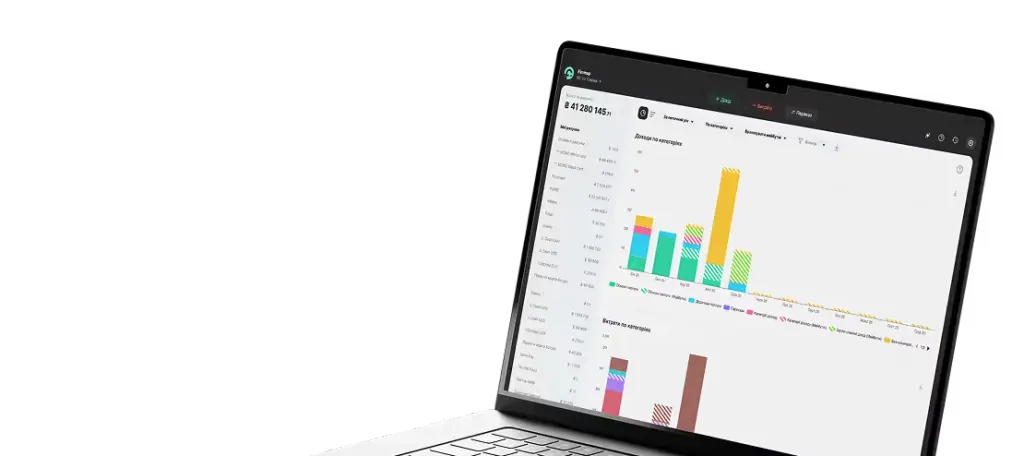
I get lost in spreadsheets. In Finmap, I opened the dashboard — in 5 minutes I found the mistake and fixed it. — Kateryna Vyshnevetska, entrepreneur
Why the owner needs a financial view “in the palm of their hand”
Even if you have a CFO, you still need to quickly see the real situation. Without that, you risk being left in the dark and missing problems until it’s too late.
How to combine delegation and control
Result. You control your finances without wasting time on spreadsheets and complicated reports.
Financial visualization is like radar for a pilot: you see everything in advance.
— Kateryna Vyshnevetska, entrepreneur
Instead of a conclusion: take the first step today
- Open a separate bank account for your business.
- Turn on bank sync in Finmap — it takes only 3 minutes.
- Set aside the first 3% of profit for your financial cushion.
- Review the budget for your next project and add a +20% buffer.
- Audit your small expenses and reduce the “Miscellaneous” category to ≤5%.
Controlling the numbers is an investment in my peace of mind and freedom. R$136.25 per month versus R$1,362,500 in potential losses — the choice is obvious. — Kateryna Vyshnevetska, entrepreneur
Ready to move your business from chaos to control?
Leave a request — our specialists will show you, free of charge, what is happening with the money in your business.
Frequently asked questions
1. How do I separate personal and business money if the business is just starting out?
Start by opening a bank account used only for the business and setting a fixed “owner’s salary.” This helps you avoid mixing finances from the very beginning.
2. Why is it so important to track even small expenses?
Small, invisible payments — coffee, subscriptions, taxis — add up to significant amounts and can “eat” up to 30% of the budget, hurting profit. Regular review and categorization help you stay in control and avoid cash gaps.
3. Why include a +20% buffer in the budget? Isn’t that an extra expense?
The buffer is insurance against surprises: currency fluctuations, extra marketing costs, customer refunds. It helps you avoid crises and maintain stability.
4. How much should I set aside for a financial cushion, and what is it for?
Ideally, set aside 3% to 10% of net profit each month until you build a cushion that covers at least three months of fixed expenses. This money should be untouchable — not even for paying debts.
5. What should I do if I already have a cash gap and debts?
Communicate honestly with creditors and ask for a 3-month deferral. Focus on increasing sales and marketing, and pay debts gradually — use a spreadsheet to track progress and stay motivated.
6. How should I account for rising costs in the budget?
Include an expected cost increase, for example +5–10%, in your financial forecast and compare it with actual costs every month to avoid losses.
7. Why is the balance sheet not just about spending, but about transforming assets?
Buying equipment means investing in assets that can be rented out or sold — creating new opportunities for the business instead of simply spending money.
8. How can an owner avoid getting lost in the finances even with a CFO?
Even with a CFO, the owner should have quick access to key financial indicators through simple tools like Finmap, so they can make informed decisions and stay in control.
Share valuable content — become a source of insights