

Table of Contents
Home
/
Blog
/
The Owner's Real Profit: What a Beauty Salon Actually Earns After Masters, Chair Rent, and Products

290

5 min

02.07.2026
The Owner's Real Profit: What a Beauty Salon Actually Earns After Masters, Chair Rent, and Products

Karine Shevchenko
Financial Expert at Finmap
"Every master paid me their chair rent. Every service got its cut of the product cost. I thought I was running a healthy salon. Then I built a real P&L and realized I was working for what my hairdressers were paying me — nothing else."
An owner of a mid-sized beauty salon — six chairs, ₴3.2M annual revenue, five masters working as FOP contractors plus one salaried receptionist — described the exercise that changed how she read her business.
The salon "worked." Each master paid ₴8K/month chair rent. Each master paid for their own materials. Client payments went through the salon's terminal; the salon retained 100% of service revenue on receptionist-booked clients, and paid masters a 30% commission on those. Master-booked clients paid the master directly, minus chair rent. Products (retail cosmetics) were sold at 100% owner margin. It felt profitable.
The consolidated P&L her accountant produced monthly said: revenue ₴268K, expenses ₴180K, net ₴88K. Multiplied by 12: ₴1.05M net profit. She had been treating herself as running a comfortable business.
Then she built a real owner P&L. Owner's actual take-home, adjusted for her own 40 hours per week of work at market rate, plus salon net after all real costs: ₴32K per month. ₴384K annualized. Not ₴1.05M. Because the "profit" she was seeing was largely her own unpaid labor.
Why Beauty Salon Owner Economics Are Confusing
The FOP-chair-rent model creates layered revenue streams that look profitable in aggregate and hide the owner's real position.
Chair rent from masters is revenue that requires nothing from the salon except the space and the shared front-desk. If the salon is otherwise breaking even, chair rent looks like pure profit.
Salon-booked client revenue looks like the "real" salon business, but pays 30% to a master and consumes receptionist time.
Product retail is high-margin but low-volume for most salons.
The owner's own hours — often 30–50/week — are usually treated as unpaid founder labor. That's the biggest hidden distortion.
When you consolidate these into one P&L, the salon appears to generate a healthy margin. When you separate them and price in owner labor, the picture changes.
The Real Owner P&L Framework
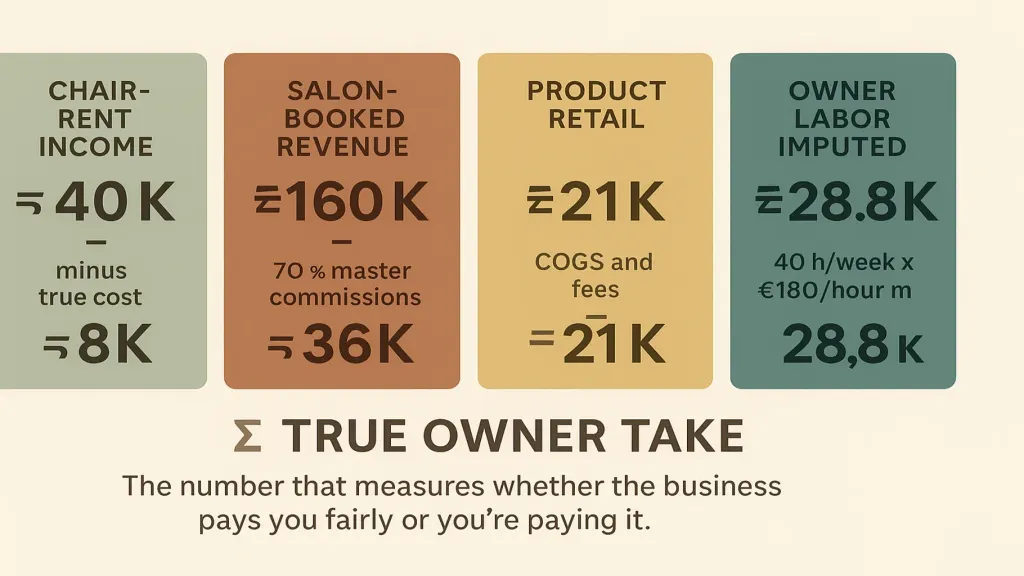
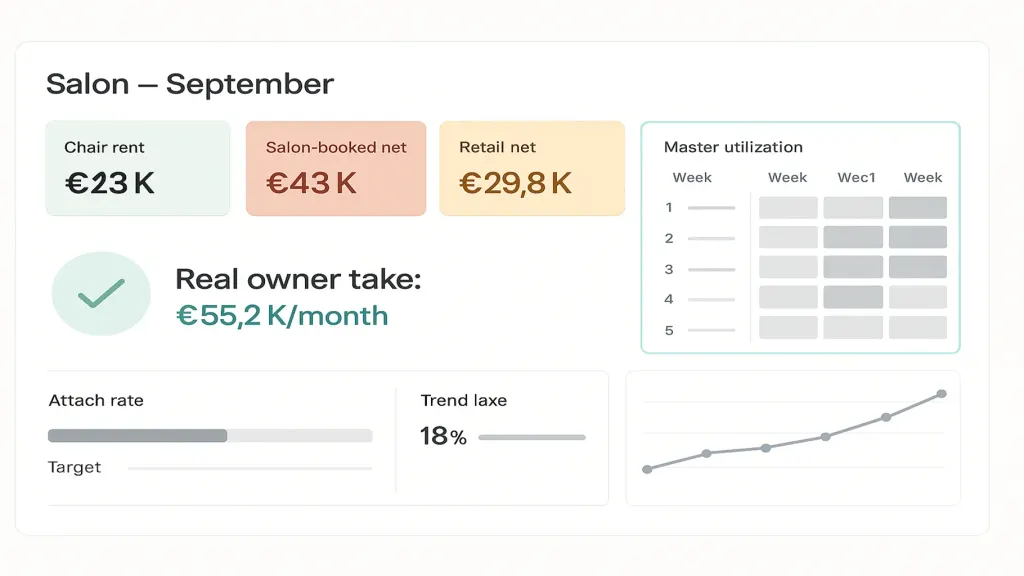
Layer two — Salon-booked client economics. Revenue: ₴160K/month. Master commissions (70%): ₴112K. Receptionist portion (share of booking work): ₴12K. Master materials (paid by master, not salon): 0. Real salon-booked net: about ₴36K/month.
Layer three — Product retail. Revenue: ₴40K. COGS: ₴18K. Merchant fees: ₴1K. Real retail net: ₴21K.
Layer four — Owner labor. Owner works 40 hours/week on operations + management. Market rate for that role: ₴180/hour × 160 = ₴28.8K/month "imputed" salary. This is what you'd pay to hire someone else to do it.
Sum: ₴8K + ₴36K + ₴21K − ₴28.8K = ₴36.2K/month real owner take.
Compared to accountant P&L's ₴88K/month "profit," this is a very different picture. The gap is owner labor.
What She Did With the Truth
The insight didn't say the salon was bad. It said the salon was paying her ₴36K/month, and she had been mistaking that for ₴88K. The rebuild was about changing the mix.
Chair rent renegotiation. Two of five masters were paying below market. Raised chair rent from ₴8K to ₴10K on renewal. +₴4K/month.
Salon-booked volume. She'd been passive on marketing because "we're profitable." Once she saw that salon-booked was the highest-margin layer per hour of her time, she invested modestly in local marketing. Salon-booked volume grew 20%. +₴7K/month contribution.
Retail attention. Retail had been neglected. Added shelf placement discipline and staff training on recommendation. Retail grew 40%. +₴8K.
Reduced her own hours. Hired a delivery-manager equivalent at ₴25K/month for 20 owner-hours per week. Recovered 20 hours; ₴25K expense; net +₴3.8K on labor differential + freed time to focus on marketing.
Six months later: real owner take ₴58K/month vs the original ₴36K. And she was working 20 hours less per week.
The Six Numbers You Actually Need
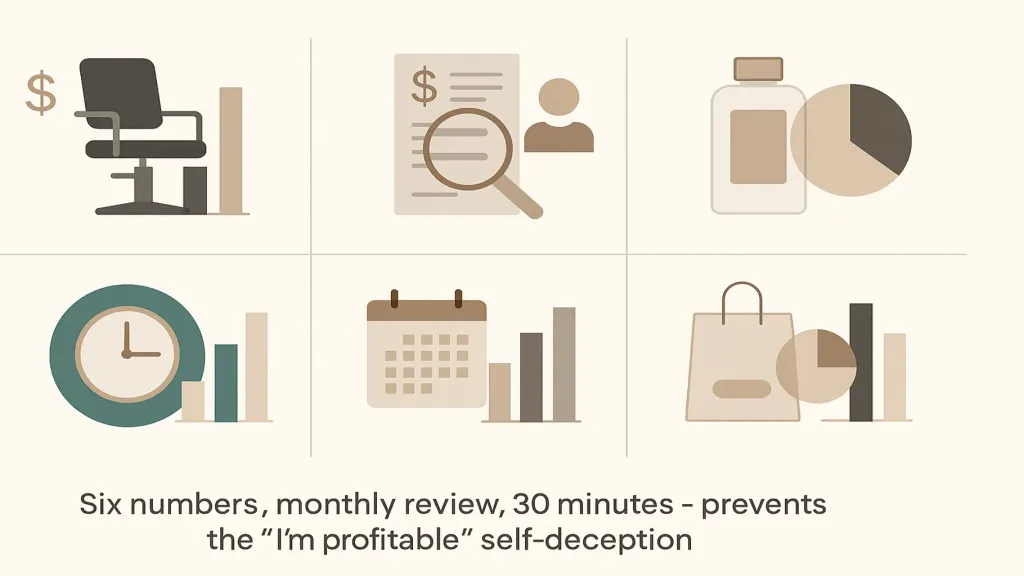
- Chair rent revenue vs true cost of hosting (net per chair)
- Salon-booked revenue after all commissions and receptionist cost
- Product retail contribution margin
- Owner hours × market rate for that role (imputed labor)
- Bookings per master per week (utilization)
- Product attach rate (% of service clients buying retail)
Monthly review, 30 minutes with the bookkeeper (or alone). Prevents the "I'm profitable" self-deception that costs many owners years.
📌 Want to see what your beauty salon is actually paying you — after chair rent, commissions, products, and your own labor? Send us three months of revenue by stream, master commissions, and your time — we'll build the real owner P&L. Request your free Finmap diagnostic →
Read also
Share valuable content — become a source of insights




Frequently Asked Questions
Why should I count my own labor as a cost? I own the business.

Because otherwise you can't tell if the business is paying you or you're paying the business. If the "profit" disappears when you count your labor at market rate, the business is subsidizing itself with your time — that's information you need for hiring, expansion, or pricing decisions.
Chair rent is passive income. Should I really adjust it?
It looks passive. It isn't. Every chair master consumes some receptionist time, some overhead, some cleaning. Calling it net without those costs overstates it.
My masters won't accept a chair rent increase.
Test the alternative. If a master leaves and the chair sits empty for 2 months, that's ₴20K opportunity cost — probably more than the increase would have raised over a year. The negotiation is worth having.
Should I switch masters from FOP to salary?
Depends. Salary makes sense when the market allows and when you want to control quality tightly. FOP-with-chair-rent is common in Ukraine because it aligns incentives and reduces owner overhead.
Retail is small. Is it worth the attention?
Yes. 40% of client base × 15% attach rate × ₴400 average purchase = ₴30K/month at minimum for a mid-sized salon. Retail is the layer most owners neglect and most improve fastest.
Spreadsheet or platform?
Spreadsheet is fine for a single salon. Multi-location or multi-format (salon + academy + product line) → platform.
Any questions left?
We are ready to answer them.


Finmap support