

Table of Contents

2.1k

11 min

04.08.2025
How Finmap Helps Construction Businesses Regain Financial Control

Kateryna Gulchenko
Senior Customer Support Manager
You can build with quality, on time, even profitably — and still lose money. Not because something went wrong on site, but because your finances remain out of control.
In construction, that’s a classic: the number of projects grows, turnover increases — but at the end of the month, the account is empty, contractors await payment, and the numbers don’t add up.
The reason is simple: without structured financial management, a business doesn’t grow — it breaks down into chaotic processes.
What exactly isn’t working in your construction business finances — and how do you fix it?
Let’s look at three core problems that destroy profit and how to solve them.
Problem #1: No Detailed Tracking by Project
In construction, everything revolves around projects. You invest in materials, crews, equipment rental — often across multiple projects at once. But when you try to tally things up, the numbers don’t match. Revenue looks good, but the bank balance is zero.
Job costing — the allocation of costs to specific projects — is a basic tool for building real budgets, analyzing efficiency, and forecasting profitability.
Without project-based management, a business quickly becomes unmanageable:
- It’s hard to say how much a single project actually costs.
- Overruns and budgeting errors are impossible to catch.
- The business scales, but profitability declines.
- There’s no way to analyze margins and make informed decisions.
According to a study published on the MDPI portal:
25% of construction companies may face bankruptcy after just two or three poorly costed projects — due to underestimating labor or materials.
How Finmap Turns Chaos into a Controlled Process
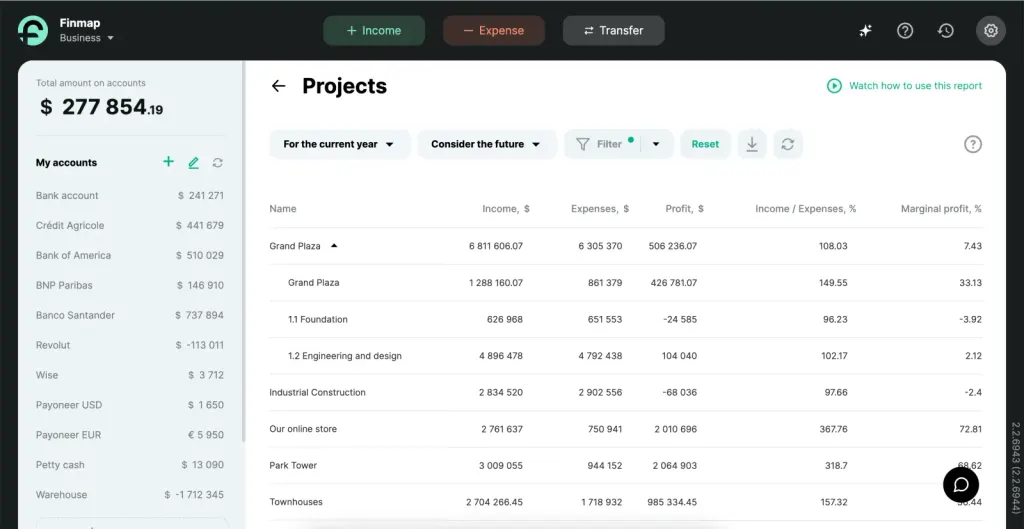
In Finmap, you can manage financials by project and subproject — for example, track foundation, roofing, or interior costs separately within one site.
This allows you to see the financial picture not just across the business as a whole, but per project: where overruns occur, which sites are profitable, and which need budget revision.
The system lets you:
- Build a structure of projects and subprojects (e.g. site → subprojects: foundation, interiors, structural work, engineering, etc.).
- Automatically or manually assign and track transactions on the right level.
- Generate key reports — especially P&L and Projects, which provide deep financial analytics.
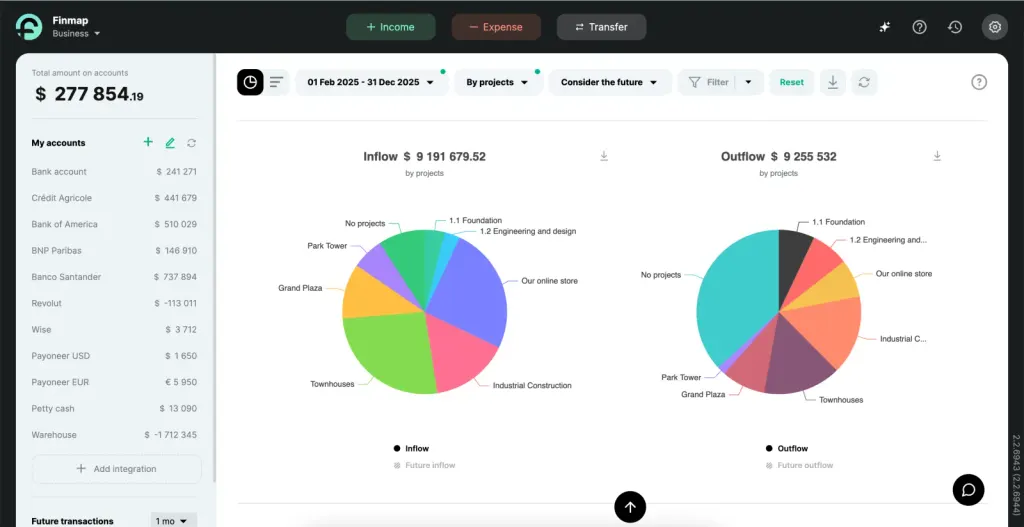
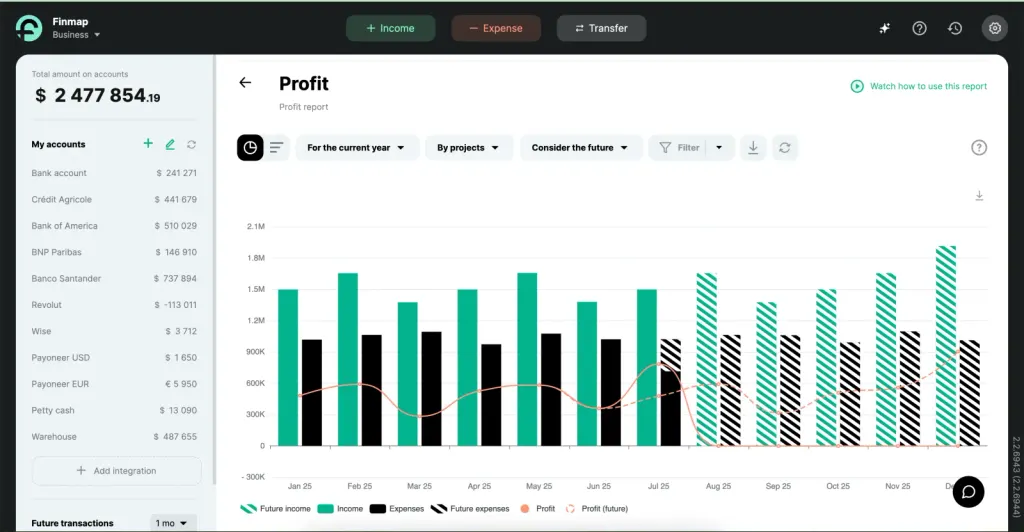
By aligning Finmap’s structure to your real business model, you go beyond tracking costs — you unlock real financial insights.
The system shows key performance metrics — both across the company and per project. Here are suggested benchmark metrics for construction businesses that Finmap helps you track:
| Metric | Description | Target Range |
|---|---|---|
| Project Profitability | Profit as a share of project expenses | 10–20% |
| Gross Profit | Revenue minus direct costs (materials, labor) | 20–30% |
| Net Profit | Profit after all costs and taxes | 8–12% |
| ROI (Return on Investment) | Profit relative to capital invested | 15–25% |
| Cash Flow Forecast | Projected income vs expenses | Positive |
Companies using analytics and job costing make decisions faster and more accurately: a research shows that implementing job costing allows 42% faster resource reallocation across projects, improving business agility.
With Finmap, you’re no longer flying blind — the system gives clear, project-specific data so profit becomes a result of management, not luck.
Problem #2: Cash Gaps in Construction — and How to Avoid Sudden Crises
In construction, cash flow gaps aren’t an exception, they’re the norm. You spend heavily upfront: advances to suppliers, prepayments to subcontractors, material purchases.
Income comes later — after completion or with delays.
Without smart financial management, this leads to:
- Cash gaps even in profitable companies.
- No visibility into upcoming financial strain.
- Delays in payments to vendors and employees.
- Loss of trust from contractors and internal teams.
According to Entrepreneur:
Up to 82% of construction businesses go bankrupt due to poor cash flow management — one of the most overlooked risk zones.
Finmap’s Solution: What Changes When a System Is in Place
Finmap doesn’t just show your account balances — it answers the key question: Will you have enough to meet your obligations in the coming weeks?
The core tool is the Payment Calendar, which tracks all upcoming income and expenses by day and giving you early warning of potential shortfalls.
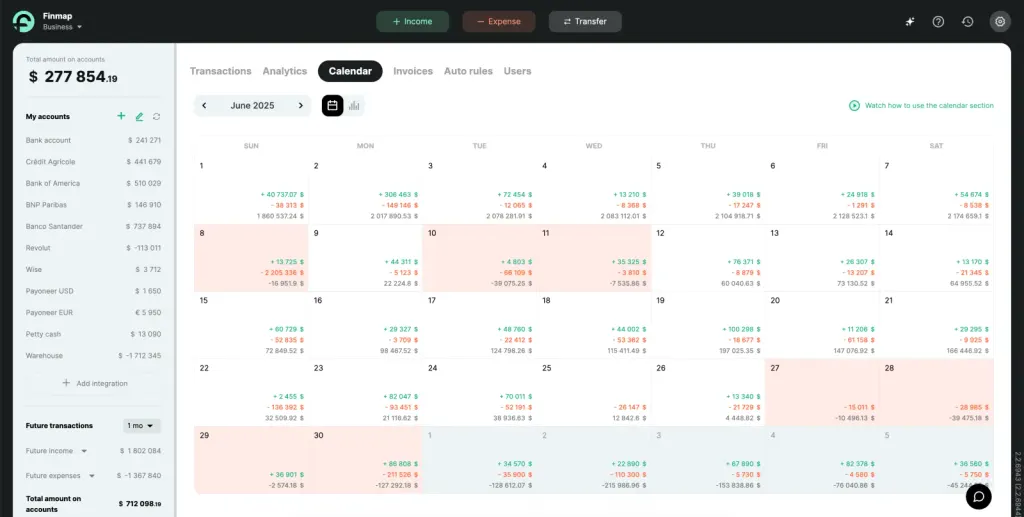
The system lets you:
- Factor scheduled expenses into your financial projections.
- Track expected income (milestone payments, receivables).
- View cash movement by date, account, and project.
- Forecast cash flow and highlight risk periods.
Cash flow forecasts aren’t just reports, they’re early warning systems. Businesses that see what’s coming don’t react, they plan.
In Finmap, this tool works daily — to ensure money doesn’t disappear unexpectedly, but instead drives growth.
Problem #3: When No One Knows Who Owes What to Whom
In construction, financial obligations pile up fast: dozens of contractors, suppliers, advances, partial payments, petty cash.
Without systematic management, this data cannot be combined into a single picture and even the company's manager cannot accurately say how much money is “in circulation,” how much is actually available, and how much is tied up in debt.
Late payments are widespread. According to PYMNTs:
71% of construction subcontractors regularly face payment delays — often due to the lack of structured obligation tracking.
The consequences of disorderly accounts receivable and accounts payable that your business experiences every day:
- No control over receivables or payables.
- No view of real company liquidity.
- “Leaked” petty cash — with no clear trace or accountability.
- Irregular cash pressure, forcing last-minute transfers, credit usage, or personal funding.
Without obligation tracking, you’re not managing money — you’re chasing it. And the bigger the business, the bigger the chaos.
How Finmap Handles This in Real Business Scenarios
Finmap helps you systematically manage receivables and payables via dedicated reports and planning tools that recognize and reconcile operations.
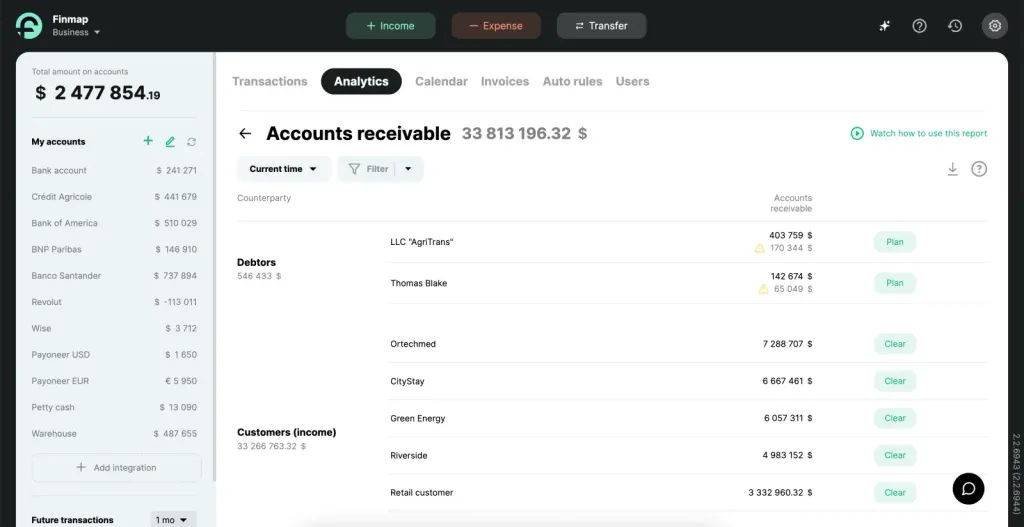
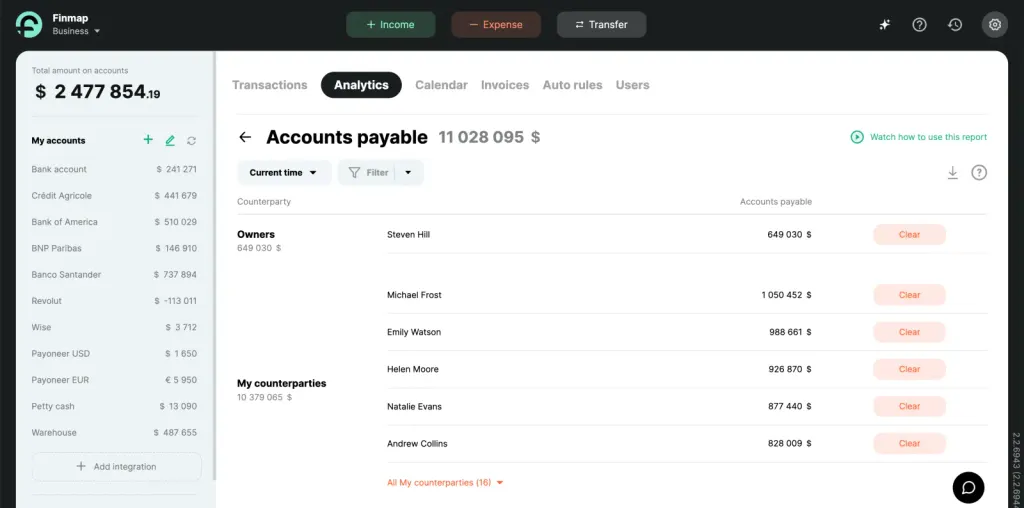
All obligations — future and overdue — are collected in one system, linked to contractors and due dates. The Payment Calendar includes them in forecasts, so you see not just your balance — but the full picture: How much needs to be paid, when, to whom, and from what source.
Petty Cash Management in Construction: a Practical Fix
Petty cash is a “gray zone” in construction: site managers, supervisors, and buyers often receive cash or direct transfers for small purchases, logistics, or repairs.
Without a system, these funds often go untracked or are reported late. So you don’t know:
- What’s been spent.
- What’s still outstanding.
- What was never returned.
Common issues:
- No receipts, or they’re scattered in Viber / Telegram / private chats.
- Some expenses never get logged.
- The cash register “drops,” and no one’s accountable.
- At month-end, reconciling projects is impossible.
In Finmap, you can manage petty cash per employee — with amounts, purpose, project, and closure status.
Here’s a step-by-step framework for gaining control:
| Step | Action | Result |
|---|---|---|
| 1 | Create virtual accounts for each petty cash holder or team | See how much they hold, what’s spent |
| 2 | Add a bank feed or import statement (if using a dedicated card) | Automates logging — no manual input needed |
| 3 | Add users with restricted access to only their account | They enter transactions — data stays in the system, not in chats |
| 4 | Train staff to log cash ops via mobile app or Telegram bot | Foremen log expenses right from the site — nothing gets lost |
| 5 | Require photo receipts attached to every expense in Finmap | Complete, confirmed expense tracking — no payments fall through |
If you think petty cash isn’t an issue, and trust alone is enough look at the data provided by Business.com:
67% of employees have violated company expense rules at least once.
ACFE studies show that businesses lose up to 5% of revenue every month due to internal errors, abuse, or simple lack of control.
If your business makes $1,000,000/month — you’re losing $50,000 without even knowing it.
Now multiply that by 12, or 5 years, or 10.
Petty cash isn’t minor. It’s an invisible budget leak, one that grows unless closed systematically.
Finmap Client Case: How an Architect Became a Financial Manager
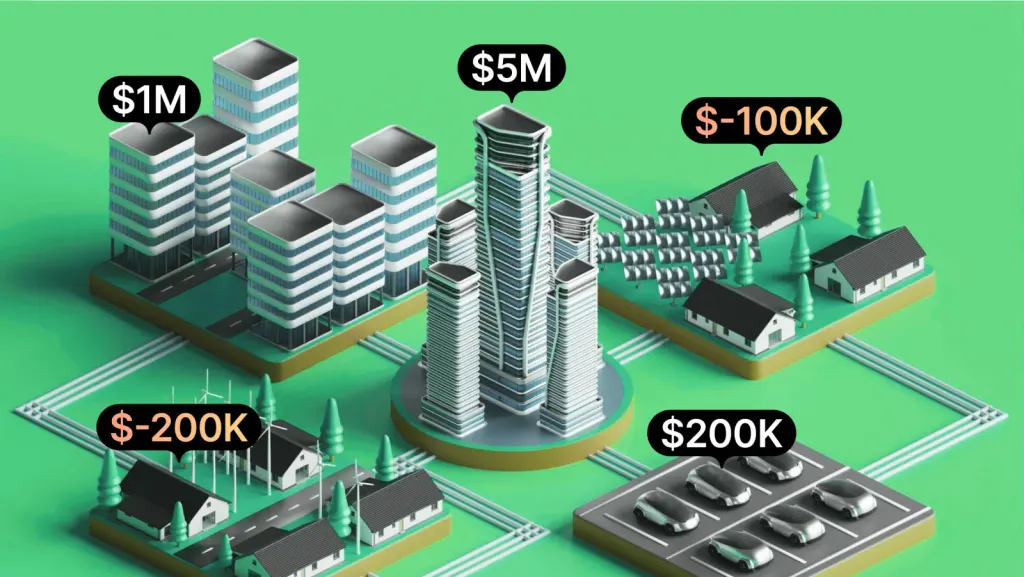
Bogdanova Bureau is an architecture studio handling full-cycle interior and building projects, with offices in Kyiv and Switzerland. Each project is highly individual with large budgets ($1M to $5M), and responsibility not just for design but for timelines, teams, phases, and costs.

In the early days, there was no structured financial management. Money was scattered across accounts, cards, and cashboxes. Some transactions weren’t logged, some costs went into Excel, some stayed in someone’s head.
Simple questions had no answers:
- How much did we earn?
- Can we cover payroll?
- Which project is profitable?
We’d finish a project — everyone got paid. But we were left with nothing. No money. And no idea where it went. — Olga Bogdanova, founder of Bogdanova Bureau
Things got critical when multiple projects went into the red — by $50K, $80K, even $180K. Reserves were drained. Cash gaps appeared. They had to take loans — but the company nearly collapsed.
That experience became a turning point.
Olga realized: without financial management, you don’t just lose profit — you lose control.
Learn how Olga decided to implement Finmap, built a new financial model, and grew revenue by +173%.
What changed after Finmap:
| Before | After | ||
|---|---|---|---|

|
Lack of profitability calculation: projects looked profitable but generated hidden losses. |

|
Each project has its own financial model with fixed expenses, profit, operating margin, and fund allocation. |
|
|
Money is scattered across accounts, cashboxes, and currencies — it’s impossible to quickly determine balances and available funds. |
|
All accounts are consolidated in a single financial interface: full transparency over cash balances and liquidity. |
|
|
Decisions were made based on gut feeling — without analytics, regular reporting, or planning. |
|
Weekly financial reports, a payment calendar, and regular cash flow analysis have been implemented. |
|
|
Administrative costs, bonuses, and PR activities were funded chaotically or “from whatever profit remained.” |
|
A fund system has been implemented: reserve, development, and PR — with a fixed % from each project’s profit. |
|
|
Strategic plans were built without reflecting the actual financial situation. |
|
Management decisions are now based on numbers: Finmap provides trends, risks, forecasts, and financial signals. |
Today, Bogdanova Bureau handles fewer projects — but with bigger budgets. Financial management became the foundation for forecasting, strategic planning, and transforming the business model.
My team is a factory that produces projects. And I need to know exactly how much that factory costs — to be sure we’re earning, not just working to break even. — Olga Bogdanova, founder of Bogdanova Bureau
Now Olga has full clarity: where the profit is, where reserves lie, where growth is possible. The business shifted from manual operation to system-based management.
Finance isn’t about spreadsheets. It’s about choice, clarity, and the ability to act strategically.
Build Your Business on Numbers — Not Assumptions
In construction, every number matters — especially the ones you don’t see at first. Not having a financial system costs you: in time, stress, and money.
Finmap brings structure to the chaos:
- See project profitability;
- Prevent cash gaps;
- Track petty cash and debts;
- Delegate financial management confidently.
Don’t wait until the money runs out again — try Finmap today and take control.
With Finmap, you’re not just building sites — you’re building a profitable business.
Frequently Asked Questions
1. Why does construction need project-based accounting?
Because in construction, profitability isn’t about totals — it’s about how each site performs. Without job costing, you don’t see what’s eating margin, where the overruns are, or which project is in the red.
2. Why do even profitable companies face cash gaps?
Because profit ≠ cash. In construction, payments often come late, while expenses happen upfront. Without a payment calendar, it’s easy to have dozens of invoices due — and nothing in the account.
3. How to fix the chaos in contractor and supplier payments?
Structure your contractor data — amounts, terms, and due dates. Use Receivables and Payables reports in Finmap for a full picture of who owes what to whom. You’ll stop missing payments, avoid penalties, and build trust with partners and your team.
4. What about petty cash that always slips through the cracks?
Create separate accounts for foremen and buyers. Give them limited access via the mobile app or Telegram bot. Require receipts. Result: every expense gets logged, nothing gets lost, and your cash flow stays healthy.
5. What practical results can financial management deliver?
Look at Bogdanova Bureau. After adopting Finmap, they overcame cash gaps, optimized costs, revised their project model — and increased revenue by +173%. Financial management turned from a burden into a tool for growth.
Industry cases
- +173% in Revenue: How Financial Management Made a Project-Based Business Profitable
- How Viora Build Freed Up 20 Hours a Week for the Operations Manager and Focused on Scaling the Business
- Profitability of projects: how to set up financial management in the construction business
- The Construction Firm With ₴18M in Signed Contracts That Couldn't Make Payroll
- How to Grow by 150% in One Year, Even during a pandemic, by Setting up Sound Financial Management: The Case of a Building Company
Share valuable content — become a source of insights




Frequently Asked Questions
Why does a construction company lose money even when projects are profitable?

Quality work delivered on time doesn't guarantee a healthy bank balance if finances aren't structured by project. Costs for materials, crews, and equipment spread across multiple sites, so revenue looks good while the account sits empty and contractors await payment. Without job costing and project-level tracking, the numbers simply don't add up.
What is job costing and why does it matter in construction?
Job costing is the allocation of costs to specific projects, and it's the basis for real budgets, efficiency analysis, and profitability forecasts. Without it, you can't tell what a single project actually costs or catch overruns and budgeting errors. Research suggests up to 25% of construction firms risk bankruptcy after just a few poorly costed projects, so tracking costs per project and subproject is essential.
How can construction businesses avoid cash gaps?
In construction, you spend heavily upfront on advances and materials while income arrives later, making cash gaps the norm rather than the exception. A payment calendar tracks all upcoming income and expenses by day, giving early warning of shortfalls before they hit. Seeing what's coming lets you plan around milestone payments and risk periods instead of reacting at the last minute.
How do you keep track of who owes what among many contractors?
Construction piles up obligations fast — dozens of subcontractors, suppliers, advances, partial payments, and petty cash — and without structure no one can say how much money is truly available or tied up in debt. Dedicated receivables and payables reports consolidate every obligation into one clear picture. That visibility prevents leaked petty cash and the last-minute transfers or credit use caused by losing track.
Any questions left?
We are ready to answer them.


Finmap support