

Table of Contents

81

15 min

23.07.2025
How Finmap helps retail businesses organize their finances

Karine Shevchenko
Financial Expert at Finmap
You sell every day: through your website, Instagram, marketplaces. Money comes in — but you keep coming back to the same question: “So how much profit is the business actually making?”
Sales are growing, revenue is up, but your finances still feel unstable. There’s not enough cash for ads, not enough money for purchasing stock. Instead of a clear financial picture — chaos and confusion. Is your business really profitable, or is it just staying afloat?
In retail and e-commerce, mistakes are expensive.
You offer a discount without factoring in logistics — and you’re already losing money.
You invest in ads without calculating the costs — and your profit disappears.
Without a clear financial view at hand, decisions are based on guesswork. And guesswork can drive a business into bankruptcy.

Common financial problems in retail and e-commerce
You make dozens of decisions every day: how much to spend on advertising, when to pay suppliers, which products to buy. But without a clear financial system, those decisions are almost blind.
Here are the 5 most common problems that stop a business from scaling:
1. No unified financial system
Multiple accounts, payment processors, marketplaces, cash on delivery, cash payments — all your financial information is scattered across different platforms and spreadsheets.
If this data isn’t centralized in one system, you can’t see the reality: how much money you have, what payments are expected, what has already been spent, and what is still due to come in.
The consequences:
- Every balance check turns into an audit that eats up time and patience. Instead of running the business, you’re hunting for numbers between Excel and online banking.
- Your accountant or finance team doesn’t have up-to-date data. That makes it easier to exceed transaction limits and can lead to extra taxes or customer refunds.
- Calculation errors create cash gaps, late payments, purchasing failures — or frozen balances you can’t use when you need them most.
A business owner shouldn’t waste time reconciling data manually — they need to see the full financial picture in two clicks. That’s the foundation of efficient management.
2. It’s unclear what actually makes money
Most retail and e-commerce businesses only know their gross revenue. But which product is truly profitable, which channel generates margin, and which one simply drains resources — that’s rarely tracked.
According to a study by PwC Strategy:
About 50% of products in a typical company’s portfolio generate less than 5% of gross margin.
The consequences:
- You sell a product that looks popular or attractive, but in reality hurts profitability.
- It becomes hard to scale because you don’t know what you should prioritize in sales.
- Your budget goes into advertising that doesn’t deliver the expected result.
It doesn’t matter how much you sell. What matters is how much you earn on each item. Margin by product and channel should guide your decisions.
3. Cash gaps caused by disorganized financial relationships
In your company, you deal every day with dozens of partners: suppliers, delivery companies, managers, freelancers. Each one has their own payment terms: upfront, partial payment, 7-, 14-, or 30-day credit.
But without systematic control over these financial relationships, you lose track: you don’t know who still owes you money and whom you should have already paid.
The consequences:
- Cash gaps appear: the balance looks positive, but it can vanish at any moment after one call from an irritated supplier.
- Penalties, blocked deliveries, lost customers.
- You have to put out fires with your own money — paying out of pocket or taking on debt.
Your financial relationships with partners need to be under control. Every payment should be planned and transparent — otherwise you don’t have a business, you have a chain of chaotic reactions.
4. No financial planning
In most e-commerce businesses, money comes in after the order is completed.
But the main expenses are fixed and require upfront payment: you need to buy products, launch campaigns, make advance payments, cover shipping, refunds, and more.
The consequences:
- If you don’t plan when and how much money will come in, sooner or later you’ll run out of cash.
- Payments are made on credit or with debt, creating extra costs.
- You can’t forecast profit — until the end of the month, you don’t know whether you’ll finish in the black or in the red.
According to JPMorgan Chase, more than 60% of companies don’t even have a basic monthly cash flow model. Do you think they’ll last long?
Without financial planning, you’re not managing money — you’re just reacting to the consequences of not doing it.
5. Money frozen in inventory
One of the most common mistakes in retail and e-commerce is buying products without a financial case. Many decisions are emotional: “good price,” “it’ll sell in season,” “we’ll keep it, it doesn’t spoil.”
But every batch of products is frozen money. If you don’t know whether it will sell, at what margin, and whether the profit covers marketing, delivery, and packaging costs — that’s not an investment, it’s dead weight.
The consequences:
- Without a full cost calculation and margin analysis, you buy something that looks profitable, but after shipping, packaging, and commissions, you’re practically giving it away.
- You can’t pay for what really matters — because your money is frozen in inventory.
- You can’t grow sales — because you don’t know which products actually bring in profit.
Every purchase needs to be analyzed: Will it sell? How much profit will it bring? Is it better than investing in traffic or growth?
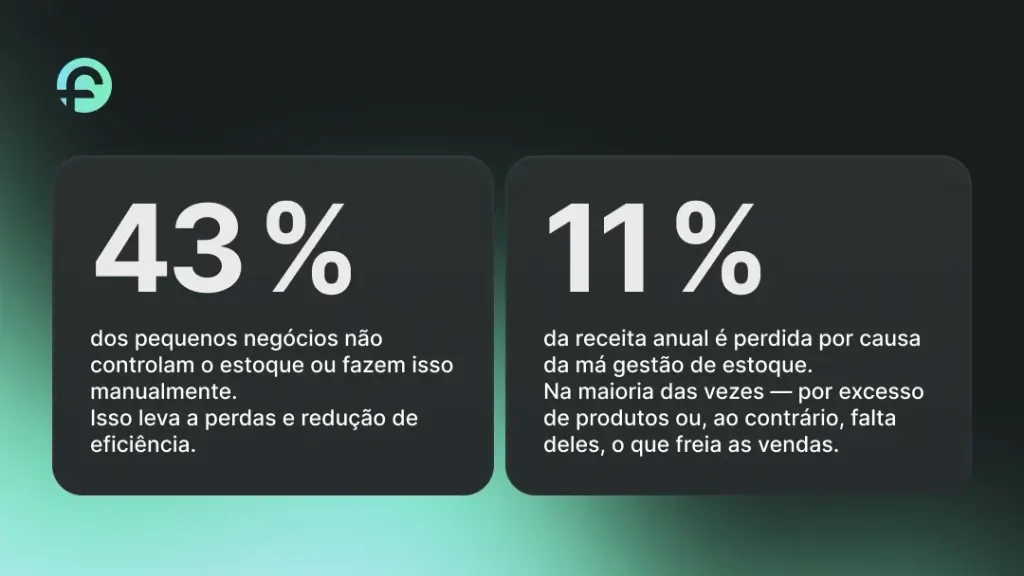
This is not the full list of financial problems e-commerce and retail businesses face. But these are the most dangerous ones.
They eat into profit, block growth, and create constant instability.
If you don’t solve them, any attempt to scale will only scale the chaos.
Why isn’t a regular CRM enough?
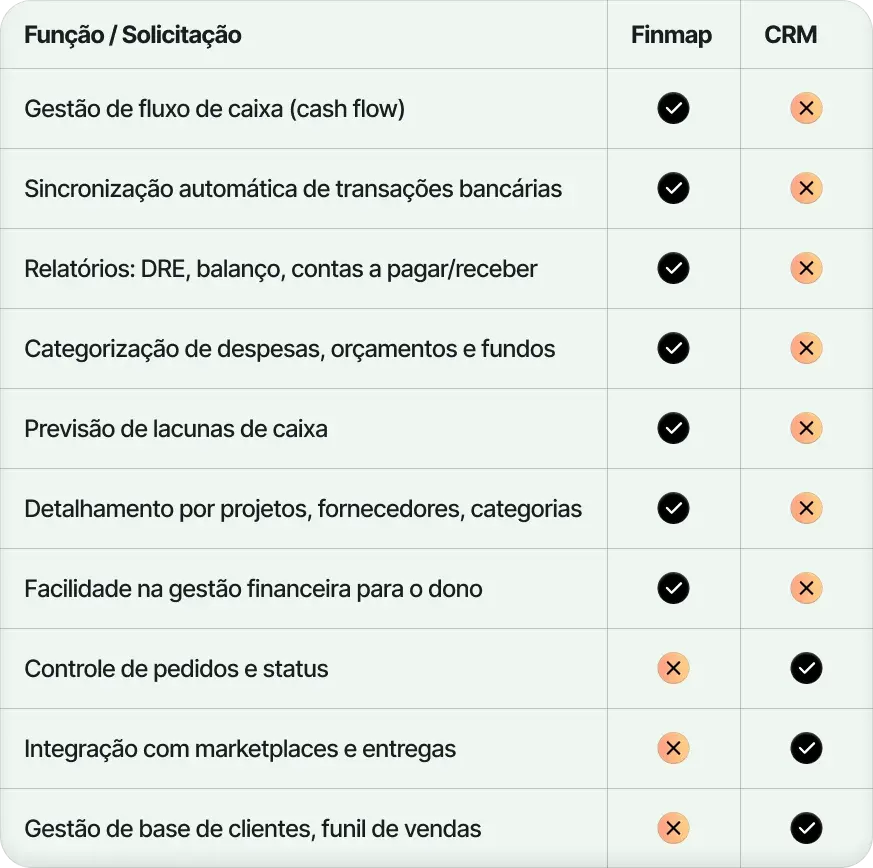
Many entrepreneurs believe that if they already have a CRM, then their finances are under control. Yes, a CRM is an important tool — but it was built to manage orders, not money.
A CRM helps you sell, and that’s its main purpose. The tool:
- records leads and customer orders;
- shows sales stages and the funnel;
- helps manage the sales team’s work;
- lets you calculate conversion, average order value, and target achievement.
But it doesn’t answer the main financial question: is the business actually profitable?
A CRM doesn’t collect real expense data — advertising, delivery, packaging, salaries. It doesn’t factor in when marketplace payouts will arrive or when you need to pay a supplier.
It doesn’t show how much money is in the account, what is frozen, how much you owe, or how much you need to cover commitments.
CRM is about who bought. Financial management is about how much you earned.
If you want to manage your finances, not just record sales — you need a separate tool.
Finmap — real-time cash flow management
Finmap is an online financial management platform that gives you a complete view of your finances.
It brings everything together in one place, automates routine tasks, and shows where your profit is and where your costs are. It’s not “accounting for taxes,” but a tool for management decisions.
For retail and e-commerce, this is essential: cash flow is unstable, expenses are scattered, and data is spread across dozens of sources.
No more chaos: all your money under control on one screen
Finmap lets you bring every financial source into one single system: bank accounts, payment processors, marketplace data, cash on delivery, and cash payments.
Finmap has an open API that lets you connect your CRM and other systems, so not only payments but also sales information is automatically included in your management system.
Result: At any moment, you know how much money you have, where it came from, and where it’s going. This isn’t just convenience. It’s profit control.
Automate management — run the business, not spreadsheets
Finmap lets you automate financial processes in just a few steps — without bureaucracy or constant manual control:
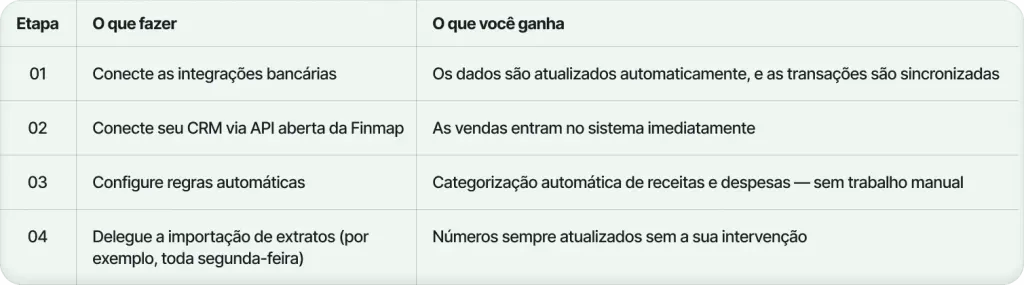
Result: All data updates automatically, control happens without errors or delays, and you finally free up time for strategic decisions, growth, and profit — instead of operational tasks.
“Projects” report — see the profitability of each area separately
Want to know what really makes money: Shopee sales or Instagram, wholesale or retail, dropshipping or resale?
Finmap lets you split your business into separate “projects” — by channel, product line, brand, or marketplace. And for each one, you can see income, expenses, and profit.
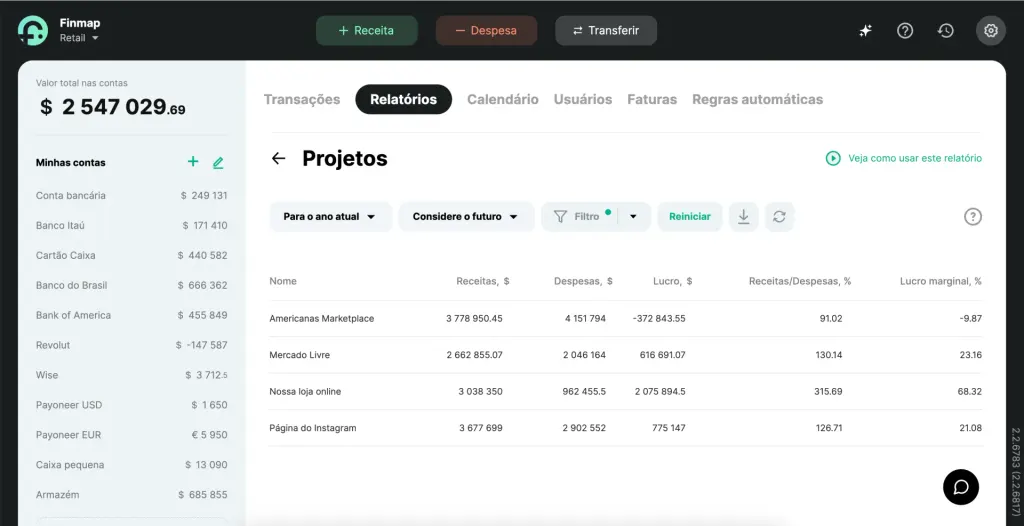
Result: You make decisions based on margin and profitability. Scale what works — and cut what loses money.
Payment Calendar — your financial planner
Tired of putting out fires? With Finmap, you see all future income and expenses day by day — and understand in advance when a cash shortage may happen.
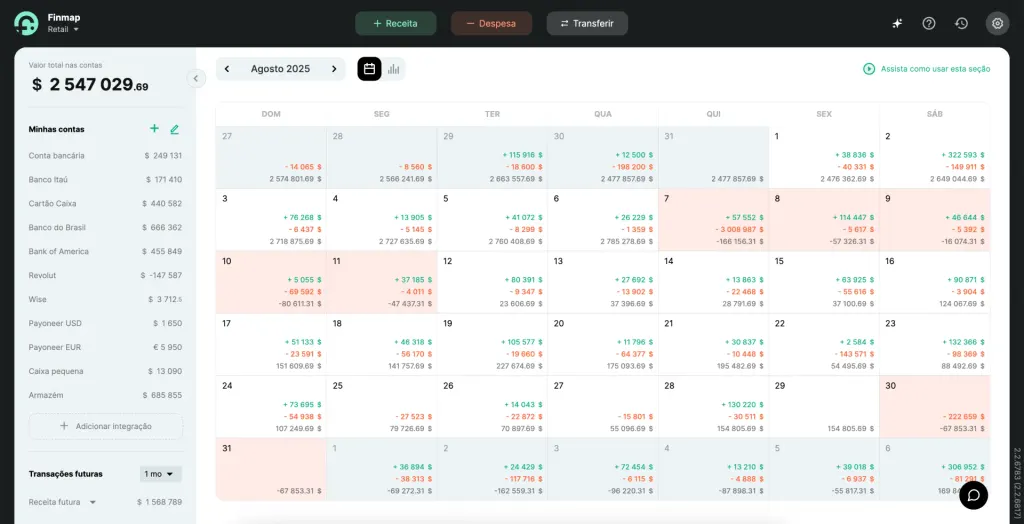
Result: You plan cash flow in advance, meet your commitments on time, avoid gaps, and run the business strategically — not under stress.
Inventory as money — see profit, not just volume
You bought products, but haven’t sold them yet. The money has already gone out, but the profit hasn’t come in yet.
Create a separate “Inventory” account in Finmap to track the value of your products in cash terms.
Result: You know exactly how much you earned from what was sold. You don’t confuse cost with an asset. This is especially important for businesses with large inventories.
Control accounts payable and receivable — avoid losses and cash shortages
Many businesses don’t lose money because they sell poorly, but because they don’t get paid on time or don’t manage their commitments.
Finmap lets you track all debts: who owes you, how much, and when payment is expected. And the other way around — what you owe, the due date, what has already been paid, and what is still outstanding.
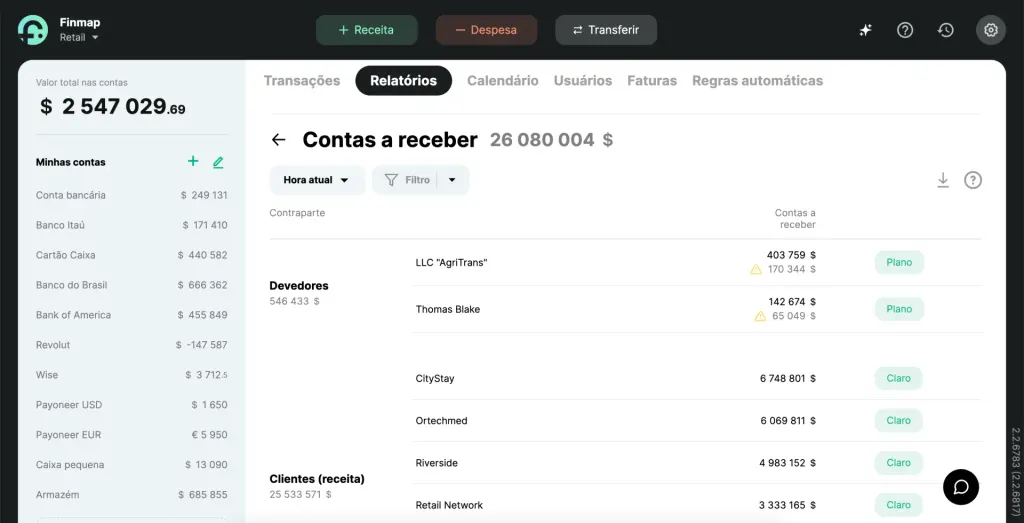
Result: All overdue payments and obligations are under control. You don’t forget important payments, lose customers, or damage your reputation. You forecast cash gaps, plan working capital, and know exactly what you can count on.
A flexible tool for all your needs
Beyond the core features, Finmap easily adapts to your business. You can:
- track salary payments and manager bonuses;
- delegate routine tasks to employees with customized access;
- analyze profitability by customer, marketplace, and ad campaign;
- control how much each team member earns and spends;
- issue invoices and record customer payments.
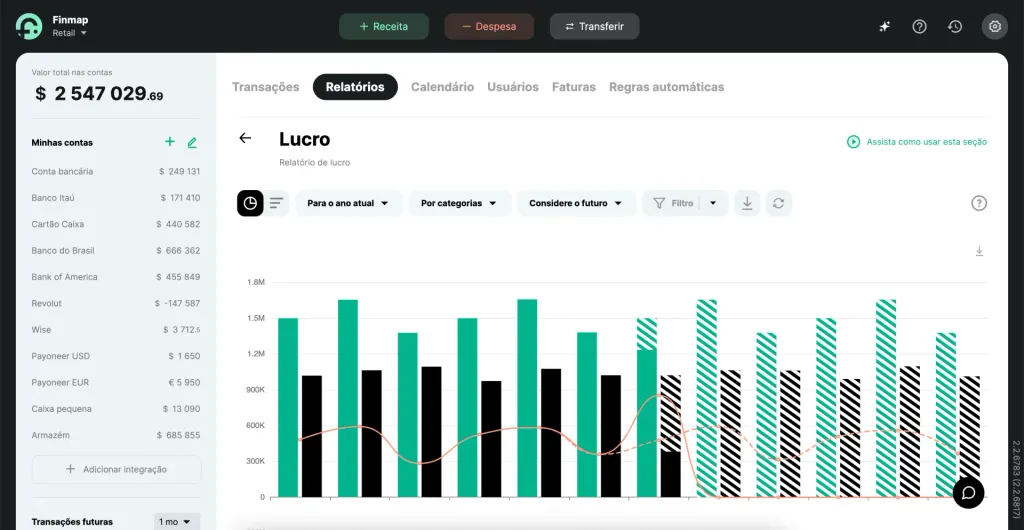
Result: You get not just control, but a financial system that adapts to your business. From operational payments to strategic analysis — everything that affects profit is under control, in one place.
Real case: from financial confusion to strategic management with Finmap
Klebrig is a chemical products hypermarket that repackages and sells to food and household industries. It has its own production, a wide product range, regular purchasing, and constant logistics costs.

Before Finmap, financial management was done in Excel spreadsheets. The accountant handled only the tax side, and the owner didn’t trust the overall financial picture.
Only after stepping away from operations did founder Andrii start managing the money — and he ran into cash gaps, uncontrolled operating expenses, and incorrect P&L analysis.
There were days when the money wasn’t in the account, but I knew it was coming. Managing the numbers and seeing the full picture are two different things. — Andrii Fem’iak, founder of Klebrig
At first, Finmap was adopted to record income and consolidate financial sources.
But over time, Andrii realized that Finmap is a universal financial management tool that shows the full view of the business: revenue, expenses, working capital, and obligations.
In the beginning, Finmap was just a payment log. Later, it became an analytical system that helps assess profitability, plan investments, and avoid financial mistakes. — Andrii Fem’iak, founder of Klebrig
The company built its financial management around three pillars:
- P&L reports: to assess monthly profitability and identify unprofitable areas.
- Cash flow forecasting: to plan working capital and know when money will be available.
- Expense control: to organize operating costs, purchasing, and development.
Result: The company’s financial decisions stopped being based on guesswork.
The business could now see not only what had happened, but what was going to happen: when money would come in, whether it would be enough for purchases, and whether there was a reserve for investment. This stabilized the finances and made strategic management possible.
Andrii’s advice for other entrepreneurs:
Before investing, clearly separate operating expenses from working capital. Calculate the full cost, including logistics, packaging, and commissions. Without this, no investment will generate profit.
Finmap — the tool that gives retail and e-commerce businesses financial control
This isn’t just convenience. It’s an essential tool for stability, growth, and profit. Finmap:
- Brings all income and expense sources together in one system
- Automates financial management
- Shows profitability by product, channel, and segment
- Helps forecast cash gaps
- Tracks seasonality in sales and products
- Controls accounts payable and receivable
- Provides a complete financial view for strategic decisions
Finmap is the foundation for real profit and scalability.
With it, you don’t guess what’s happening with your money — you know.
Implement a financial system in your business now — and start making profit, not just sales.
Frequently asked questions about financial management in retail and e-commerce
1. We already have a CRM. Why use Finmap too?
CRM is about orders, not money. It doesn’t factor in real costs, show cash gaps, or generate P&L. Finmap answers the main question: is the business profitable, not just making sales?
2. We use Excel. Isn’t that control too?
No. Excel means manual work, constant errors, and outdated data. Finmap automates, syncs with banks, and shows your financial reality in real time — not a week after the “reconciliation.”
3. Our business is small. Do we really need a system like this?
Small businesses are exactly the ones that suffer most from cash gaps and poorly planned spending. Finmap isn’t about size — it’s about control. Start small so you have a real chance to grow.
4. We’re already profitable. Why add another system?
Profit without a transparent system is a guess, not management. Without control over cash flow, margins, and obligations, you won’t scale safely. And without planning, even a profitable business can break because of one cash gap.
5. Does Finmap show which products and channels are profitable?
Yes. Finmap shows profitability by product, channel, or marketplace. That’s the foundation for scaling: you focus on what makes money and cut what drains resources.
6. What if I’m not a finance person? Will I understand it?
Finmap was built for business owners, not accountants. It’s simple: clear charts, automatic reports, no complicated terms. Your financial picture is just a few clicks away — so you can make decisions, not drown in spreadsheets.
Share valuable content — become a source of insights