


Table of Contents

133

8 min

20.03.2025
Money down the drain? How a profit and loss statement can save your business

Karine Shevchenko
Financial Expert at Finmap
Have you ever wondered where the money goes when your business seems to be doing well? Have you ever got lost in the numbers and struggled to understand where the profit is?

Without clear financial control, it’s easy to lose money and miss opportunities to grow. That’s why a profit and loss report (P&L) is an essential tool for every business owner. It helps you spot hidden problems, find ways to fix them, and keep your business growing steadily.

Why does a business need a profit and loss report?
Assessing financial performance
A profit and loss report lets you take a detailed look at your company’s financial performance. By comparing income and expenses, you can see whether you’ve reached your financial goals.
For example, a restaurant owner can use this report to identify which dishes bring in the most profit and which ones should be removed from the menu.
According to the U.S. Bureau of Labor Statistics:
Approximately 20% of small businesses close in their first year, 30% within two years, and 50% within five years, largely due to a lack of financial control.
Budgeting and strategic planning
By preparing a profit and loss report regularly, you can plan your budget more effectively and build growth strategies.
For example, a company may discover it is spending too much on marketing and redirect those funds to innovation or employee training.
According to research by CB Insights:
One of the main reasons startups fail is a lack of proper financial planning and management, accounting for up to 39% of all failures.

Tracking and controlling expenses
A profit and loss report helps you identify overspending and find ways to optimize costs. It allows you to respond to rising costs in time and take steps to reduce them, helping maintain the company’s financial stability.
By analyzing his costs, Dmytro Sheremeta, owner of the cleaning company “Chystota,” managed to save R$66,000 in one year.

Dmytro’s company has always aimed to provide high-quality cleaning services, using essential equipment such as vacuum cleaners and ladders that needed to be transported. The cost of this delivery was usually included in the service price. The company often used taxi services for transport, which led to unpredictable logistics expenses, depending on the weather, day of the week, and demand for taxis.
By analyzing costs through the profit and loss report in Finmap, Dmytro discovered that logistics costs were higher than expected. Together with his team, he started looking for ways to reduce these expenses. After a careful analysis, they decided to change the delivery method and partner with a service that used electric scooters. This approach not only reduced delivery time but also eliminated dependence on fuel prices, making transport costs more stable.
Before optimizing costs, a round-trip delivery cost the company R$47, while under the new logistics strategy, the cost dropped to R$13. This significantly reduced logistics expenses and increased the company’s efficiency.
Financial reporting for stakeholders
Investors and lenders look at the profit and loss report when assessing a company’s financial health. This is especially important if you plan to attract investment to expand your business. Reliable financial reporting makes your business more attractive to investors.
A profit and loss report is an essential tool for every entrepreneur. It gives you a clear view of the company’s financial position, helps identify hidden costs, and optimize resources. Using this report allows business owners to plan effective strategies, make informed decisions based on real data, and ensure the long-term stability and growth of the business.
How to create a high-quality profit and loss report
A well-prepared profit and loss report is the foundation of your business’s financial health. It not only helps you understand where things stand today, but also opens up new opportunities for growth. To make your report as useful as possible, follow these steps:
- Choose the reporting period. Set the reporting period — monthly, quarterly, or annually — depending on the specifics of your business and industry standards.
- Collect financial data. Gather all the financial data you need: income, expenses, operating profit (or loss), interest, taxes, and other financial indicators. This includes cash flow from official accounts, cash registers, cards, and digital wallets.
- Classify income and expenses. Carefully classify all income and expenses by their purpose and nature. Main revenue streams (sales of goods or services) and additional income (investments, licenses, etc.) should be shown separately. Expenses should be divided into categories such as salaries, materials, marketing, administrative costs, and so on.
- Calculate net profit (or loss). Subtract total expenses from total income to determine net profit or loss. This figure is key to assessing the company’s financial health.
- Compare with previous periods. Compare the results for the reporting period with previous periods to identify trends and analyze changes in financial performance.
- Prepare an analytical report. After completing the main profit and loss report, prepare an additional analytical report with detailed information on specific income and expense items, as well as explanations for financial changes.
- Visualize the results. Use visualization tools to make financial data easier to understand and interpret. Charts and dashboards help you quickly assess the company’s financial position.
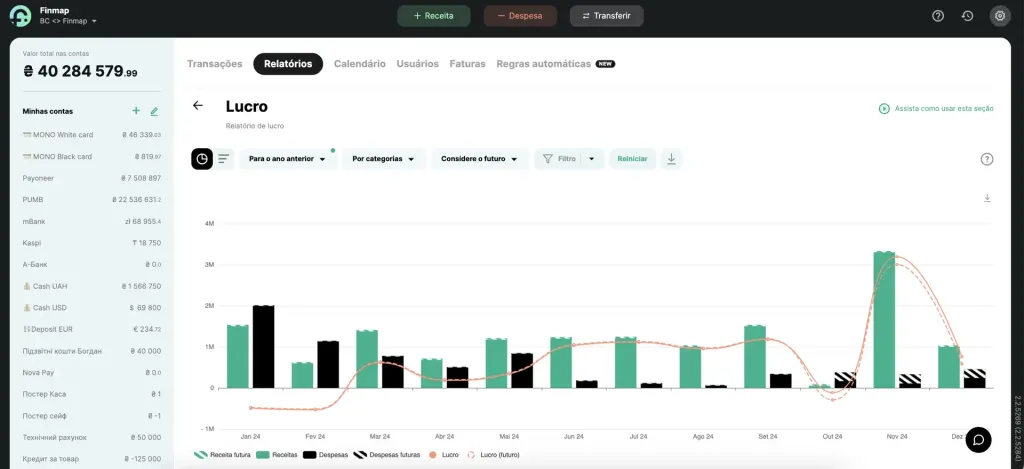
Additional tips:
- Retrospective analysis. Compare results with previous periods to identify trends and forecast future income and expenses.
- Market analysis. Consider economic changes and market trends that may affect your company’s financial performance.
- Separate finances. Keep personal and business finances separate to avoid the common mistake of mixing funds.
- A professional approach. Consult a financial professional for guidance on setting up your accounting. If ongoing support is expensive, an initial consultation can help you get on the right track.
- Technology solutions. Use modern tools to automate accounting. For example, Finmap integrates with banks and payment systems, simplifying data collection and analysis.
By following these steps and standards for preparing a profit and loss report, you’ll get a clear, objective view of your company’s financial health. This will help you manage your business more effectively and make strategic decisions that support growth and stability.
For greater convenience and efficiency, automate your accounting with Finmap and forget about complicated spreadsheets. Finmap integrates with banks and payment systems, providing intuitive charts and dashboards that make analysis and business decision-making significantly easier.
Share valuable content — become a source of insights