

Table of Contents

1.1k

9 min

17.06.2026
₴100K Revenue, ₴62K in Hand: How to Count Real Profit as a Ukrainian Sole Proprietor

Sergiy Shuldik
Financial Expert at Finmap
"I had a strong year. ₴1.2 million on the FOP account. Then I opened my savings and saw ₴340,000. Where did ₴860,000 go?"
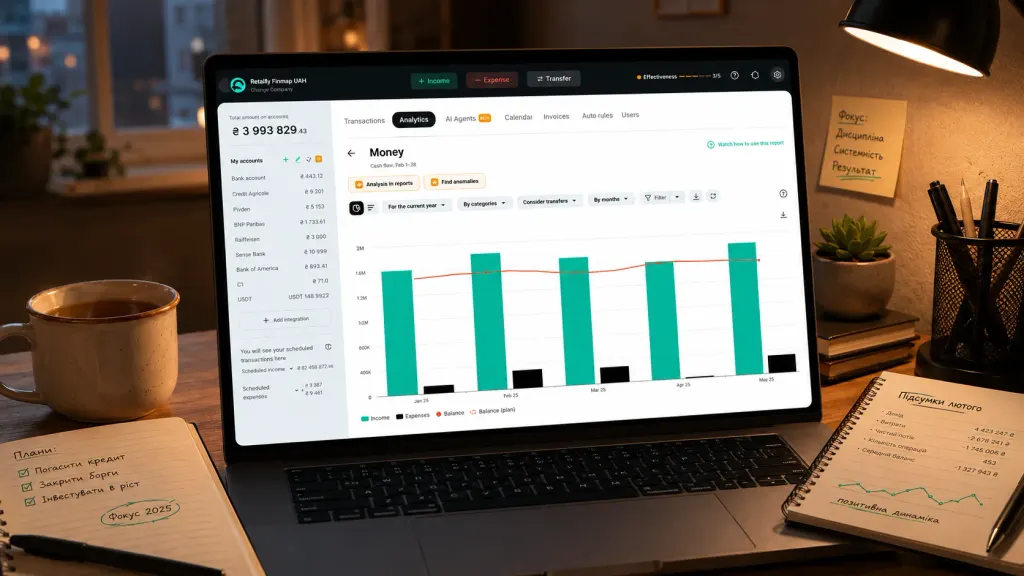
It was the last Sunday of December. The kind of evening when small business owners — especially Ukrainian FOPs — sit down with a calculator and a glass of something, trying to understand the year that just passed.
An IT consultant on FOP Group 3 (5% Single Tax) opened his banking app. Revenue for the year: ₴1,200,000. Roughly ₴100,000 a month. By any reasonable measure, a successful year.
Then he opened his personal savings. ₴340,000.
The math didn't add up. He had not bought a car. He had not done a major renovation. He had taken one short vacation. He had not lent money to anyone. Where had ₴860,000 gone?
This is the story of the kind of accounting most Ukrainian sole proprietors never do — and what changes the moment they finally do it.
The Paradox: Revenue Is Not Income, Income Is Not Profit, Profit Is Not What You Keep
If you are a FOP, your bank account shows one number: the money that came in. You glance at it and feel rich, or stressed, depending on the month. Most owners then mentally subtract the Single Tax (ЄП) and ЄСВ — and call what's left "my income."
This is the first mistake. There are four layers between the money on the FOP account and the money you can actually spend on your life — and FOP owners regularly skip three of them.
Layer 1 — Revenue. The total of all client payments hitting the FOP account during the year. The number that feels like success.
Layer 2 — After regulatory costs. ЄП (5% of revenue) and ЄСВ (a flat monthly contribution). For a ₴1.2M FOP, that's roughly ₴60,000 + ₴30,000 = ₴90,000 out of revenue.
Layer 3 — After business costs. Tools and software subscriptions. The accountant's monthly fee. Co-working or office. Equipment that wears out. Professional courses. Banking fees. None of this is "luxury" — it's the actual cost of running the business.
Layer 4 — Real take-home. The money left after you have set aside reserves for slow months, equipment replacement, your own pension, and the personal financial obligations that ride on top of FOP income (private medical, family savings, future-quarter taxes).
The number most FOPs call "my income" sits between Layer 2 and Layer 3 — and the gap between that and Layer 4 is exactly the gap our IT consultant could not account for that Sunday evening.
The Four Layers — Worked Out on a ₴1.2M Year
Here are real numbers for the consultant, kept anonymous but typical for a third-year IT consultant on FOP Group 3 doing services for both Ukrainian and EU clients.
Layer 1 — Revenue. Annual: ₴1,200,000. Monthly average: ₴100,000.
Layer 2 — After regulatory costs.
- Single Tax 5%: −₴60,000
- ЄСВ contributions: −₴26,400
- Bank conversion fees and FX on EU income: −₴9,600
- Layer 2 total: ₴1,104,000 (₴92,000/month)
This is the number most FOPs stop at. "I net ₴92K a month." It feels close to the ₴100K headline — only ₴8K of friction. Comfortable.
Layer 3 — After business costs.
- Notion, Figma, ChatGPT, GitHub, Loom, cloud hosting: −₴48,000/year
- Accountant + bookkeeping: −₴14,400/year
- Co-working (part-year, 6 months): −₴42,000/year
- Equipment depreciation (laptop refresh, monitor, chair amortized): −₴30,000/year
- Professional courses + books: −₴24,000/year
- Layer 3 total: ₴945,600 (₴78,800/month)
Already 22% lower than "I earned ₴100K/month." But this is the number a Western accountant would call "net business income" — and it is still not what FOP owner takes home.

Layer 4 — Real take-home (the layer FOPs forget exists).
- Slow-month reserve (3-month buffer built over the year): −₴84,000/year
- Equipment replacement fund (next laptop, next monitor): −₴25,000/year
- Private medical / health buffer: −₴18,000/year
- Personal pension / long-term savings (15% of net): −₴75,000/year
- Layer 4 total: ₴743,600 (₴62,000/month)
The real take-home number is ₴62,000 per month, not ₴100,000. A 38% reduction from the headline revenue. And not because the consultant was wasteful — because every line above is a cost of running this business at a sustainable level.
This is the number that explains the ₴340,000 in savings. Of the ₴743K real take-home, roughly ₴400K had been spent on normal monthly life (rent, food, family, leisure). ₴340K remained. The math added up — but only after the four layers were honestly counted.
5 Hidden Costs FOP Owners Consistently Skip
Across consulting calls with dozens of Ukrainian sole proprietors, the same five categories come up as invisible-until-counted.
One. Slow-month reserve. Every FOP knows February and August are slower. Yet most don't actively set money aside in fat months to smooth out lean ones. When a slow month happens, they "borrow from next month's tax money" or cut into personal savings. Honest accounting requires a buffer line item.
Two. Equipment amortization. The laptop you bought three years ago for ₴65,000 has to be replaced. The ergonomic chair wears out. Your phone breaks. None of these are "this month's expense" — but they are an unavoidable yearly cost. Spread them across 12 months and they amount to ₴2,000–3,000/month for a typical knowledge worker.
Three. Private medical and health. State medical care exists, but most FOPs end up paying out of pocket for important moments. A planned ₴1,500/month line for medical reserves is cheaper, less stressful, and turns a "surprise expense" into a budgeted one.
Four. Personal pension / long-term savings. A FOP does not have an employer building a pension for you. If you do not save for the long term yourself, no one will. The standard guidance — 15–20% of net income going to long-term savings — is exactly the line item that "I'll start next year" never gets done.
Five. Future-quarter taxes. This one is subtle. FOP taxes are paid quarterly, and many owners use the upcoming tax payment as "temporary cash" in their account between quarters. This works until one quarter is weaker than expected. Then the tax money is "needed" elsewhere, and the next quarter is in a hole.

The pattern across all five is the same. None of these costs feel like "real" expenses in the month they don't happen. They feel like savings. So FOPs feel richer than they are — until the month they need to spend the money and discover it's already gone.
The Formula: How to Count Your Real Profit
The formula itself is not complicated. The discipline is in actually running it every month, not once a year in December.
Real Profit = Revenue − Regulatory − Business Costs − Reserves
In practice, that breaks down to four monthly steps that take about 30 minutes once a month.
Step one — record every inflow. All FOP account credits, by client and project. Most owners are good at this. The bank does most of the work.
Step two — subtract regulatory costs at the moment of inflow. As soon as a payment lands, mentally (or actually, via a transfer) move 5% to a tax sub-account. Move ЄСВ for the current month too. This stops you from feeling richer than you are.
Step three — track business costs monthly, not yearly. Every subscription, every tool, every coffee with a client that was actually for business. Most FOPs underestimate this category by 30–50% because they forget annual subscriptions, occasional courses, and small purchases.
Step four — set aside reserves, every month, automatic. Open a separate savings sub-account. Move a fixed monthly amount the day the FOP payment lands — not the day before tax season. Reserves you set up to be automatic actually accumulate. Reserves that require willpower do not.
The result is a number you can trust. It is usually 30–40% lower than your headline revenue. It is what you can actually spend on your life without secretly borrowing from your future self.
What Changed Once He Knew the Number
The consultant's discovery that his real take-home was ₴62K/month, not ₴100K/month, changed three things in the following year.

Pricing. He raised his hourly rate by 15% for new clients in Q1 — the first such raise in three years. Not arbitrarily — based on the realization that his quoted rates assumed a "Layer 2" view of income, which had silently underweighted the cost of running his business.
Client mix. Two clients who consistently paid late and required 30+ days to collect were dropped. The arithmetic now showed that "₴25K/month from a late-paying client" was actually closer to ₴15K when you accounted for cash flow stress and admin time. He replaced them with two new clients on shorter payment terms.
Personal expectations. Most importantly, he stopped feeling vaguely guilty about not saving more. ₴62K/month is not ₴100K/month. Knowing the real number meant making real decisions about lifestyle, family budget, and long-term goals — instead of running on a fiction.
The most quoted line from that year, in his words: "I didn't earn less. I just finally knew how much I'd been earning all along."
Topic foundation: Financial Management for a Small Business: When You Outgrow Your Own Head
Share valuable content — become a source of insights



Frequently Asked Questions
Does this apply to FOP Group 2 (single tax fixed amount) the same way?

The math changes slightly because Group 2 has a fixed monthly tax instead of 5% of revenue, but the four-layer structure is identical. Regulatory costs are a known fixed line item; the rest stays the same.
What if I'm a FOP Group 3 with 3% + VAT instead of 5%?
Same structure, slightly different Layer 2. The 3% rate plus VAT changes the tax line, but every other layer (business costs, reserves) is calculated the same way. Group 3 with VAT also requires more careful accounting in Layer 3 because VAT recovery on expenses needs tracking.
How much should I set aside for slow months?
Two to three months of fixed monthly costs (rent, subscriptions, accountant, ЄСВ). For a typical solo consultant in Ukraine, that's ₴60K–₴120K reserve. Build it over 6–12 months by automatic monthly transfers, not in a single big move.
Is 15–20% of net income for personal pension realistic on FOP?
It feels uncomfortable when you first try it. After two or three months it becomes normal. The owners who actually do it consistently are those who automate the transfer immediately when income lands — before they "see" the money as available to spend.
What's the easiest way to track all this without becoming an accountant?
Two separate accounts at minimum: your operating FOP account, and a reserves account. A simple categorization of expenses (regulatory / tools / office / reserves / personal). Either a spreadsheet you fill once a week or a tool that does it automatically from bank feeds. Most FOPs don't need anything more elaborate than this — the value is in consistency, not complexity.
Should I count my work time as a cost?
For deciding pricing — yes. For calculating real profit — no, because there's no actual money outflow. But knowing your effective hourly take-home (real profit ÷ hours worked) is the single best number to use when deciding whether to raise rates next quarter.
Any questions left?
We are ready to answer them.


Finmap support