


Table of Contents
Home
/
Blog
/
Drone unit cost: how to calculate the real price of a product — from components to engineer hours

397

7 min

28.07.2026
Drone unit cost: how to calculate the real price of a product — from components to engineer hours

Julia Polinyak
Financial expert at Finmap
In complex-hardware manufacturing, the price is often set on a hunch. You add up the components, mark it up, and land on a number that feels right. The product sells, orders come in, and everything looks fine.
Then it turns out the company earns less on each unit than it thought — and on some units it barely breaks even. The reason is always the same: the unit cost captured only what's visible — the hardware. Engineer hours, assembly, testing, defects and the share of R&D didn't make it in. And those often weigh more than the components.
You can calculate the true unit cost. But to do it you have to pull together everything that went into the product, not just the invoice from the components supplier.
Why "components plus a markup" lies to you
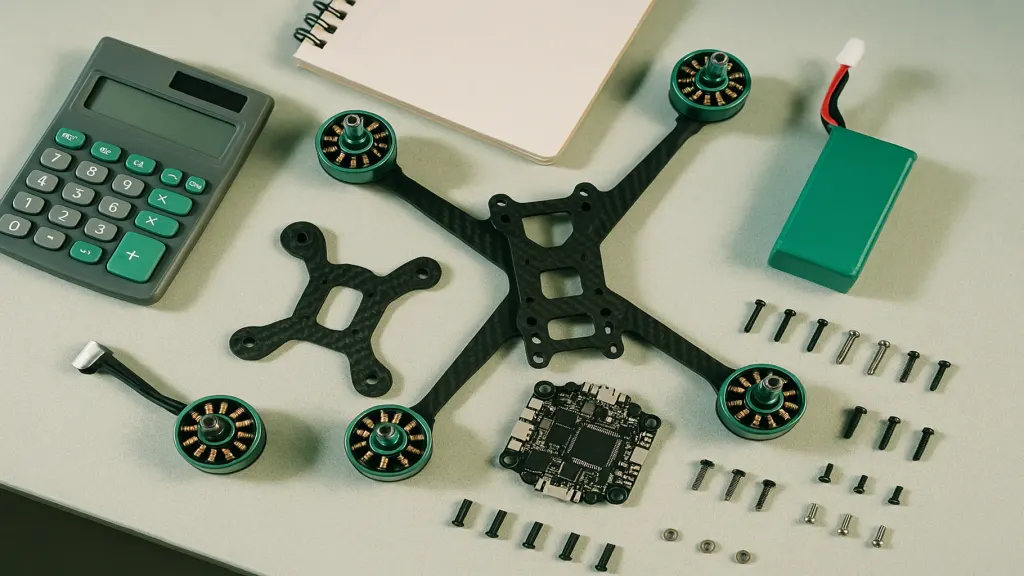
Hardware is the most visible part of a product's cost, but often not the biggest. The most expensive part hides in people's labor and in everything that never made it to production.
| What gets counted | What gets forgotten |
|---|---|
| Cost of components | Engineer hours for assembly and setup |
| The "hardware" cost | Testing, defects and rework |
| Direct materials | The R&D allocation every production unit has to carry |
As long as the unit cost is just components, the price looks profitable. Add engineer hours, defects and the share of development, and that same price can turn out to be a loss. "We sell a lot, but there's less money than there should be" is the classic symptom of an understated unit cost.
"We were sure our margin was 40%. Once we counted the engineer hours for assembling and testing each unit, the real margin turned out to be half that. Nobody ever saw those hours in the price."
What the real unit cost includes
For the price not to run at a loss, the unit cost has to carry everything the product pulls along with it:
- Components and materials — the obvious part, adjusted for the exchange rate if you buy abroad.
- Engineer and assembly hours — the actual time to build, set up and test a single unit.
- Defects and rework — some units fail the test the first time, and that's a cost too.
- R&D allocation — development has to pay off across the production run, so each unit carries its slice of that spend.
- Share of fixed costs — the workshop rent, equipment and administration.
A product whose price only covers components sells at a loss, even if "the hardware paid for itself." You only see the real margin once everything is inside the unit cost.
What it looks like in numbers
One product, two ways to count it. The difference is in what you include:
| Calculation | Unit cost |
|---|---|
| Components only | 28,000 — the margin looks big |
| Components + engineers + defects + R&D allocation | 41,000 — the real unit cost |
At a selling price of 45,000, the first calculation made the margin look like 17,000, when it's actually 4,000. And that's still a profit — but on some variants, where the engineer hours run higher, the same approach hides an outright loss.
"The most useful thing was seeing the unit cost for each variant separately. It turned out one we were pushing hard was running at a loss — purely because of the hours to set it up."

Where a financial specialist comes in
Allocating engineer hours, defects and the R&D share across products is work an owner rarely gets to alone, because they're heads-down in development and production every day. A financial specialist pulls all the costs together and shows the real unit cost and margin for each product — not "on average across the company."
For that calculation to be possible, costs have to be gathered in one place and tied to products and projects. In Finmap you see costs by line and by product right next to the revenue — and then the real unit cost of a drone, or any product, is something you can calculate rather than guess.
📌 Find out the real unit cost and margin of every product. Book a free financial diagnostic with Finmap — a financial specialist will break down the full unit cost, from components to engineer hours, and show you where you're in the red. No commitment.
Share valuable content — become a source of insights





Frequently asked questions
What goes into the real unit cost besides components?

Engineer hours for assembly and testing, defects and rework, the R&D allocation and a share of fixed costs (workshop, equipment, administration). Count only components and the unit cost is understated and the margin is imaginary.
How do you allocate R&D spend across production units?
You estimate the expected size of the run and divide the development spend by that number — so each unit carries its slice of R&D. The larger the run, the smaller the share per unit; for small runs that share is significant and can't be ignored.
Do you need to calculate the unit cost for each variant separately?
Yes, if the variants differ in components or assembly hours. Often it's a single variant that hides a loss invisible in the "average" unit cost across the whole lineup.
We buy components abroad — how does that affect the unit cost?
The exchange rate at the moment of payment becomes part of the unit cost. If the rate shifts between the prepayment and delivery, the real cost of the components differs from the plan — you have to account for that too, or the margin drifts.
Where do you start if you've never calculated the unit cost this way?
With your best-selling product: add engineer hours, defects and a share of fixed costs to the components, then compare against the price. Usually the very first breakdown already shows the real margin is smaller than it seemed.
Any questions left?
We are ready to answer them.


Finmap support