

Table of Contents

314

7 min

24.07.2026
Your Store Turns a Profit, But There's No Cash — It's Stuck in Stock

Karine Shevchenko
Financial Expert at Finmap
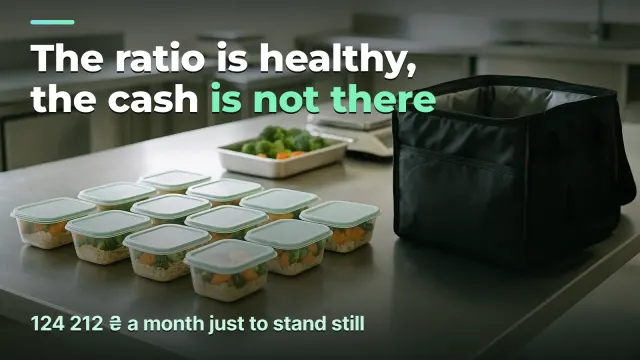
The store is doing fine. Sales are coming in, the markup is healthy, and at the end of the month the report shows a profit. But the account is empty. You need to pay your supplier and the rent, yet somehow there's no money — even though on paper the business is in the black.
This is the classic retail trap. The profit exists, but it's not in your account — it's on the shelves. You put money into stock that hasn't sold yet, and while it sits in the showroom and the storeroom, it isn't profit — it's frozen cash.
The worst part is that a standard profit report won't show it. Everything looks fine there. The problem hides in the gap between "earned" and "received in actual cash."
Why there's profit but no money
Profit and cash in the account are two different things. In retail they drift apart the most, because between buying and selling the goods sit around for a long time, holding your money inside them.
| In the report | In reality |
|---|---|
| Profit for the month — 80,000 | Bought 200,000 worth of stock, sold half |
| Markup 40% — all good | The markup exists, but it's on the shelf, not in the account |
| Sales are growing | So is the stock you've put even more money into |
And so it turns out: "I don't know where my money is" — while it's in the storeroom, in boxes that haven't yet become sales. The more stock you hold, the more cash is frozen, even if the store is profitable.
"I thought I had a sales problem. But the problem was that half the store is stock that's been sitting for months. The money didn't vanish — it just turned into inventory."

Where the cash disappears to
In retail, money gets stuck in three places, and all three are easy to miss as long as you only look at profit:
- Slow-moving stock. Items that sit for months. Every one of those boxes is money that isn't working.
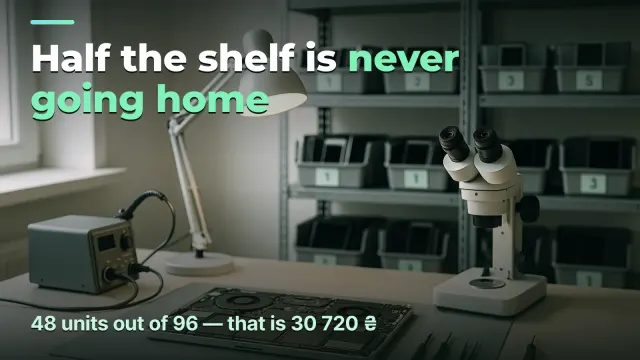
- Overstocking. "I'll take more to get the discount" — and now half a year's worth of supply sits there as dead capital.
- Expanding the range without a plan. Every new item is a little more money tied up, while the same twenty best-sellers do most of the selling.
The key number that reveals this is inventory turnover: how quickly stock turns back into money. The slower it turns, the more cash sits on the shelves instead of in your account.
What it looks like in numbers
Picture two items with the same markup. On paper they're equally "profitable," but for your bank account they're worlds apart:
| Item | Sells in | What happens to the money |
|---|---|---|
| Best-seller | 2 weeks | The money comes back twice a month and goes to work again |
| Slow-mover | 4 months | The money sits idle for 4 months |
The same invested capital turns over several times a month in the first case, earning the markup each time. In the second, it just sits there dead. That's why a store packed with "profitable" slow-moving stock can be in the black on the report and permanently in the red in the account.
"When we cleared out the twenty slowest items and put that money into best-sellers, turnover didn't drop — and for the first time in a year, we had free cash."
What to do about it
You can free the money off the shelves without heroics — it's enough to stop pouring it in blindly:
- Find the slow-moving items and sell them off, even at a lower markup — live cash now beats dead capital for another six months.
- Buy for turnover, not "just in case." Fast-movers more often and in smaller batches than rare items in big loads.
- Don't chase a wide range. Often 20% of items deliver 80% of sales, while the rest just holds your money.
- Watch the cash, not just the profit. A profitable month means nothing if all the profit has settled into stock.
Why you need a financial expert here
It's hard to see how much money is frozen in stock and exactly what's sitting dead when you only look at the till and the profit. You need a view that brings stock, purchases, and sales together and shows turnover by item. That's what a financial expert gives you — and usually the very first review uncovers hundreds of thousands sitting motionless on the shelves.
To even be able to see numbers like these, it helps to track your money and your stock in one place. In Finmap you can see cash flow separately from profit — and then it's immediately obvious when there's profit but no money, because it went into stock.
📌 Find out how much of your money is sitting on the shelves instead of in your account. Book a free financial diagnostic with Finmap — a financial expert will show you where the cash is frozen and which stock is eating your turnover. No strings attached.
Share valuable content — become a source of insights



Frequently asked questions
How do I tell whether the money is stuck in stock or I just have weak sales?

Compare the profit in your report with what's actually in the account. If the report consistently shows a plus, but there's no free cash and you have to borrow for purchasing — the cash has almost certainly settled into stock.
What is inventory turnover in plain terms?
It's the speed at which stock turns back into money. A best-seller turns over several times a month and earns the markup each time; a slow-mover sits for months and holds your money without moving.
Is it normal to sell off slow-moving stock at a loss?
Often, yes. Live cash now is more useful than dead capital for another six months. Even selling at breakeven or a small loss frees up cash you can put into fast-moving items and earn on.
Do I need to calculate turnover for every single item?
It's enough to start with groups and the largest stock holdings. The bulk of the money is usually stuck in a few dozen items — those are the ones worth finding first, rather than breaking down the whole range unit by unit.
I have a small store — does this still apply?
Yes, and even more sharply: a small store has a thinner safety margin, so every sum frozen in stock hurts more. It's worth seeing your turnover before it drives you into a cash gap.
Any questions left?
We are ready to answer them.


Finmap support