

Table of Contents

249

8 min

30.07.2026
How Agency Owners Can See Their Finances in Real Time

Olena Smolikova
Financial expert at Finmap
A typical situation for an agency owner: to understand how things stand with money, they have to poke someone. Message the accountant, wait for someone to pull a spreadsheet together, collect statements from several banks. The answer comes days late — often weeks — when it's already too late to react. Managing finances "through the rearview mirror" is expensive: the decisions are always behind.
Seeing your finances in real time isn't a luxury — it's a basic condition for a business you can actually steer. Let's break down what that means in practice and what it takes.
Why "finances once a month" is too late
When you only see the month's result halfway through the next one, you're managing the past. A cash gap, an unprofitable client, a project that has slid into the red — you notice all of it after the fact, once it has already happened. Yet most financial problems are cheap to solve only while they're still ahead of you: agree on prepayment before the gap hits, raise your price before a client eats up the quarter. Late information means lost chances to act.
What "in real time" means
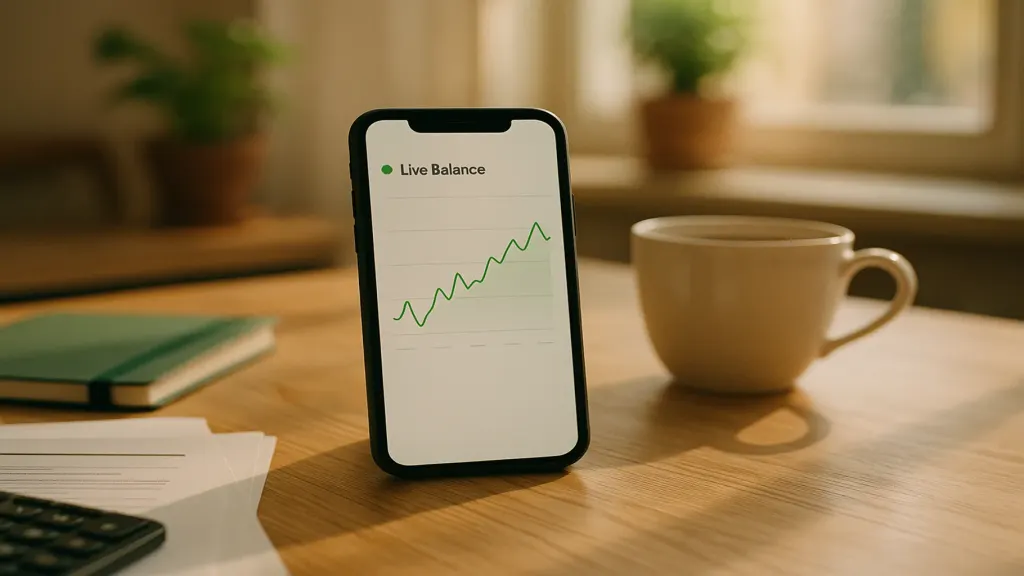
Finances in real time means that at any moment, without anyone's help, you see three things: how much money you have right now across all accounts combined, how much you'll have in the coming weeks (the forecast), and how profitability looks for your key clients and projects. Not "somewhere in a spreadsheet someone will update," but now, on your phone or laptop screen.
Condition 1. All accounts in one place
The first thing you can't have real time without is all your accounts and all your FOPs brought together into a single ledger, where transactions flow in automatically. As long as the money is scattered across several banks and statements are gathered by hand, the picture is always a few days out of date. How to bring several FOPs into one whole — in the article Agency finances with multiple FOPs, and a consolidated dashboard across accounts — here.
Condition 2. Data enters itself, not by hand
Real time is incompatible with manual entry. If someone types every transaction into a spreadsheet, the data always lags reality by the volume of "not yet entered." That's why you need bank integrations: transactions land in the ledger automatically, and the picture updates on its own. This is exactly where the line runs between Excel/Google Sheets and a proper system — see the article The agency outgrew Excel.
Condition 3. Ready-made views, not manual reports
For "real time" to be useful, you need not raw transactions but ready-made views: the balance across all accounts, a payment calendar with a forecast, profit by client. When these calculate themselves, you open the screen and see where things stand at once, instead of assembling it from scratch each time. Mobile access makes this available anywhere — your cash at hand on the go.
What this gives the owner
When finances are visible in real time, the very style of management changes. You make decisions on fresh data rather than data a month old; you catch cash gaps and unprofitable clients early; and, just as importantly, you stop depending on whether someone got around to pulling the spreadsheet together. The business becomes manageable in the moment, not in hindsight.

Where to start
Connect all your accounts into a single ledger with automatic transaction import — that alone gives you a current picture instead of an outdated one. Ready-made views by client and cash flow come next. The basic order in an agency's finances — in the article Management accounting for a marketing agency: where to start.
In Finmap, all your accounts come together in one ledger, transactions pull in from the banks on their own, and the balance, forecast, and profitability are visible in real time — from laptop and phone. Try it free for 7 days.
Share valuable content — become a source of insights




Frequently asked questions
What does it mean to see finances in real time?

At any moment, without anyone's help, seeing the balance across all accounts, a forecast for the coming weeks, and the profitability of your key clients and projects — now, on screen, not in a spreadsheet someone will update someday.
Why isn't accounting once a month enough?
Because you see problems after the fact. A cash gap or an unprofitable client are cheap to fix only while they're still ahead of you; late information means lost chances to act in time.
What do you need for real-time accounting?
All accounts in one place, automatic import of transactions from the banks (no manual entry), and ready-made views — balance, payment calendar, profit by client.
Can you have real time on Excel?
Practically no: manual entry always lags reality, and the views have to be assembled every time. Real time comes from a system with bank integrations and built-in reports.
Any questions left?
We are ready to answer them.


Finmap support