The room is full, the reviews are great, and the profit is thin. Usually the answer is on the menu: a bestseller with a 48% food cost quietly drags the whole kitchen down. Here is how to find it and fix it.
Rent out the chair for a fixed fee, or employ the master and keep the service revenue? One is stable but capped, the other has a higher ceiling and real risk. Here is the math that decides it, chair by chair.
"We have a 50% markup" — and we're working at a loss. Why a 50% markup ≠ a 50% margin, how to calculate each, and why confusing them quietly eats an agency's profit.
You agreed in dollars, but by the time the client paid, the rate had moved and the profit was gone. Where an agency's currency risk with foreign clients comes from, and how not to lose on exchange rates.

The project started out profitable, and at the end there were pennies. The most common cause is scope creep. How to keep a project within the estimate and not give your margin away for free.


You track how much you earn on a client, but do you track what it cost to win them? What CAC is, how to calculate it, and why you should only read it alongside client value.
Team swamped with work but no profit? Often the cause is low utilization: you pay for all the time but sell only half. What utilization is, how to calculate it, and what's healthy.
Revenue is growing, but the money isn't? Unit economics shows how much each client actually brings in. How to calculate it and what to do with a loss-making unit.
One account for everything is the root of an agency's financial chaos. Why you must separate personal and business money, and how to do it in three steps: account, salary, dividends.
Summer goes quiet, January budgets freeze, a big contract ends — and the month falls flat. How to predict your agency's revenue seasonality and survive the slow months without a cash gap.
An agency can be profitable and one step from disaster — all it takes is one big client paying late. How much to keep in your cash reserve, where to store it, and how to build it.
An in-house hire costs far more than their salary; a freelancer costs more than their invoice. How to count the real price of each option and when each one wins.
An unpaid invoice hits twice — your profit and your cash flow — because you've already covered the costs. How to keep it from turning into debt, what to do when payment is late, and when it's smarter to just write it off.
How much do you need to earn per month to avoid going into the red? How to calculate your agency's break-even point, translate it into clients and hours, and plan around it.
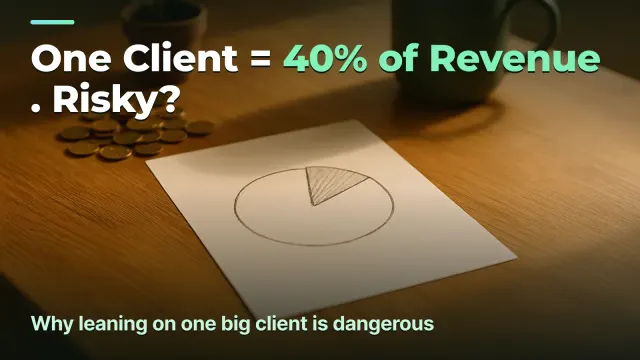
A big client bringing 40% of your revenue feels like a blessing — until they leave. Why concentrating revenue in one client is dangerous, what share is risky, and how to reduce it.
The report shows a profit, but it's nowhere to be found in your bank account. Five places where an agency's money most often "disappears" — and how to make these hidden costs visible.
Payment terms decide when the money lands and whether you hit a cash gap. Three models (upfront, on delivery, milestones), their risks, and how to pick the right one for a given project.
To grow deliberately — to hire, take a loan, launch a new service — you need a simple one-year model. Here are the four blocks it's built from and how it catches cash gaps in advance.
Only looking at the bottom line of the report? A full guide to reading an agency P&L line by line: revenue, gross and operating profit, where the margin leaks and where the profit is actually made.
A 10% discount off the price can wipe out half your profit — because your costs don't change. When discounts make sense, what to ask for in return, and how to stop working at a loss.
You have profit but nothing to pay salaries with? The complete guide to agency cash flow: why profit and cash are different things, the three flows, the payment calendar, and how to predict a cash gap.
Your prices haven't changed in years while salaries and rent have gone up — you're funding rising costs out of your own pocket. When, by how much and how to raise prices so most of your clients stay.
The question isn't "how much to charge" but "how to charge": by the hour, per project, per month, or for results. 5 pricing models for agencies — pros, cons, and how to pick yours.
Every round of revisions is team hours nobody pays for. How to calculate the cost of rework, why "free" revisions hurt you, and how to cap their scope.
Revenue-based bonuses make you pay out even on loss-making projects. What to actually base a bonus on (real project profit), how much to set aside and when to pay it, so that motivation works for profit rather than against it.
Some owners pull everything out of the business, others pay themselves nothing — both extremes come from the same mistake. How to separate the owner's salary for work from the owner's profit and set yourself a fair paycheck.
Two agencies with the same headcount can post very different profits because of one invisible metric — utilization. How to calculate it, what the healthy range is, and why a 10% drop can wipe out your entire profit.
Payroll is an agency's biggest cost, and it's what decides whether there's any profit at all. What the payroll benchmark is (40–55% of revenue), why it depends on utilization, and what to do when payroll eats up too much.
Retainers give you a stable base; one-off projects give you spikes. Run them in one pot and a big one-off month masks a weak base. Here's how to split the two flows and measure how stable your agency really is.


The money is scattered across several sole proprietors (FOPs) and accounts, and the owner can't see how much the whole agency actually earns. How to pull every FOP into one set of books, strip out internal transfers, and finally see the business as a whole.

A client pays one lump sum for several projects — or months in advance — and your analytics fall apart. How to split a payment correctly by purpose and period, so each project's profitability stays honest.
Five projects, each at a different stage, all the money in one pot — and no way to tell which one earns and which one drags you down. A four-step system to see every project on its own, even when you're running dozens.
If you roll out just one financial tool in your agency, make it the payment calendar. Here's how to build one for an agency — advances, milestones and retainers against payroll, contractors and taxes — and catch a cash gap two weeks ahead.
One month it pours, the next it's silence — but payroll is the same every month. Why planning "by the average" is dangerous, and how a date-based forecast plus a reserve carry you through the lean months without cash gaps.
You give clients payment terms, but you pay your team and contractors now — so the deferral turns into a permanent gap. How to manage receivables, shrink the gap, and fund it when net-30 is here to stay.
You're profitable, yet there's no cash for payroll — the classic cash flow gap. Four levers (advances, milestones, a cushion, a payment calendar) an agency uses to clear the gap before it happens.
Pricing off salary is the number-one reason margins stay thin. What indirect costs really are, how to work out your overhead rate, and why without it even a "profitable" project can end up at zero.
Hourly and fixed price are two different economies with different risks. Using a single example, we show how the same project yields different profit depending on the model — and how to pick the right model for the job.
A client on a modest retainer who stays for two years is worth more than a single big project. What LTV is, how to calculate it, and why it only shows its full power alongside CAC.
If a client costs more than they bring in, growth only deepens the loss. What CAC is, how to calculate the cost of acquiring a client on a worked example, and why you should read it alongside LTV.
Pricing "off the market" is dangerous — it tells you nothing about your own costs. Here's how to calculate your team's cost per hour (adjusted for billable hours) and use it to set a rate you can actually defend.
Everyone knows what a client pays; almost no one knows what they cost. How to calculate a client's full cost — team hours, contractors, overhead — and why a 15% discount can wipe out their profit.
"Are we in the black?" is the wrong question. Here are the profitability breakdowns (by project, client, service line, and over time) that actually drive agency decisions and how to read them without complex dashboards.
Total profit is the average temperature in the hospital: one line feeds the company while another quietly eats the profit for years. How to build a P&L by business line on a real example and see what you actually earn on.
The project's done, the client's happy — but you're no richer. What project margin is, why jobs slip into the red, and how to build margin into your price.
A client with an average invoice can eat up a disproportionate share of your team's time and run deep in the red. How to measure client profitability and spot the ones eating your team.
Half of your "profitable" projects are actually breaking even. What really goes into project profitability, and the 4 mistakes that only make a project look profitable.
The biggest invoice isn't the biggest profit. How to build a P&L for every client in three steps and see who feeds the agency and who quietly drags it down.
Retainers look stable until you count the hours each client eats up. How to calculate per-client margin in a PR/SMM agency and figure out who actually makes you money and who just breaks even.
High rates, solid revenue, but modest profit. Management accounting for consulting: how to measure project margin, team utilization, and stay out of cash gaps.
Money comes in big lumps, contractors do half the work, and advances and fees get tangled up. How to set up your accounting so you can see the profit on every project after all the fees.
Clients pay on their own schedule, salaries go out every month, and it's never clear whether you're actually earning or just moving money around. Three steps to get your service business finances in order and see your real margin.
Excel does the job honestly while you have two clients. Here are four signs your agency has outgrown spreadsheets, and what moving to a management accounting system actually gives you.
Clients pay in dollars while your team and taxes are in hryvnia (UAH) — and profit turns into fiction. How to run multi-currency accounting in an agency: a base currency, FX differences, and real profit, with a worked example.
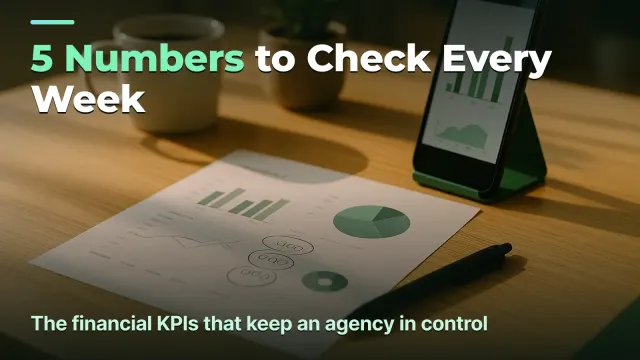
A month is too late to catch a cash gap or an unprofitable client. Five financial KPIs an agency owner reviews every week in 15 minutes to stay in control.
Google Sheets feels like the fix for scaling pains, but it's just Excel in a browser. Here's why it breaks under volume and exactly where it starts to fail an agency.
Recording the past and steering your money forward are two different things. We break down the difference between accounting and financial management — and why a digital agency needs both.
Revenue is growing, but how much you actually earn — and on what — stays a mystery. In plain language: what management accounting for an IT company really means, and the three reports that are enough to keep.
A marketing agency looks profitable — until you dig into the details. Here's how management accounting differs from financial accounting, and the three steps to get your money in order.
The client paid in dollars, but your hryvnia account shows less than you expected. Here's exactly where you lose money on conversion (spread, timing, double conversion) and how to cut those losses in half.
"There's lots of work, we need to hire" is a feeling — but a hire is a fixed commitment for months. How to treat hiring as a financial decision: full cost, payback and stable demand.
«We already have an accountant, why bother with more accounting?» — a common mix-up. Here's how management accounting differs from bookkeeping, using an IT company as an example, and why you need both.
You issue an invoice in dollars, get paid whenever, record it "however it landed" — and the profit doesn't add up. How to keep the books on invoices to foreign clients: receivables in foreign currency, the exchange rate, and payment control.
When you only see the month's results halfway through the next one, you're managing the past. What it means to see your finances in real time — and the three conditions that make it possible.
Teams often walk into a round with impressive tech but no financial model and no track record of their numbers. Here are the 7 metrics an investor will ask for at due diligence.
The team grows, salaries grow too, yet profit somehow melts away. How to figure out what share of revenue your business can actually afford to spend on people.
Manually tagging every transaction is why most owners quit financial tracking. Set up category rules once and Finmap sorts ~80% of operations by itself — here's how it works.
A budget you never compare to reality is just a wish. Plan-vs-actual is the habit that turns numbers into decisions — what to compare, how to read the gaps, and how to do it in minutes.
How big should your business safety cushion be — and how to calculate it from your real numbers. A simple formula, where to keep it, and how to build one even when cash is tight.
Dollars, hryvnias, crypto spread across a dozen accounts — and absolutely no idea what you actually have. Here's how to manage multiple currencies without losing money on conversions.
One number every business owner needs to know: how much you have to sell this month just to break even. How to calculate it in 10 minutes — and track it every single day.
The studio ran near break-even for years and had no idea why. A financial analyst uncovered the true cost of each project — and prices went up 30%. A real-numbers breakdown.
"Generally profitable" tells you nothing. Here's how to see the margin on every single project in 15 minutes — and finally know which ones are carrying your business and which ones are draining it.
Every small business owner in Ukraine says a version of the same sentence in the third or fourth year of running the business: "I don't know where the money actually goes." Not in a dramatic sense…
Every small business owner reaches a moment where "we should cut costs" becomes conventional wisdom in her own head. She can feel there's fat somewhere. She just can't point at it, and so nothing h…
Every small business owner has a moment where an adjacent product line, a new service, or a new segment feels obviously right. The customers ask for it. The team is capable. The market seems presen…
An owner of a services agency — brand and product design, 14 designers, ₴22M annual revenue, roughly 40 active clients — described the exercise that changed which clients she took on and how she pr…
How to manage finances when you work with many contractors: bring all payments and debts into one system, forecast cash flow, and decide proactively.
Instead of hours generating reports, you get full transparency of your business finances in seconds. How Finmap helped Gold Kitchen save time and money.
No matter what stage your business is at now, these 5 steps can be the start of a new quality of management.
A step-by-step guide to building a financial model for a startup or small business: forecast revenue, expenses, cash flow, and your break-even point.
How a small business can overcome a financial crisis and stabilize income in conditions where every hryvnia counts? How to optimize expenses and increase profit without using complex financial programs?