


Table of Contents

276

6 min

11.08.2026
Client Profitability: Which Client Is Eating Your Team

Olena Smolikova
Financial expert at Finmap
Every agency has a client everyone dreads. They message every day, change the brief on the fly, demand calls, and "catch fire" every Friday. Their invoice is average, but they take up a disproportionate share of the team's time. And it almost always turns out that on profitability they're deep in the red — nobody ever ran the numbers.
Let's break down how to measure client profitability and find the ones "eating" your team.
Revenue isn't profitability
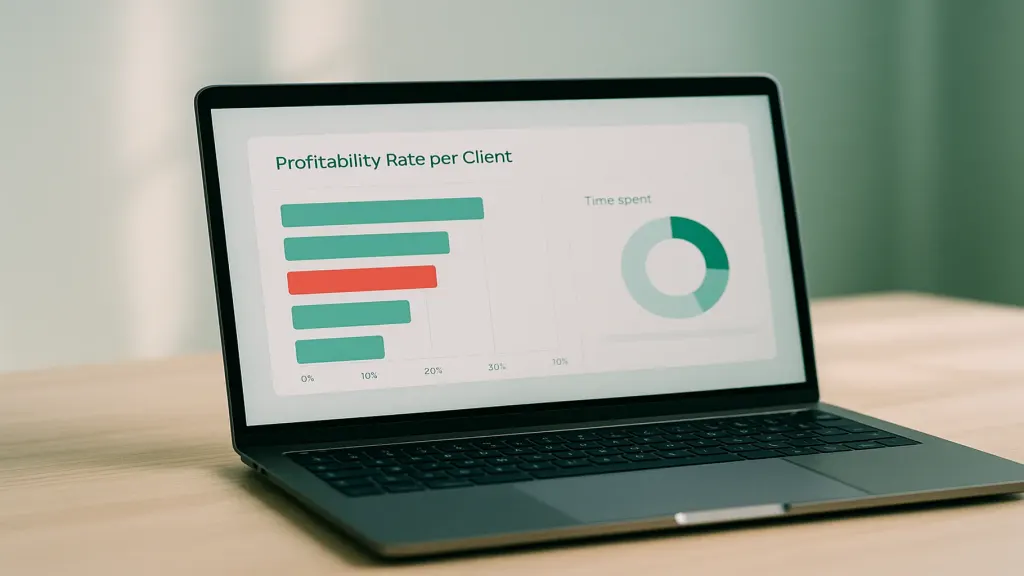
Revenue shows how much a client pays. Profitability shows how much of that is left, as a percentage, after the cost of serving them. A client paying 50,000 at 40% profitability brings in more than a client paying 100,000 at 5%. You can only see this through the profit on each one — how to build a P&L by client.

Why a big client is often unprofitable
Big clients demand more attention: more meetings, more revisions, more reports, more managing. Often they also got the biggest discount. The result: a big invoice and the lowest profitability. It's a classic — when 60% of orders are unprofitable and the business doesn't see it.
How to measure how much a client "eats" the team
The key number is team hours per client. Keep at least a rough log of time by client each month. Compare the hours with what the client pays: if the team spends 80 hours on a 30,000 retainer, that's a loss disguised as a "steady client".
What to do with "difficult" clients
There are three options: raise the price to the real cost of the work, cap the scope within the retainer, or let the client go. Often raising the price on a "difficult" client either frees up the team or finally makes them profitable. How to find profitable and unprofitable clients systematically — Client profitability: the 20% that deliver 80%.
Where to start
For one month, track team hours by client and match them against payments. You'll spot your "team eater" right away. In Finmap, client profitability is built from your transactions automatically — 7 days free.
Share valuable content — become a source of insights






FAQ
How is profitability different from profit per client?

Profit is an amount in money; profitability is that same amount as a percentage of the client's revenue. Profitability is handier for comparing clients of different sizes.
How do I count hours if the team doesn't track time?
Start with a rough monthly estimate: roughly how much time goes into each client. Even that reveals the "team eaters". From there you can roll out more precise tracking.
What if the unprofitable client is the biggest one by invoice?
Don't keep them "for the sake of revenue". Try raising the price or capping the scope. If that doesn't work, they're tying up a resource that could go to profitable clients.
Any questions left?
We are ready to answer them.


Finmap support