

Table of Contents

267

10 min

21.09.2026
Tool and Equipment Rental: Profit Per Unit and Real Utilization

Olena Smolikova
Financial expert at Finmap
«I have 240 units in the rental fleet: hammer drills, cement mixers, scaffolding, plate compactors, generators. It comes to around ₴380,000 a month. And at month-end there's forty-five thousand of free cash. That's with about three million worth of kit sitting in the warehouse. I buy more — the money doesn't grow» — that's how Vitalii, the owner of a construction equipment rental business, opened our conversation.
Sound familiar? The warehouse is full, gear goes out and comes back, the phone rings from first thing in the morning, and in season there aren't enough hands to hand it all out. It looks like a business turning over nicely. Yet when you sit down to count what's actually yours, the number is laughable. And the first thought is always the same: «I need to buy more lines, then turnover will catch up.»
The trouble is that rental gets counted as a single pot: everything clients pay goes into one cauldron, and all the repairs, consumables, wages and warehouse rent come out of the same one. While the numbers are blended, you can't see one simple thing: one hammer drill brought you three times its purchase price this year, while the ₴60,000 generator next to it went out four times and still hasn't paid for itself.
This article is about breaking a rental business into individual units: how many days each one worked, what it brought in, and when it returned the money you put into it. Because in rental you don't earn on the number of lines you stock — you earn on how many days each of them is actually with a customer.
The Founder's Path: From One Hammer Drill to 240 Units
Vitalii started out as a builder. He bought tools for himself, and the crews on neighbouring sites were forever asking to «borrow it for a day.» Then strangers started asking, and he realised there was more money in that than in building.
The first real rental operation was a garage, ten lines and an ad on a local forum. After that it moved fast: plate compactors, scaffolding, generators, cement mixers, towers, heaters. Six years on: a rented warehouse, two counter staff, a delivery van and 240 units of equipment.
And somewhere around the hundredth line, the simple «hand it out, take the money» arithmetic stopped working. Plenty of kit, money coming in, and never enough free cash: a repair here, a purchase there, then the season ends. Vitalii had a hire log, a notebook of repairs and a bank app. Three sources with the profit vanishing somewhere between them.
«I thought my whole warehouse was working. When we counted it unit by unit, two thirds of the money turned out to be sitting in gear that goes out once a month.»
How Money Actually Works in Equipment Rental
Before we get to what Vitalii changed, let's break down what a rental business's profit is made of. Because this is exactly where the money that «disappears» gets lost.
What You Sell Isn't Equipment, It's Days
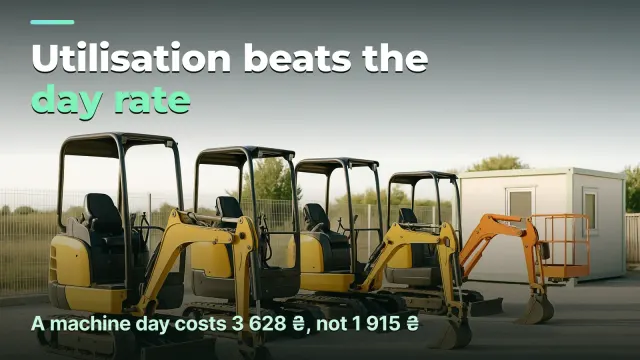
In rental you don't sell a tool, you sell the time someone uses it. Your unit of sale is one piece of kit for one day. And the entire economics of the business hides in those days.
Take a hammer drill. It cost ₴12,000 and rents for ₴350 a day. If it's out 18 days a month, that's ₴6,300 coming in and it has paid for itself in two months. If it's out 4 days, that's ₴1,400, and payback stretches across a year in which it will wear out anyway.
The equipment itself brings in nothing. The days it spends with a customer do. This is plain unit economics, and we covered it separately — how to calculate unit economics for a small business.
Utilization: The Key Number That's Usually Missing
Utilization is the share of days a unit was out on hire. A drill working 18 days out of 30 runs at 60%. A generator that went out four times runs at 13%.
Compare two lines. A ₴45,000 plate compactor at 55% utilization brings in roughly ₴130,000 a year — nearly three times its cost. A ₴45,000 heater at 8% utilization brings in ₴20,000 a year, while taking up warehouse space and needing a service after every season.
In the log both look identical — «available.» But the first one feeds the business while the second quietly holds your money. So the real question in rental isn't «what else should I buy,» it's which lines are worth buying because they can't come back fast enough.
I wasn't short of equipment. I was short of the specific equipment people kept asking for — the kind I never bought, because my money was sitting in the gear gathering dust.
Repairs and Consumables: The True Cost of a Rental Day
Rental equipment lives a harder life than your own: nobody looks after someone else's kit. Bits go blunt, bags tear, hoses crack, generators come back without oil. All of that is a normal part of the business — what isn't normal is leaving it out of the day rate.
An honest cost per rental day includes not just depreciation (price divided by expected life in days) but the average cost of upkeep: oil, filters, belts, wheels, replacing worn parts, plus the counter staff's time checking and cleaning after every return.
When those costs live as one general «repairs and consumables» line, you only see the total. In reality half of it lands on three «favourite» lines that should have been replaced long ago — or priced higher.
Deposits and Damage: Money That's Easy to Lose in Small Pieces
A deposit isn't income, it's somebody else's money temporarily sitting with you. If you don't keep it separate in your books, it creates the illusion of cash: the balance looks healthy, but half of it has to go back to customers.
The second half of that story is damage. A customer brings back a grinder with a cracked housing, you take ₴500 «for the repair,» and the repair comes to ₴2,200. Over a year those small gaps add up to a sum no report ever shows, because it's smeared across dozens of transactions.
Seasonality: A Flood in Summer, the Same Rent in Winter
Construction rental lives on the season. From April to October it's a flood: the shelves are stripped and you're turning customers away. From November to March demand drops several times over, while the warehouse, the counter staff, the van and the loan payments stay exactly the same.
Count month by month and summer looks brilliant while winter looks terminal. In reality it's one annual cycle, and it has to be planned as a whole: set aside in season what will be eaten in winter. We covered the mechanism separately in our piece on planning cash in a seasonal business.
Buying New Lines: The Most Expensive Decision in This Business
Every new unit is frozen cash. A buying mistake costs more here than almost anywhere: an unpopular line doesn't merely fail to earn, it also takes up space and demands servicing.
Most of the time equipment gets bought on a feeling: «people asked a few times,» «the competition has one,» «the price was good.» The decision should come from numbers instead: how many times you had to turn that request down, what utilization similar units run at, and how many months it will take to pay back at a realistic load.
Life Before Finmap
Before he put things in order, Vitalii lived roughly like this. He recognises these lines himself — and you might too.
- «Turnover grows, there's more kit, and free cash stays the same. Where it goes, I don't know.»
- «Which line earns and which one just sits — I can only tell you by feel.»
- «Repairs eat a lot, but what exactly they go on, I don't track separately.»
- «Every winter I plug holes with money set aside from who knows where.»
- «I bought the generators because everyone was asking. They go out once a month.»
Every one of these lines is about the same thing: the business is measured by total turnover instead of profit and utilization per unit. The moment you break the numbers apart, the picture becomes almost uncomfortably clear.
How Vitalii Put Things in Order
The turning point was mundane: at the height of the season he didn't have the cash to buy four plate compactors that were being snapped up instantly — while three million worth of equipment sat in the warehouse. Vitalii sat down and realised he wasn't poor, his money was simply parked in the wrong lines. What he needed wasn't «buy more,» it was a clear view of what to cut, what to keep and what to increase.
That's how he came to Finmap. The brief was simple: see income by equipment group, track repairs separately, and understand how much cash is genuinely free for buying. Setting it up took a couple of evenings.
- Every equipment group is its own line of business. Income and costs are tied to a category — and for expensive items, to the specific machine.
- Bank integration and auto-import. Customer payments and outgoing transfers pull in automatically — nothing to key in by hand.
- Deposits kept apart from income. Other people's money no longer creates an illusion of profit.
- Repairs by category. You can see which kit swallows the most servicing and where the day rate no longer covers wear.
- Payment calendar. Warehouse rent, wages, loans and purchases laid out in advance — the winter trough is visible back in summer.
What Vitalii particularly liked is that Finmap speaks the owner's language rather than the accountant's: not «trial balance,» but «this equipment group yields 62% margin and that one yields 9%.» And that the AI adviser flags the odd stuff by itself: «generator repair costs exceeded generator income for the quarter.»
It turned out I'd spent years buying whatever people asked for loudest, rather than what they actually hired most.
The Finances Now
In five months with Finmap, Vitalii didn't grow the warehouse — he sold part of the fleet. And net profit, on the same turnover, more than doubled. Here's what changed.
| Metric | Before Finmap | After 5 months |
|---|---|---|
| Income by line | «roughly average» | visible per equipment group |
| Average utilization | about 31% | 48% |
| Cash tied up in equipment | ~₴3,000,000 | ~₴2,500,000 |
| Net profit / month | ~₴45,000 | ~₴100,000 |
How did he get there? He sold the lines running below 10% utilization and used the proceeds to buy what was chronically short in season. He raised the rate on the equipment with the most expensive upkeep. He introduced proper deposits and an inspection sheet on return. And he started budgeting for winter during the summer instead of hunting for money in February.
An insight for business owners. In rental, profit hides not in how many lines sit in the warehouse but in how hard each one works. Two rental businesses with identical stock can differ twofold in profit — and the whole difference is that one knows how many days each unit works while the other only watches total turnover.
A Few Closing Tips
- Measure income per unit of equipment, not for the rental business as a whole.
- Track utilization: how many days a month a line is genuinely with a customer.
- Know the payback on every expensive machine — and the date it reached it.
- Build upkeep and wear into the day rate, not just depreciation.
- Keep deposits separate from income so you don't mistake other people's money for yours.
- Buy new lines based on refused requests and utilization figures, not a feeling about demand.
Money Doesn't Disappear. You Just Don't See It.
Money in a rental business doesn't evaporate. It sits on the shelves as equipment that once looked like a smart purchase, and dissolves into repairs, idle units and winter months while you watch total turnover. The moment you break it down per unit, you can see what feeds the warehouse and what merely gathers dust.
You don't need more equipment. You need to see which unit actually brings in money and how fast it returns what you spent — and to have the kind of order in your finances where that's visible every day, not guessed at once a year.
Try looking at your rental business in a new way — and within the first month you'll see what feeds you and what is quietly eating you.
Share valuable content — become a source of insights




Frequently Asked Questions
How do I calculate the profit of a single piece of equipment?

Take everything that line brought in over the period and subtract its direct costs: servicing and repairs, consumables, depreciation (price divided by expected life) and the counter time spent checking it after each return. Compare the result against what the equipment cost — that tells you whether it has paid for itself or is still holding your money.
What is utilization in an equipment rental business?
It's the share of days a unit was out on hire out of all the days in the period. A drill that worked 18 days out of 30 runs at 60% utilization. That figure, not the number of lines in your warehouse, drives profit: storage and upkeep costs run continuously, while equipment only earns on the days it's with a customer.
How should deposits be recorded?
Separately from income. A deposit is someone else's money sitting with you temporarily and it must not land in profit. Record it as a liability, and post any damage deduction as its own transaction at the real repair cost rather than a rough guess.
How do I survive the winter trough in a seasonal rental business?
Plan the year as a whole. Work out what your dead months cost — warehouse rent, permanent wages, loan payments — and set that sum aside separately during the peak. A payment calendar a few months out shows the trough while it's still summer, so in winter you're spending planned money instead of hunting for it.
How long does it take to set a rental business up in Finmap?
A couple of evenings, essentially: connect the bank for auto-import, set equipment groups up as separate lines of business (and expensive units as their own projects), separate deposits, and define expense categories (repairs, consumables, delivery, warehouse). After that it's seconds per transaction. Within the first month you'll see which lines earn and which ones are holding your cash.
Any questions left?
We are ready to answer them.


Finmap support