



Table of Contents
The orders are coming in. The team is flat out. You raised prices, you're busier than last year — and somehow the account is still tight at the end of every month. "We're growing, so where's the money?" you ask yourself. Or worse: "I don't actually know if this product makes a profit, or just moves cash around and keeps everyone busy."
If that's you, the problem usually isn't your total revenue. It's the economics of a single sale. Because here's the uncomfortable truth about growth: if one unit loses money, selling more of them doesn't dig you out — it digs the hole faster, with more effort and more stress. Unit economics is the math that tells you which one you've got: a profit machine that gets better with scale, or a treadmill that runs faster the harder you push. This guide covers the handful of numbers that decide it, how to calculate them on one page without an accounting background, and how to see them per product and per client so pricing stops being a guess.
The one question unit economics answers
Strip away the jargon and unit economics asks one blunt thing: when you sell one more unit, are you better off or worse off?
First, pick your "unit" — whatever you can count and put a price on:
- A product business: one item sold.
- A service or agency: one project, or one billable hour.
- A subscription: one active customer per month.
- A café or shop: one average check.
Everything else — total revenue, headcount, the office, your own salary — is a story built on top of that single unit. Get the unit right and every extra sale makes you richer. Get it wrong and no amount of marketing, hustle or "we'll make it up on volume" will save you. Volume is a multiplier; it multiplies losses just as happily as profits.
The five numbers that decide everything
You only need a few, and they stack on each other. Learn these and you can diagnose almost any "busy but broke" business:
- Price — what the customer actually pays, after discounts and promos. Not your list price. The real one.
- Variable cost per unit — everything that grows with each sale: materials, packaging, delivery, payment-processor fees, the contractor paid per project, the ad spend it took to win that specific sale. If a cost goes up when you sell one more, it belongs here.
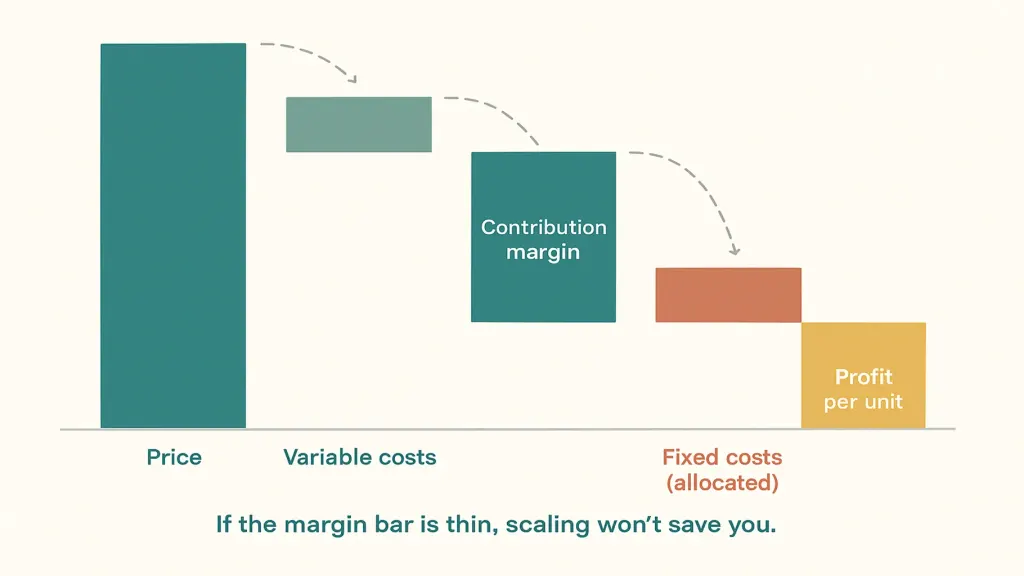
- Contribution margin — price minus variable cost. This is what one sale contributes toward covering your fixed costs, and after that, profit. It is the single most important number in this whole article. Learn to see it and half your pricing questions answer themselves.
- CAC (Customer Acquisition Cost) — what you spend on marketing and sales to win one customer.
- LTV (Lifetime Value) — the total contribution margin one customer brings over the whole relationship, not just the first order.
Two relationships matter, and they're both simple:
- Contribution margin must be positive. If a sale doesn't even cover its own variable costs, you lose money on every single one — and scaling is just a faster way to lose it.
- LTV must comfortably beat CAC. A common rule of thumb is LTV at least three times CAC. If you pay more to win a customer than they'll ever contribute back, growth is the quickest route to the wall.
What "broken unit economics" looks like in real life
These aren't textbook cases. They're the everyday ways owners fool themselves with a healthy-looking top line:
- An online store proudly reports a "30% margin". Then you count the returns, the payment fees, the free-shipping promo and the ad spend that drove the order — and the real contribution margin is in single digits. The bank balance was telling the truth the report was hiding. On a ₴1,000 order, "₴300 margin" quietly becomes ₴70.
- An agency prices a project on gut feel — ₴80,000, "sounds right". Once you count the contractor, three rounds of revisions and the manager's hours, half the "profitable" projects are actually underwater. The busy months feel productive and end poor.
- A subscription business celebrates record signups while CAC creeps up with every campaign. Nobody notices the month CAC quietly passes LTV — and now every new "win" costs more than that customer will ever pay back.
None of these owners are careless. They're steering by total revenue instead of per-unit margin. And total revenue can rise beautifully while every single sale bleeds.
How to calculate your unit economics
You can do this on one page, in an afternoon, with numbers you already have.
1. Define one unit and its real price. Use the average price customers actually pay after discounts — not the number on the price list.
2. List every variable cost for that unit. Be honest and be complete: materials, packaging, delivery, payment-processor fees, per-sale ad spend, contractors paid per job. The temptation is to leave out the "small" ones. The small ones are usually where the margin went.
3. Contribution margin = price − variable cost. In money and as a percentage. This is your per-sale engine. If it's thin or negative, stop and fix this before you spend another hryvnia on growth.
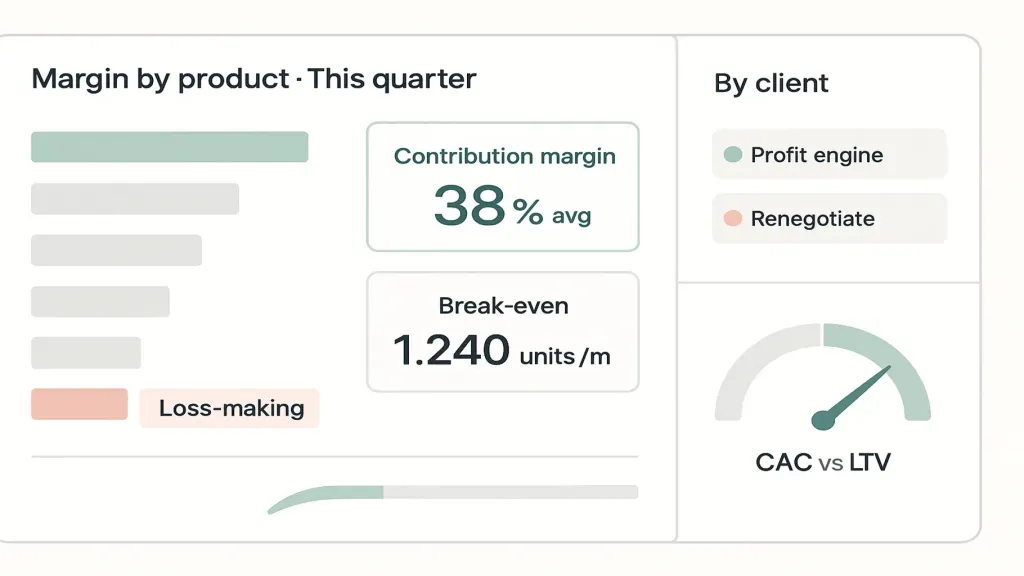
4. Cover your fixed costs to find break-even. Divide monthly fixed costs (rent, salaries, subscriptions) by contribution margin per unit. That's how many units you must sell each month before you earn your first hryvnia of profit. If break-even is 1,200 units and you sell 900, no marketing tweak fixes that — the unit or the price has to change.
5. Compare CAC and LTV. Marketing spend ÷ new customers = CAC. Contribution margin × how long an average customer stays = LTV. Put them side by side. If LTV isn't comfortably above CAC, you're buying customers at a loss.
The moment you can see contribution margin per product and per client, the hard decisions get easy: which product to push, which discount to kill, which client to renegotiate or let go. A tool like Finmap lets you tag income and costs by product, project and client, so the margin of each unit is a number you read on a screen — not a number you hope is fine.
How it differs by type of business
The framework is the same; what counts as a "variable cost" and where margin leaks changes:
| Type of business | The "unit" | Where margin quietly leaks |
|---|---|---|
| E-commerce / retail | One order | Returns, payment fees, shipping, per-order ad spend |
| Agency / services | One project or hour | Unbilled revisions, contractor cost, manager time |
| Manufacturing | One product made | Materials waste, rework, under-counted labour |
| Subscription / SaaS | One customer / month | Churn, refunds, rising CAC, support cost |
| Café / food | One average check | Ingredient waste, staff on slow shifts, discounts |
In every row the fix is the same shape: count all the variable costs honestly, protect the contribution margin, and never let CAC outrun LTV.
The three most expensive mistakes
- Counting gross margin, not contribution margin. Leaving out fees, returns and per-sale ad spend makes a losing unit look like a winner — until the bank balance disagrees.
- One blended average for everything. Your best product silently subsidises a loss-maker and you never see it — until you "cut costs" by dropping the winner.
- Chasing revenue while CAC creeps past LTV. More sales, less money, more stress. The classic growth trap, and the one that kills the most ambitious small businesses.
📌 Stop guessing which sales actually make money. In Finmap you can tag income and costs by product, project and client — so contribution margin per unit is a number you see, not a number you assume. Find your loss-makers before they find your bank account. Set it up in about 20 minutes.
In this topic
- LTV and CAC for a Small Business: The Two Numbers Every Owner Should Be Able to Compute in 30 Minutes
- Client Profitability: How to Find the 20% of Clients Who Actually Generate 80% of Your Profit
- 4,800 Covers, ₴47K Loss: Why Restaurants Can't Feel Their Break-Even Point
- Where the Profit Hides in a Small Production Business: COGS Isn't What You Think, and WIP Is Eating Your Cash
- The Report Said 30% Margin. The Bank Said Otherwise. Here's Where E-commerce Margin Actually Goes.
- 20 Developers, an Hourly Rate, and No Idea What the Project Actually Made
Share valuable content — become a source of insights






Frequently Asked Questions
What is unit economics in simple terms?

It's the profit math of a single unit — one product, order, client or subscription. If one unit makes money after its own variable costs, selling more makes you richer. If it loses money, scaling just loses money faster. Fix the unit and you fix the business.
What is contribution margin?
Contribution margin is the price of one unit minus the variable costs of that unit. It's what each sale contributes toward covering fixed costs and then profit. It must be positive — if a sale doesn't cover its own variable costs, you lose money on every one.
What's the difference between CAC and LTV?
CAC is what you spend to acquire one customer; LTV is the total contribution margin that customer brings over the whole relationship. Healthy unit economics usually means LTV is at least three times CAC — otherwise you're paying more to win customers than they'll ever pay you back.
How do I find my break-even point?
Divide your monthly fixed costs by the contribution margin per unit. The result is how many units you must sell each month before you start making a profit. If that number is far above what you actually sell, the price or the unit cost has to change — marketing alone won't close the gap.
Why is my business growing but not profitable?
Almost always because the unit is broken: contribution margin is thin or negative once you count every variable cost, or CAC has climbed above LTV. Total revenue rises while each sale loses money, so more effort produces less profit. Fixing the unit — price, cost, or which customers you chase — fixes the profit.
Any questions left?
We are ready to answer them.


Finmap support