



Table of Contents
Home
/
Blog
/
Expense Analysis: The Four-Step Procedure That Tells You What to Cut, What to Keep, and What to Increase

788

5 min

07.07.2026
Expense Analysis: The Four-Step Procedure That Tells You What to Cut, What to Keep, and What to Increase

Olena Smolikova
Financial expert at Finmap
"I knew there was fat somewhere. I just didn't know where to cut. Every category felt necessary until I sat down and forced myself to sort them into four boxes."
Every small business owner reaches a moment where "we should cut costs" becomes conventional wisdom in her own head. She can feel there's fat somewhere. She just can't point at it, and so nothing happens — or the wrong things get cut in a panic.
This article is the four-step procedure that separates costs into four honest categories: what to CUT, what to REDUCE, what to KEEP, and — the category most owners never use — what to INCREASE. Yes, increase. Some of your costs are underinvested, and finding them matters as much as finding the fat.
Why This Problem Occurs
One — everything looks necessary in isolation. Line by line, every expense has a reason. Cutting requires stepping back and looking at the whole surface at once.
Two — the emotional cost of cutting is unequal. Team-related costs feel harder to touch than software subscriptions, even when the software is more expensive.
Three — nobody teaches you to look for underinvestment. Cost analysis is presented as pure cutting. In reality, some of your best moves are to increase spend on categories that are creating disproportionate returns.
Four — the analysis becomes a monolithic project instead of a habit. Owners think they need a two-week audit. What they need is a two-hour quarterly practice.
How to Recognise You Need This
- You've said "we should cut costs" three times this year and nothing changed.
- You cut something in a panic six months ago and now can't remember why.
- You feel like you're spending more than you're getting back but can't point at where.
- Your accountant produces expense categories monthly but you never act on them.
How to Solve It — The Four-Step Procedure
Set aside one focused evening. Coffee, printed expense summary from the last 6 months, three markers (coral, amber, sage) plus one teal for INCREASE.
Step 1 — List everything, group into 15–20 categories. Not 100 line items. Not 5 buckets. About 15–20 categories that cover 100% of monthly spend. Rent. Salaries by role type. Software. Marketing by channel. Professional services. Supplies. Etc. Print or write them out.
Step 2 — For each category, answer three questions.
- What does this cost me per month? (You know this.)
- What am I getting from it? (Written in one sentence.)
- Would I start paying for it today if it didn't already exist? (Honest yes/no.)
The third question is the analysis. It cuts through inertia. Most subscriptions and services fail it once asked.
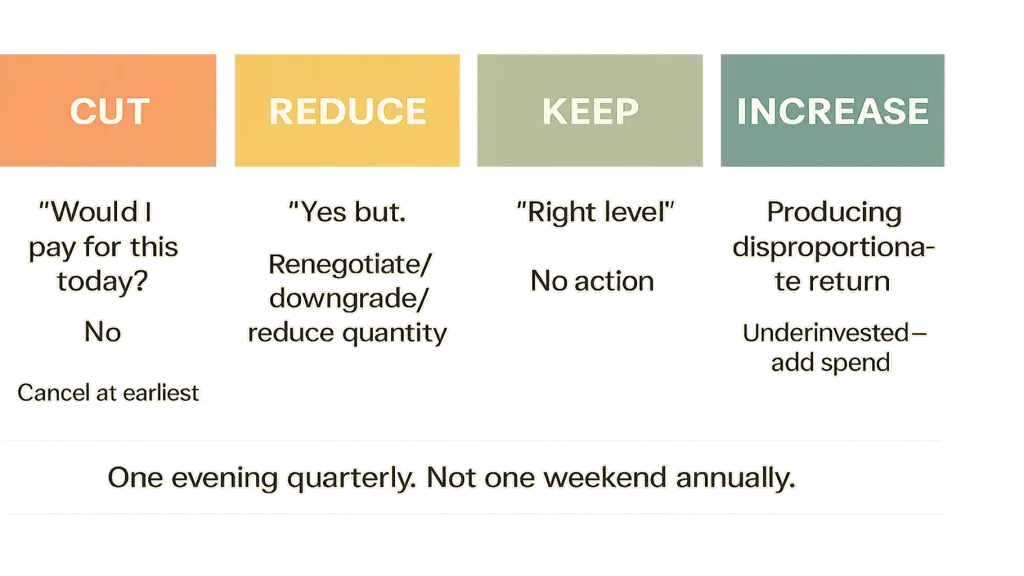
Step 3 — Sort into four boxes — CUT, REDUCE, KEEP, INCREASE.
- CUT — categories where the honest answer to Q3 is no. Cancel/end at earliest opportunity.
- REDUCE — categories that pass the yes bar but at a lower level than you're paying now. Renegotiate, downgrade, or reduce quantity.
- KEEP — categories at the right level. No action.
- INCREASE — categories delivering disproportionate returns. Underinvested. Add spend.
Step 4 — Write actions with dates. Not "we'll cut X". "Cancel Y by the 15th". "Renegotiate Z at next renewal, target −20%". "Increase paid-search budget by ₴30K starting next month". Actions without dates don't happen.
A platform like Finmap categorises actual spend automatically and shows month-over-month drift by category — so the quarterly audit takes 90 minutes instead of a weekend.
What the Four Categories Actually Look Like
For a real ₴14M services business the owner ran through:
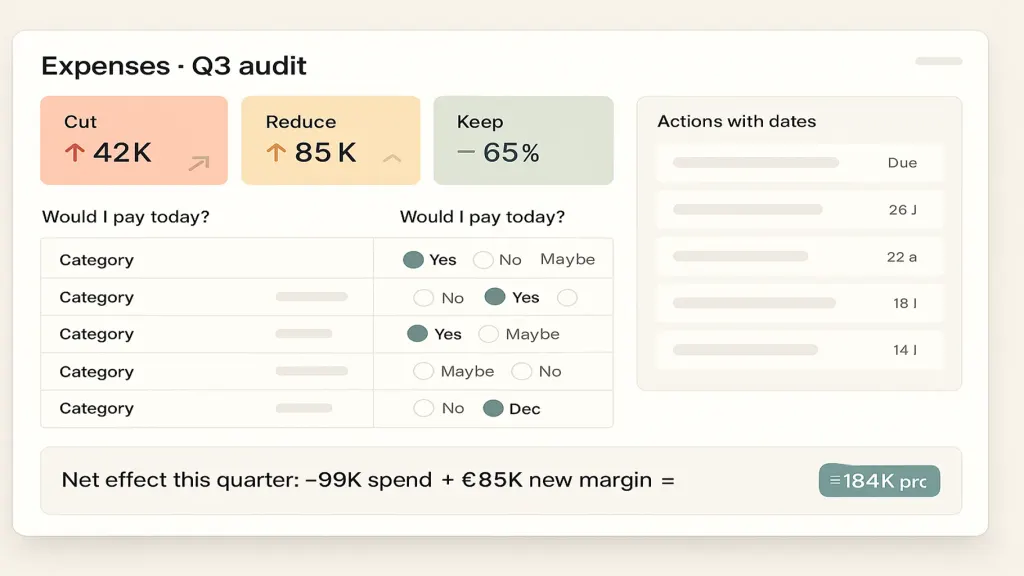
- CUT (₴42K/month total). Three unused SaaS subscriptions. A marketing consultant who hadn't delivered value in 6 months. A legal retainer overlapping with a lawyer already used ad hoc.
- REDUCE (₴85K/month savings). Rent renegotiated (5% down at renewal). Cloud infrastructure right-sized. Two contract roles moved from full-time to project-based.
- KEEP (~65% of total spend). Salaries at current level. Core software stack. Compliance costs.
- INCREASE (+₴28K/month). Paid search producing 3× the return per hryvnia of the previous best channel. Two more hours a month with the outsourced finance director whose input had been paying back 4-5×.
Net effect: monthly cost dropped by ~₴99K. Two "increases" produced ~₴85K/month of new margin within three months. Total quarterly improvement in profitability ~₴550K annualised.
The Discipline
Do this quarterly, not annually. Costs drift monthly; catching drift quarterly is much cheaper than annual overhauls.
Do it as a habit, not a project. Two hours per quarter is much less painful than a weekend once a year.
Include INCREASE deliberately. Cost analysis with only three colours (cut/reduce/keep) is incomplete. The most valuable moves often live in the fourth.
Three Common Mistakes
- Only cutting, never increasing. Half the value of the audit lives in the INCREASE column.
- Cutting team-related costs first. Salaries feel like the biggest number so they attract cuts. Usually the wrong target — software and subscriptions offer larger, easier savings.
- Doing this once a year. Twelve months of drift is much harder to unpick than three months. Quarterly is the cadence.
📌 See your expenses categorised, drift-tracked month-over-month, and ready for the quarterly cut/reduce/keep/increase decision — free for 14 days. No card required. Start your free 14-day Finmap trial → finmap.online/ua
Read also
Share valuable content — become a source of insights






Frequently Asked Questions
How is INCREASE different from just spending more?

It's a considered increase on categories with evidence of disproportionate return. Not enthusiasm; evidence.
What if I can't answer the third question honestly for team-related costs?
That's usually a signal to look at role clarity rather than the salary itself. The cost isn't the problem; the return is unclear.
Do I share the analysis with the team?
The CUT and INCREASE conclusions, yes (with reasoning). The full audit is usually owner + one finance advisor.
Should I do this before or after the annual budget?
Before. The audit informs what next year's budget should actually contain.
How is this different from cost cutting?
Cost cutting is one of four possible actions. The audit is the framework that decides which action for which cost.
Any questions left?
We are ready to answer them.


Finmap support