

Table of Contents

406

6 min

11.08.2026
Project margin: how to stop losing money on client work

Olena Smolikova
Financial expert at Finmap
Every agency has taken on at least one job that ended up losing money. Usually you notice too late: the project's closed, the client's happy, and yet somehow there's no more cash. The reason is always the same — the price didn't include real margin, and the project ate itself.
Let's break down what project margin is and how to stop losing money on client work.
What project margin is
Project margin is how much is left from the client's payment after all direct costs: team hours, contractors, services. It's the number that tells you whether the job was worth taking. For how to calculate project profitability without mistakes, see Project profitability: how to count it right.
Why projects go into the red
Most often it's not the low price but the underestimated work. You sold the project as a fixed fee based on 100 hours, and it took 180: revisions, scope changes, "just one more little thing." Without built-in margin and control, every one of those hours eats into your profit. A classic example — 20 developers, an hourly rate, and no idea how much the project actually earned.
How to build margin into your price
Price from cost, not "from the market": hours times your hourly cost plus contractors, and margin on top. If the real cost of the project is 120K and you sold it for 130K, any overrun is already a loss. With a 30–40% margin built in, you have a buffer for revisions and risks.
Tracking margin during the project
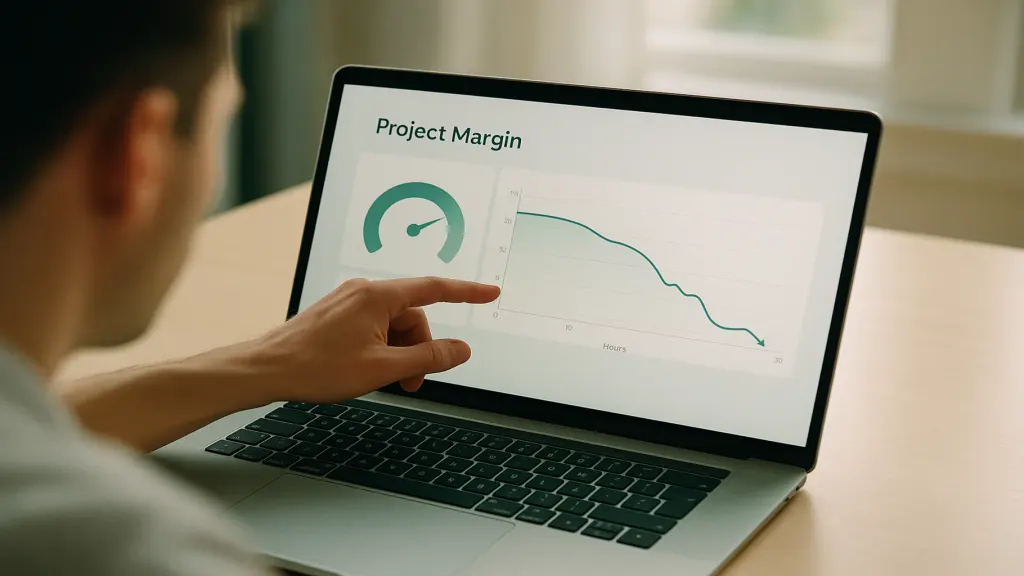
You need to see margin during the project, not after. If you track hours as the work goes, you catch the moment it starts to "burn" and can stop or renegotiate with the client. Without that, the loss only shows up after the fact.
Where to start
Before your next job, calculate its real cost in hours and add margin on top. For current projects, start logging hours so you can see which ones are already in the risk zone. In Finmap, project margin is calculated from your transactions automatically — try it free for 7 days.
Share valuable content — become a source of insights






Frequently asked questions
What margin should I build into a project?

It depends on the risk and the market, but 30–40% on top of cost gives you a buffer for revisions and overruns. The more uncertainty in the brief, the bigger the buffer.
How do I avoid losing money on a fixed-price project?
Calculate the cost in hours before you start, build in margin, and track hours as you go. Log scope changes separately — they're grounds for extra payment.
What do I do if a project is already in the red?
Stop the uncontrolled revisions, review the scope with the client, and record the lessons for next time: exactly where you underestimated. One honestly costed loss-making project saves you a dozen future ones.
Any questions left?
We are ready to answer them.


Finmap support