

Table of Contents

932

6 min

08.07.2026
AI Assistant in Business Finance: What It Actually Means for a Small Business Owner
.avif)
Oleksandr Solovei
CEO & Co-founder Finmap
"Every conference this year had 'AI' in the title. Every second post on LinkedIn had 'AI' in it. I still had no idea what it changes for me on a Tuesday morning when I'm trying to decide whether to hire a designer. Show me that, and I'll believe."
Every small business owner in Ukraine hears "AI" somewhere between five and fifty times a week. Most of it lands as noise. What's genuinely different for the owner running a services agency, a small retail chain, a HoReCa business, or a construction company is much narrower — and much more practical — than the noise suggests.
This article is not about AI in general. It's about what an AI assistant inside a finance platform actually does for a small business owner on a Tuesday morning. What she can ask. What comes back. Where it saves her time. Where it doesn't replace her. And what "5 agents = your second brain" actually looks like when you open the app.
Why the Word "AI" Feels Empty for Small Business Owners
One — most descriptions are about the technology, not the moment. Whether it's transformer-this or LLM-that, the language stays technical while the owner is trying to answer "will there be enough cash on the 5th?"
Two — enterprise use-cases dominate the marketing. Fortune 500 features and dashboards don't map to a business with three bank accounts and one bookkeeper part-time.
Three — the "AI-bot" framing feels toy-like. "Chat with your data" sounds like a party trick. The genuine value is quieter: fewer things fall through, decisions arrive with the numbers already attached.
Four — the outcomes are rarely spelled out. Owners want to know: what changes on Tuesday? What was I doing that I stop doing? What was I missing that I now catch? Without that, "AI" stays abstract.
How to Recognise You'd Benefit From This
- You spend more than 20 minutes a week compiling numbers before you can use them.
- You've been surprised in the last three months by a payment that shouldn't have surprised you.
- You'd ask your finance data more questions if the answers didn't require a spreadsheet detour.
- You want a second opinion on trends before you act — and don't want to wait for a monthly call.
What "5 Agents = Your Second Brain" Actually Looks Like
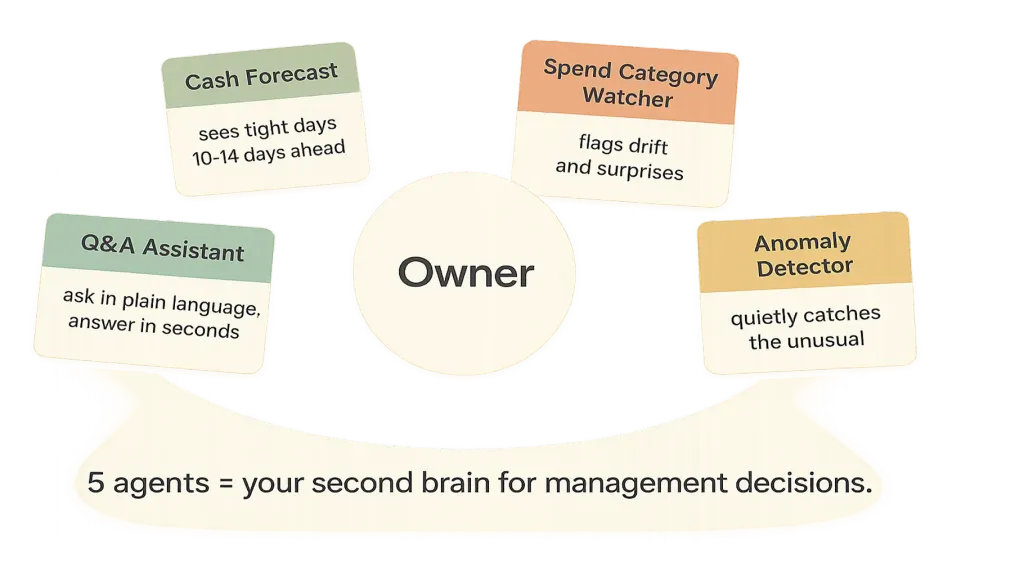
Finmap's AI layer is organised as five specialised agents, each with a clear job. They don't replace judgement — they replace the moments where judgement was starved of data.
Agent 1 — Cash Forecast. Watches your bank connections, invoices, and committed outflows. Rebuilds the 30–60 day cash projection whenever something changes. Flags tight days 10–14 days in advance, with a specific reason ("Client A invoice aging, salaries on 5th, tax on 20th converging"). No guessing.
Agent 2 — Spend Category Watcher. Sees every operation as it lands. Categorises it. Watches categories over time. When something drifts unusually — marketing +30% two months in a row, a supplier suddenly billing more frequently, a subscription renewing at a higher price — it flags. You look, you decide.
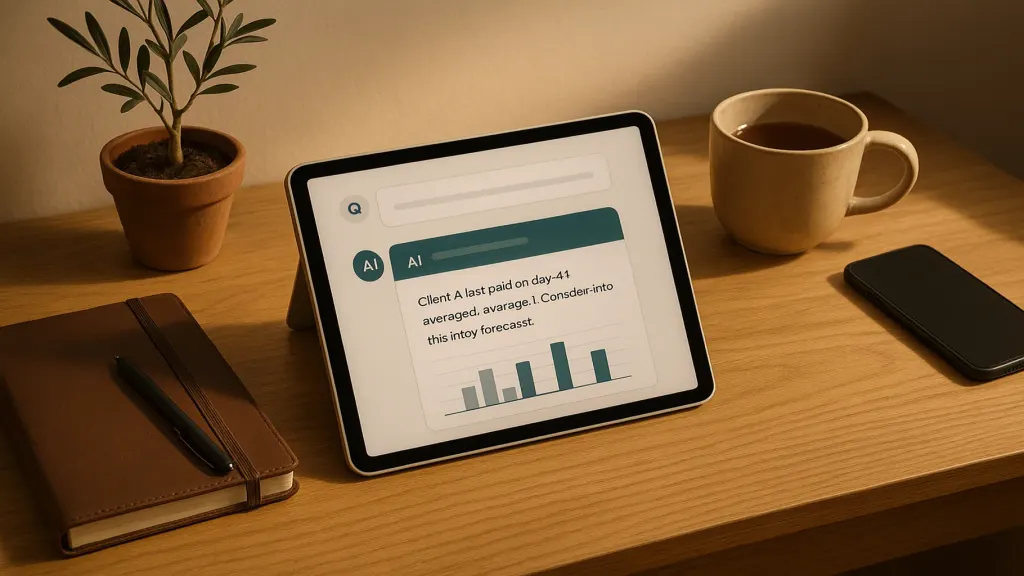
Agent 3 — Payment Predictor. Learns from your history when each client tends to pay. When a client pays 40 days late by average, the forecast reflects that instead of assuming the 30-day term. When a supplier tends to invoice on the 5th, the agent expects it. This is where "confidence tags" become automatic.
Agent 4 — Anomaly Detector. Silent by design. It watches for the operations that look unusual — duplicate payments, categories that don't match the vendor's history, sums that break the pattern. It surfaces only what's worth a second look — not everything, not noise.
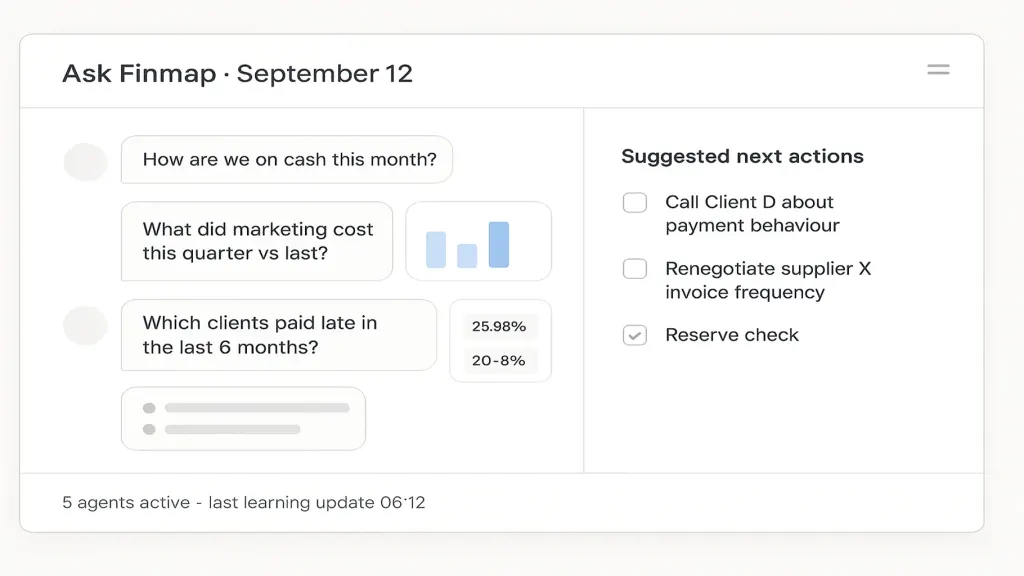
Agent 5 — Q&A Assistant. The one everyone thinks of first. Ask in plain language — "how much did marketing cost me this quarter compared to last?", "which clients paid late in the last 6 months?", "what's my real margin on Client A?" — and get an answer from your actual data in seconds. No SQL, no filters, no Excel formulas.
Together, the five agents cover the ground where a full-time finance analyst would live in a bigger company — and give the small business owner a version of that support at small business scale.
What the Assistant Doesn't Do
Just as important as what it does.
- It doesn't make decisions for you. The five agents surface things and answer things. You still decide whether to renegotiate the supplier, drop the client, hire the designer, or hold on the launch. That authority stays with the owner where it belongs.
- It doesn't replace your accountant. Legal compliance, tax filings, formal statements — the accountant's territory. The AI layer lives in operational finance: cash, spend, forecasts, patterns.
- It doesn't invent numbers. Every answer is grounded in your actual bank connections, invoices, and history. If the data isn't there, the assistant says so — it doesn't guess. That's the point.
- It's not a chatbot with personality. The tone is calm, the answers are specific, the visuals are simple. No emoji fanfare. This is a work tool, not a novelty.
Where This Meets the Business on a Real Tuesday Morning
Concrete examples of what the agents surface without you asking:
- Cash Forecast agent: "Tuesday, Sept 24: projected balance ₴82K, below your ₴150K buffer. Client A's usual pay date suggests ₴95K arriving Sept 26. Consider requesting early payment or moving Supplier B by 4 days."
- Spend Category Watcher: "Marketing category is 32% higher than the average of the last 6 months. Two new subscriptions activated this month. Review?"
- Payment Predictor: "Client D's payment behaviour has slowed from average 28 days to 41 days over the last two quarters. Confidence tag lowered from High to Medium."
- Anomaly Detector: "One operation from Supplier X for ₴38K — 4× the usual volume. Verify?"
- Q&A: "What's my top spend growth vs last year?" → "Marketing +18%. Salaries +12%. Everything else within 5% of last year. Detail below."
Each takes seconds. Each replaces a task that used to take from 20 minutes to an entire afternoon.
The Numbers Behind Finmap
- 18,000 business clients in 54 countries rely on the platform.
- 97% of clients stay with Finmap for years — retention as evidence the assistant genuinely delivers.
- PMF signal: 56% of users would be "very disappointed" if Finmap disappeared (industry benchmark for product-market fit is 40%).
Three Small-Business Truths About This
- The value is in the between-review moments. You still hold your Monday review, your monthly close, your quarterly deep dive. The assistant fills the space between them — where surprises used to live.
- Trust builds over 30–60 days. The first week feels novel. The second week you start using it without thinking. By day 30 you notice you're catching things you would have missed before. That's the sign it's working.
- You stay the boss. The five agents work for you, not around you. They surface, suggest, answer. You decide. That partnership is the whole point of "second brain".
📌 See how the five AI agents actually work with your finance data — book a 20-minute Finmap demo. Book a Finmap demo → finmap.online/ua
Знаєш що зараз. Бачиш що буде. Знаєш що робити.
Read also
Share valuable content — become a source of insights




Frequently Asked Questions
Is my data private?

Yes. Every operation stays inside your account, encrypted to banking standards. The assistant sees only your data — it doesn't train on your business for other clients.
Do I need to know how to prompt AI?
No. Ask in plain language. If the assistant needs clarification, it asks.
What if it gets an answer wrong?
Every answer is grounded in your actual operations. If a category looks unfamiliar, the assistant asks you to confirm. Over the first month, you help it learn your business. After that, accuracy is high enough to act on.
Does it work if I have TOV + FOP together?
Yes. The consolidation includes both entities. The agents watch across the whole picture.
Will it replace my finance director or bookkeeper?
No. Bookkeeper closes the past legally. Finance director provides judgement and strategy. The assistant fills operational gaps in between and gives everyone better data to work with.
How long until it's useful?
Day one for Q&A. Week two for the first drift alerts. Month one for full pattern recognition on your specific business.
Any questions left?
We are ready to answer them.


Finmap support