







Table of Contents

107

23 min

21.08.2025
How Finmap helps beauty businesses get their financial management in order

Karine Shevchenko
Financial Expert at Finmap
Cash shortages, late payments to cosmetics suppliers, not enough money to pay your specialists, messy cash handling — this isn’t the exception. It’s everyday life in many salons where financial management isn’t a priority.
There’s no point accepting it and thinking “everyone has it this way.” The truth is, successful salons prove the opposite: when finances are managed properly, profit, growth and peace of mind follow.
Together with leading beauty-industry experts Alina Tymoshenko and Nataliia Honcharenko, we identified the three most common problems. Solving them will help you regain control over your money, avoid typical mistakes, and finally see your real profit.
Read to the end if you want to:
- get a complete view of your salon’s finances;
- predict cash gaps instead of rushing to put out fires;
- delegate financial control without losing oversight;
- and start growing — in an organized way.

Problem #1: You don’t know how much money your business actually has
As the business owner, can you answer this question: how much money is available in your salon right now?
If, instead of having one clear number, you start checking banking apps, counting cash in the drawer, messaging your specialists, and remembering that something was still supposed to come through the payment terminal — this problem is already built into your salon’s processes.
The reason is simple: the money is scattered. Some of it is in business accounts at different banks, some on personal cards, some in the cash register, and some with your specialists.
How mixing personal and business money destroys financial control
This leads to an even bigger problem: mixing personal money with business money.
The first mistake — and the most painful one — is mixing personal and business money. It’s when everything is paid from the same pot: wipes for the studio and groceries for home. Or when the day’s earnings immediately go toward personal expenses. By the end of the month, it’s impossible to truly understand how much was earned and how much was spent. — Alina Tymoshenko, mentor and creator of educational programs for beauty entrepreneurs
Without a clear financial system, the owner uses whichever account is available — business or personal. This creates a false sense of flexibility, but in reality it destroys control and business stability.
The consequences:
- It becomes impossible to calculate profitability accurately — personal injections hide real losses.
- The business becomes dependent on personal money — instead of analyzing financial performance, it survives on the owner’s “cash injections.”
- Expense tracking gets messy — personal spending ends up in reports and distorts the numbers and taxes.
- There is no reserve fund or investment planning — because the business has no separate cash flow.
- Anxiety and financial fatigue increase — even with revenue coming in, there’s no feeling of stability.
How do you bring all finances into one system?
To manage your business based on numbers, you need to start with the foundation — a full list of all accounts used in your salon. Without that, any financial control is just guesswork, not reality.
That’s why the first step in Finmap is to create your account structure and see the full picture: how much money you have, where it is, and which part is actually available to the business.
Separate business accounts are not just a formality. They are a habit that changes the owner’s mindset.
Make it a rule: separate your personal accounts from your business accounts — and use each one for its intended purpose. For example, one bank account or card only for personal expenses, and another exclusively for salon operations. Don’t mix them. Even if “it’s faster to transfer from the personal account.”
This simple decision:
- creates a clear boundary between your life and the salon’s finances;
- helps you see the business’s real profitability without distortion;
- reduces stress because you stop funding the salon with your own money;
- allows you to analyze finances systematically, not by intuition.
Without this separation, there is no financial control — only the illusion of it. Finmap helps you turn chaos into a controlled system from day one.
Problem #2: Unpredictable cash flow
You might track daily revenue and have a rough idea of your expenses. But if you don’t plan and forecast money movement in advance, you’re heading straight for a cash gap.
The problem is that income is always irregular — while expenses are constant. Without an integrated financial system, the money simply isn’t there when you need it most.
What this means in practice:
- You don’t know how much money will be available in one or two weeks.
- Payroll and rent payments are at risk because decisions are made without analysis.
- Purchases are made chaotically, without considering periods of high and low demand.
Salon owners often overspend on purchases: they order stock or buy things that aren’t essential without analyzing what they already have. These costs pile up and eat up a significant part of the profit. — Alina Tymoshenko, mentor and creator of educational programs for beauty entrepreneurs
Cash flow is more than revenue: it’s the key to understanding seasonality
Yes, the beauty industry is seasonal too. For some salons, the peak is in spring; for others, it’s autumn or December around the holidays. But if you don’t record and analyze the dynamics of income and expenses, you simply won’t see it.
In Finmap, this picture is visible right in the first chart of the Money report: monthly business dynamics make it easy to spot your busiest months.
This allows you to:
- Prepare your specialists’ schedules in advance.
- Buy supplies at the right time.
- Plan team workload and priorities.
- Forecast potential cash gaps and avoid surprises.
- Create promotions or vouchers that increase revenue during the slow season.
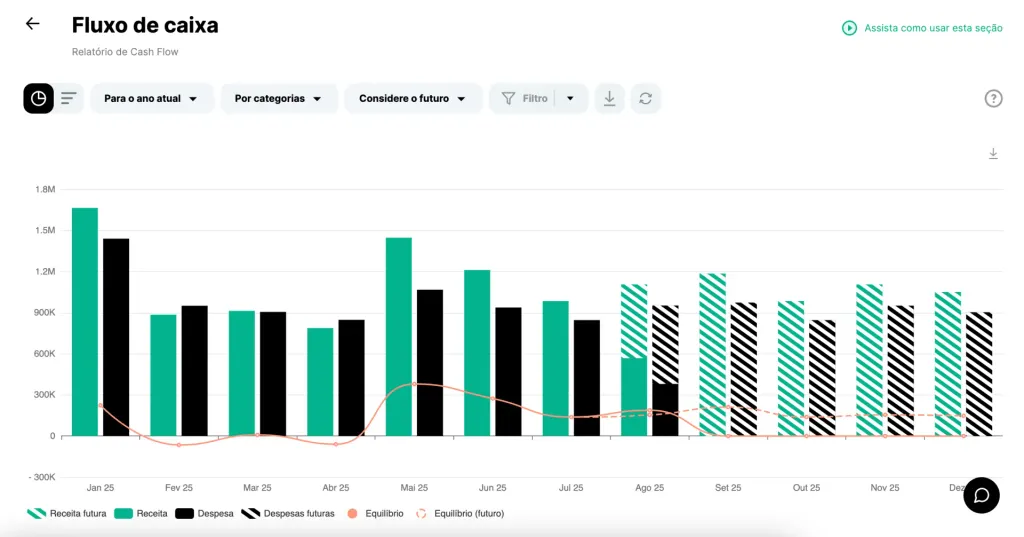
Planning is not a formality. It’s your guarantee that when it matters most, everything is under control — and you won’t run out of color or supplies during peak booking periods.
A financial reserve — the foundation of a stable business
Another equally important result of cash flow management is the ability to build a reserve fund.
The most common problem is the lack of a financial reserve. Many studios operate month to month and, even after years in business, remain vulnerable: any unexpected expense — equipment breakdown, a sudden rent increase, force majeure — can throw everything off track. When you can see surplus cash in certain periods, you can consciously set aside part of that money. — Alina Tymoshenko, mentor and creator of educational programs for beauty entrepreneurs
Running a business with and without a financial reserve looks completely different:
Download the checklist “Is your business financially secure?”

Money management: how Finmap helps you control cash flow
Once you bring all accounts into a single system, the next step toward organizing your finances is tracking cash flow — controlling the real movement of money both day to day and in advance.
How it works in Finmap:
- Sync your accounts: transactions will be imported automatically from connected banks. If you work with cash, import or enter transactions manually.
- Categorize every transaction or create automatic rules so income and expenses go straight into the right categories.
- Enter planned payments and income — such as rent, payroll, subscriptions, packages, or gift certificates.
- Use the payment calendar to see when money will be needed and whether the balance will be enough to cover expenses.
- Review cash flow reports weekly — analyze real balances, seasonality, and business dynamics so you can make decisions in advance.
Finmap turns chaotic cash movements into a clear, reliable system. Now you know what’s coming — and you act before problems happen.
This is not just reacting to financial difficulties. It is strategic business management.
But even if you can see seasonality and plan your finances, that still doesn’t guarantee order. Because as long as every decision, payment, and record depends only on you — you are the system.
And a system that depends on one person is always vulnerable.
Problem #3: You don’t delegate tasks that drain your time and energy
Expectation: you have the successful business of your dreams, and it runs on its own.
Reality: you are the main engine, the central process, and the only guarantee that everything stays in order.
Beauty salons are often born from talent and vision. From the desire to create something beautiful and special. But once clients, a team, and costs appear, that dream turns into responsibility.
The owner, who started out in a creative role, quickly becomes:
- the lead specialist (because no one does it as well as you),
- the receptionist (because the employee is absent and someone has to manage the schedule),
- the social media manager (because reels need to be posted every day),
- the purchasing manager (because the right products need to be researched, ordered, and received),
- the decorator and logistics manager (because the new shelf needs to be bought and assembled),
- HR (because only you can decide who joins the team),
- and even the cleaner (because you can’t ignore the mess in the space).
Finances don’t create the problems — ignoring them does.
Finances are quiet. They don’t call, don’t message you on WhatsApp, don’t knock on the door with complaints. That’s why, in the middle of the daily rush, they always get pushed aside: first the client, the post, the purchase, the booking, the specialist... And finances stay in your head, in rough notes, in empty spreadsheets.
That’s how chaos begins. That “later” turns into a cash gap, no money for payroll, and uncertainty about tomorrow.
A business doesn’t grow on intuition. It grows through organization.
The first step toward growth is freeing up your time and focus.
And the best place to start is with what matters most: delegating financial control.
How to delegate financial control in Finmap
In Finmap, you can hand over part of your financial processes to other people without losing control.
For this, there is the Users section, where you can add everyone involved and configure flexible access levels:
- full access,
- access limited to just one account,
- or permission only to enter data, without access to analytics.
And if you don’t yet have a finance specialist on your team, use Finmap AI Copilot. It prepares clear reports, highlights weak spots, and recommends what to do next. What’s more, it warns you about risks you may not even notice yourself.
Remember: financial management is not just another task — it’s the foundation of a stable business.
To grow, you need to delegate — and Finmap lets you hand off part of the routine without losing control.
Because your role is not to carry everything on your shoulders, but to lead the system that works for you.
How to avoid financial mistakes in your beauty salon: tips from Nataliia Honcharenko
Nataliia Honcharenko is a bestselling author for beauty entrepreneurs and the founder of The Concepts Beauty Business School.
She believes that financial management is not an Excel spreadsheet — it is a complete culture of business management.
A salon may look profitable, but without accurate calculations, that is often just an assumption.
We invited Nataliia to share practical advice to help you take control of your finances:
1. Start with discipline
Debt, cash gaps, not enough money to pay salaries — these are not the cause of the problem. They are the symptom. The real cause? The salon doesn’t have even the basics of financial control. And deeper than that: there is a lack of discipline.
In the beauty industry, the missing piece is not talent — it’s entrepreneurial discipline. When the owner takes money from the cash register for personal use, that is not a mistake — it is a conscious decision. She is choosing a cash gap over stability, delayed salaries over team loyalty, debt over growth.
Discipline is not talent or education. It is a daily choice. If you want your business to survive and grow, you need to make that choice every day. — Nataliia Honcharenko, founder of The Concepts Beauty Business School
2. Treat payroll as a separate expense category
One of the biggest mistakes in salon financial planning is ignoring the team payroll fund as a separate expense.
If you pay your specialists a fixed percentage of revenue, team costs automatically grow along with revenue. And if that percentage is flexible, higher revenue does not guarantee any profit at all.
The payroll fund should not vary in direct proportion to revenue. It is a strategic expense category that requires its own control. — Nataliia Honcharenko, founder of The Concepts Beauty Business School
Start treating payroll as a separate expense line. This will allow you to:
- accurately assess the profit margin of your services,
- control profit,
- understand where the money is really going.
3. Look at marginal profit first
Average ticket is a metric that, on its own, does not show your salon’s financial health. The only way to get clarity is through marginal profit — the amount left after subtracting the variable costs of each service or product.
This is the money that covers your fixed expenses and creates your real profit.
Why marginal profit matters so much:
- it shows how much each service or product actually contributes to covering the salon’s costs;
- it gives you data to manage variable costs;
- it allows you to use dynamic pricing and create well-designed promotions;
- it helps you set prices consciously, based on profitability and the market;
- it answers the question: what should a service look like for us to sell it at this price?
Please don’t include generic percentages of fixed costs in variable costs. And don’t multiply the cost of materials by 2, 3, or 5 — that’s a myth that has spread far too widely in the industry. If you want to learn how to calculate things correctly, go to experts, not social media posts. — Nataliia Honcharenko, founder of The Concepts Beauty Business School
Your salon’s financial stability starts with simple decisions. You don’t need to become a finance expert overnight — you just need to take responsibility and be willing to learn.
Because it is this systematic view of money that separates a salon that merely survives from one that grows and makes a profit.
Money under control = a growing business
If you recognized yourself at any point in this article, that is already the first step toward change.
Now it’s time to organize your finances, structure your cash flow, and finally see your real profit.
Having the best specialists, a waiting list of clients, and a beautiful space — all of that matters.
But financial control is what gives your salon stability, profit, and security for the future.
Finmap — the system that puts you in control:
- brings all accounts, cash registers, and expenses together in one place;
- shows how much profit each service and each specialist really generates;
- warns you about cash gaps — before they happen;
- helps you create a payroll fund and plan payouts;
- reveals where the money is disappearing — and what to do about it;
- lets you delegate tasks while keeping full control in your hands.
If you want your salon to not just operate, but make a profit, start with financial control.
Try Finmap and bring beauty to your finances too!
Frequently asked questions:
1. Why do I need financial control if the salon is “stable” right now?
Because “stable” does not mean profitable. Without structured management, you can’t see where money is leaking, which services are truly profitable, or whether you’ll have enough money for payroll next month.
2. How do I know which services or specialists generate profit and which only create expenses?
It’s important to record income and expenses separately for each service and each specialist. This helps you identify what works well — and what needs to be adjusted or optimized.
3. What happens if I still mix personal and business money?
You can’t accurately assess profitability. Personal expenses, cash withdrawals, and impulse purchases completely distort your financial picture. Separate accounts and clear tracking show how much the salon really earns and where the money goes.
4. Who should manage the salon’s finances? Does it have to be a finance professional?
Not necessarily. At first, you can do it yourself or delegate it to an administrator, a financial assistant, or an accountant. The most important thing is to have a clear system, with a regular routine and simple rules for everyone involved.
5. What if I don’t want administrators or specialists to see all financial information?
That’s fine. You can configure access so that each person sees only what is relevant to their role — for example, recording cash-register expenses or accessing only their own account. This way, you can delegate without losing control.
Share valuable content — become a source of insights