





Table of Contents

150

18 min

26.08.2025
How Finmap helps manufacturing businesses get their finances in order

Oleksandr Solovei
CEO & Co-founder Finmap
What do you rely on when you need to make a financial decision?
Your accountant uses tax regulations. Your production manager uses specs, shop-floor schedules, and the production plan. And you, as the owner? An Excel file with no “last updated” date? A supplier’s message in a chat app? A negative bank balance?
In manufacturing, money moves every day: prepayments to suppliers, salary advances for employees, countless small expenses, contractor payments, raw material purchases, rent, loans… And without a system, it all turns into a financial mess.
Let’s break down the key financial challenges manufacturing companies face — and show how Finmap helps bring order to the numbers, reduce chaos, and make decisions with confidence.

How to bring manufacturing finances into one system
In manufacturing, financial data builds up across dozens of places: bank accounts, a CRM with orders, Excel spreadsheets with production line plans, inventory management, accounting. Often, personal cards belonging to owners or managers get added to the mix too.
The result is a fragmented picture: to understand what’s really going on, you have to manually check inventory balances, supplier orders, customer payments, and production costs.
Why this is dangerous for the business:
- Loss of control over working capital — at any moment, you may discover there’s less money in the account than expected.
- Risk of cash gaps — raw materials and fixed costs are paid before customer payments come in.
- Errors in cost calculations — with incomplete data, it’s difficult to understand the true profitability of orders or production lines.
- Financial chaos between departments — purchasing, sales, and production keep separate records, so the owner never sees one single version of the truth in the numbers.
- The owner’s time gets wasted — instead of growing the business, they have to manually piece together spreadsheets and check balances.
Every account under control — from the bank to inventory
The first step toward financial transparency is bringing all company accounts into one system.
In Finmap, you can add:
- Bank accounts, sole proprietor accounts, cash registers, cards — and see their balances in real time. Use integrations with banks and payment systems to automate data collection, plus statement imports to streamline work with banks that aren’t integrated.
- Accountable funds — to track money that is temporarily held by employees. Add team members to the system and set flexible access permissions to understand how each department or area manages company funds.
- A virtual inventory account — showing the cost of available products or raw materials in monetary terms. Track inventory movement in financial values and write off only the cost of materials that were actually used.
This way, you immediately see how much money is available right now, where it is held, and what part is “frozen” in inventory. Balances are updated automatically and frequently, and you can check every number in seconds, from any device, anywhere in the world.
Connect the tools that affect your money — and get full transparency
To get a complete financial picture, it’s not enough to see account balances — you also need to understand all the financial processes currently in motion. In Finmap, this is possible thanks to an open API.
You can connect Finmap to:
- Your CRM system — so deals automatically flow into financial tracking;
- Inventory management — to record purchases, raw material write-offs, and see their impact on cash flow;
- Accounting, document management, or other services — if you also need to track other business processes.
The integration can be set up independently or with support from an official Finmap integration partner, who adapts the system to your business structure.
The result is a single system that brings together everything affecting your finances: sales, expenses, inventory, payables, and receivables. At the center is Finmap — the main source of truth about your money.
Control over customer and supplier payments
In manufacturing, money rarely moves in sync: you’ve already paid for raw materials, logistics, and salaries — while the customer will only transfer the payment in 15–30 days, or even later.
All of this creates cash gaps: money is moving through the business, but it isn’t available in the account.
At the same time, it’s hard to keep settlements under control. Some customers delay payments, others ask for longer terms. Suppliers, meanwhile, require prepayments and work with strict deadlines.
Without systematic management, it’s easy to miss a debt, mix up payment dates, or even lose a partner’s trust.
This leads to:
- You don’t know who owes you money or how much — instead of a clear list of debtors, you have to search through chats or spreadsheets.
- You may miss a payment and lose a supplier — because obligations slip through the cracks when there’s no single payment calendar.
- Contractors call before you even remember the invoice — which damages your reputation and makes future cooperation harder.
- You don’t know when to expect incoming payments or how to plan outgoing ones — everything is based on gut feeling, not numbers.
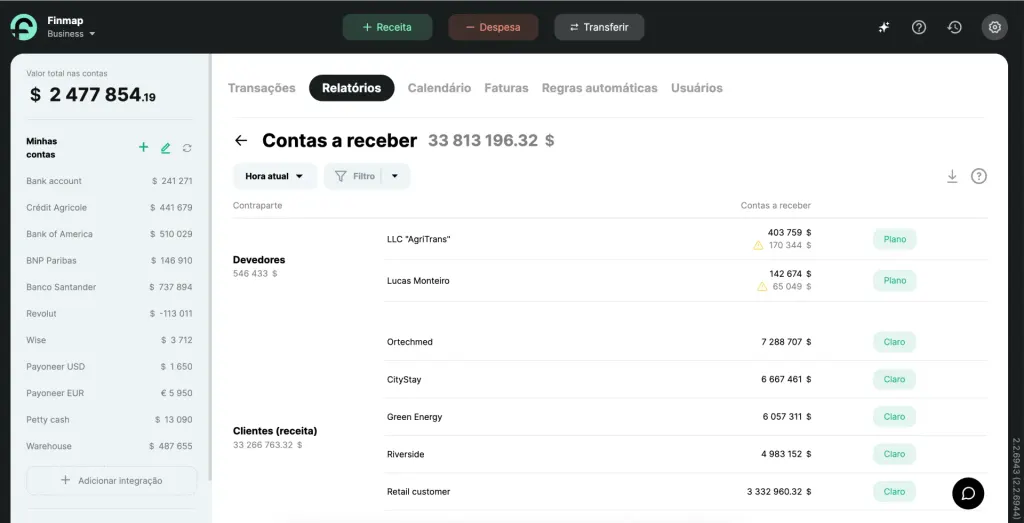
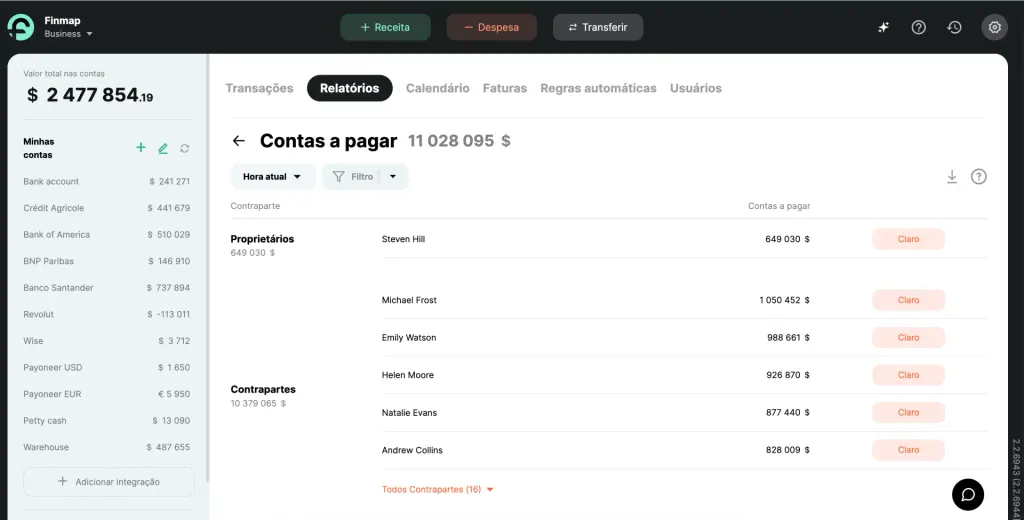
To avoid falling into the trap of cash gaps and losing control over settlements, it’s important to focus on three essential steps.
Here’s exactly what needs to be implemented — and how it works in Finmap:
Why is DSO worth calculating?
DSO answers a simple but critical question: how many days after a sale does the money actually reach your account?
The higher the DSO, the greater the pressure on liquidity and working capital.
Research by the Kaplan Group shows:
42% of companies have a DSO above 46 days, and among large manufacturers, that figure reaches 70%.
When this metric stretches out, it isn’t just “debt on paper” — it’s real money you can’t use to buy raw materials, pay salaries, or invest in growth.
DSO benchmarks for different types of manufacturing:
If you control DSO, you control liquidity. If you don’t, you’re operating in the red, even when you show profit on paper.
What really drives profit in manufacturing
In manufacturing companies, it’s often difficult to identify which products, orders, or business lines actually generate profit.
The reason is the lack of detailed tracking by financial responsibility centers or by project. Direct and indirect costs — purchases, salaries, logistics, rent — often pile up in one general production account, with no breakdown by product type or customer order.
As a result:
- Loss-making products are “hidden” among profitable ones, distorting the financial picture.
- Budget gets spent on unprofitable lines that don’t generate margin.
- Management decisions are made on intuition, without analytics to back them up.
This is a systemic problem that eats into profitability, even when the company is growing in production volume or sales.
According to McKinsey:
Around 40% of executives reduce their product portfolios to lower complexity and increase overall profitability.
These decisions can’t be made based on intuition or “gut feeling” — they require hard data.
How Finmap helps set up effective project-based tracking
This is exactly what the Projects report in Finmap provides. You see each business line with its components — subprojects — as a separate financial unit: revenue, expenses, cost, operating profit, and profitability.
A project is not only a line of business — in your company, it can be:
- A specific product type — for example, kitchen furniture, children’s beds, or metal structures.
- A batch for a specific customer — an individual order with its own budget, deadlines, and expenses.
- A test run of a new product — to assess whether it makes economic sense to launch it at scale.
- A contract or tender — such as supplying products to a public-sector customer.
- Contract manufacturing — when the company fulfills orders for other manufacturers under their brand.
- A separate department or production line — to evaluate the efficiency of different teams.
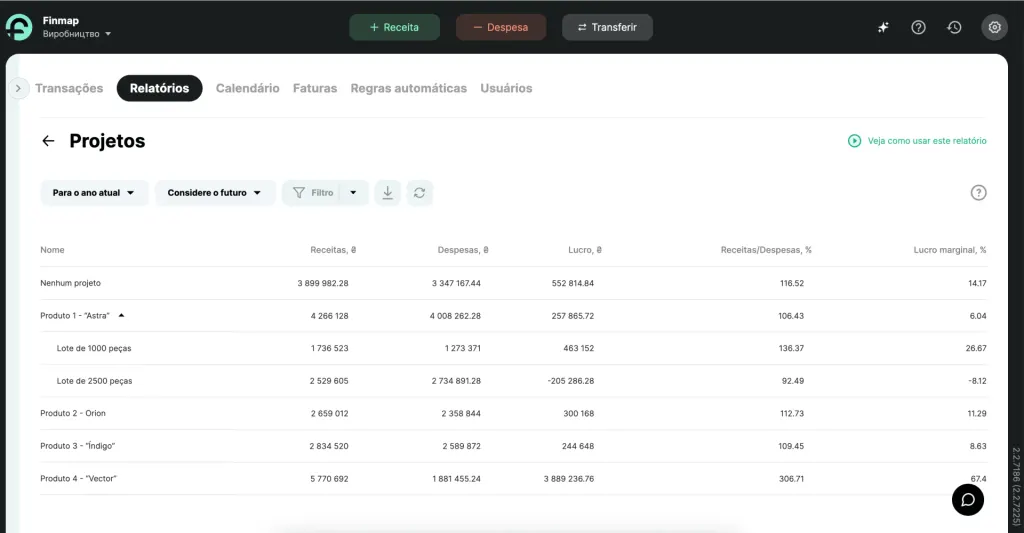
The importance of project-based tracking is more than just a theory. Research from ScienceDirect confirms how unevenly products affect a company’s profitability:
Typically, only about 20% of a manufacturing company’s products generate more than 150% of its profit. That means the remaining 80% either generate little profit — or even create losses.
Can you clearly answer which products in your production make the most money?
A financially strong manufacturing business isn’t defined by total revenue, but by analysis that shows what is worth scaling — and what needs to be cut.
From Excel chaos to systematic control: the Practik story
PRACTIK is a Ukrainian manufacturer of innovative food for dogs and cats, positioning its product as a complete meal — not just pet food. To ensure a high quality standard, the company built two factories in Ukraine from scratch, which allowed it to control every stage of production in-house.
The company works in two areas — cat food and dog food. Each has its own product lines that are constantly updated and improved.

Before implementing Finmap, the company tried to manage finances in Excel. But as the business grew and revenue sources increased, spreadsheets could no longer keep up — it became impossible to automate the process and see the full picture.
But automation wasn’t the only issue. The company had deeper reasons for moving to systematic financial management:
- Impossible to track cash flows manually — income from different areas was mixed into one stream with no breakdown.
- No centralized analysis for decision-making — expenses were not recorded in a unified system.
- Uncertainty around balances and funds available for investment — it was difficult to forecast accessible resources.
- Different business areas — one system: property rental, investments, and B2C sales all required a unified financial interface.
- Need for delegation — finances were handled by one of the partners, which limited growth.
After the company decided to introduce systematic financial control, it turned to a financial manager from the Finmap team. He helped build the right management structure and configure key processes, taking the specifics of the business into account.
Next, financial control and management were delegated to the company’s internal specialist, Nataliia. Today, she is responsible for finances and shares her experience with Finmap:
Once we started seeing all money coming in and going out in one place, decision-making became much easier. Now we understand how much money is available, where overspending happens, and how prices change month to month.
What changed after moving to Finmap
After adopting Finmap, the company gained not just a convenient tool, but a complete financial management system. Here’s what changed in practice:
- After implementing Finmap, Practik gained full control over its finances. Now all inflows and outflows are in one system, with clear analytics and transparent balances.
- Management can see how much money is available for investment, where overspending occurs, how purchase prices change — and make decisions based on numbers, not assumptions.
- Financial processes became systematic: every month, the team reviews reports, analyzes expenses, and plans the budget based on observed trends.
- Cash gaps stopped being a surprise — now they are planned for, and the company is always prepared to handle them. Delegating financial control also allowed the owners to focus on business expansion.
With Finmap, we brought order to the numbers — and, at the same time, to the entire business. It gives us confidence, stability, and the ability to keep moving forward. — the Practik team sums up
Finmap — a tool for control, confidence, and growth
Financial management answers everyday questions:
- Can we make this purchase today?
- Will there be enough money to pay salaries?
- Which product is worth scaling in production — and which should be discontinued?
In manufacturing, these decisions are expensive. And mistakes don’t happen because of a lack of experience — they happen because of a lack of data.
Finmap helps bring all financial information into one system, see the picture in real time, build forecasts, and avoid critical mistakes. That’s why it’s chosen by companies that want to grow in a structured way — not in the dark.
Book a free consultation with a Finmap specialist and see how it can work for your business.
Frequently asked questions
1. Why move away from Excel if it works?
Excel doesn’t give you an up-to-date view — data quickly becomes outdated, it’s hard to consolidate information from multiple sources, and there’s no automation. It works up to a point, but then it starts holding growth back.
2. How do I know how much money I can invest and how much I need to reserve for operating expenses?
You need a system that shows available balances and future obligations. This allows you to make well-grounded investment decisions without risking your payments.
3. Our raw material prices change all the time. How can we track when and why costs increase?
Regular, structured cost tracking allows you to monitor purchasing trends and respond to changes in time.
4. How do we find where money is being lost if sales are stable but profit isn’t growing?
You need tracking that shows expenses by category and by business line. This helps identify overspending, hidden costs, or inefficient processes.
5. Can financial management be delegated if the company doesn’t have a CFO?
Yes. The key is to set up the control structure properly. After that, management can be handled by a responsible person — an accountant, administrative assistant, or office manager. Leadership then receives reports in a practical format.
Share valuable content — become a source of insights