

Table of Contents
Home
/
Blog
/
Manage Your Business Finance Without Being a Bookkeeper: 3 Habits That Give Owners Real Clarity in Under an Hour a Week

735

6 min

08.07.2026
Manage Your Business Finance Without Being a Bookkeeper: 3 Habits That Give Owners Real Clarity in Under an Hour a Week

Karine Shevchenko
Financial Expert at Finmap
"I'm a founder, not a bookkeeper. I don't want to become one. But I want to know what's happening with the money — daily, weekly, monthly. Without opening five apps. Without asking my accountant. Without Excel. Just three things I check, and I'm in control."
For twelve years running her small consulting practice, one founder said the same thing at every year-end review: "I don't feel in control of the money. I know I'm profitable. I don't feel like I know why or when." Not because she was bad at business. Because "knowing the numbers" felt like a full-time job she didn't want, and the alternative — trusting memory and vibes — kept letting her down.
Then she installed three habits. Not systems. Habits. Each one small. Total time investment: about 55 minutes per week. Result over 18 months: she doubled her confidence in decisions and never once said "I don't know where the money is" again.
This article is those three habits. Any small business owner in Ukraine can install them — no accounting background required, no Excel wizardry, no reliance on a bookkeeper's monthly calendar.
Why Financial Control Feels Out of Reach for Most Owners
One — the accountant's world is optimised for compliance, not for you. Reports arrive monthly. They're legally correct and operationally quiet. They don't tell you where you're drifting now.
Two — Excel is a slow prison. Everyone starts there. Everyone eventually feels the weight — the file that takes 40 seconds to open, the formula somebody changed, the sheet you meant to update on Sunday.
Three — "I'll just remember" fails predictably. Memory works for the first year of running a business. Around year two or three, it stops. And when it stops, you don't notice until a Tuesday.
Four — there's no template for the owner who doesn't want to become a finance person. Enterprise playbooks assume analysts. Hobby-level advice assumes zero complexity. The middle — the small business owner who wants control without becoming an accountant — has almost no roadmap.
How to Recognise You Need This
- Your default answer to "how's the business doing?" is "fine, I think".
- You've said "все в Excel, але щось не вношу, забуваю" ("it's all in Excel but I forget to enter things") in the last three months.
- You feel richer some months and poorer others without knowing why.
- Your Monday morning starts with 20 minutes of guessing before you can start deciding.
- You've considered hiring a finance director but the business isn't ready.
The Three Habits
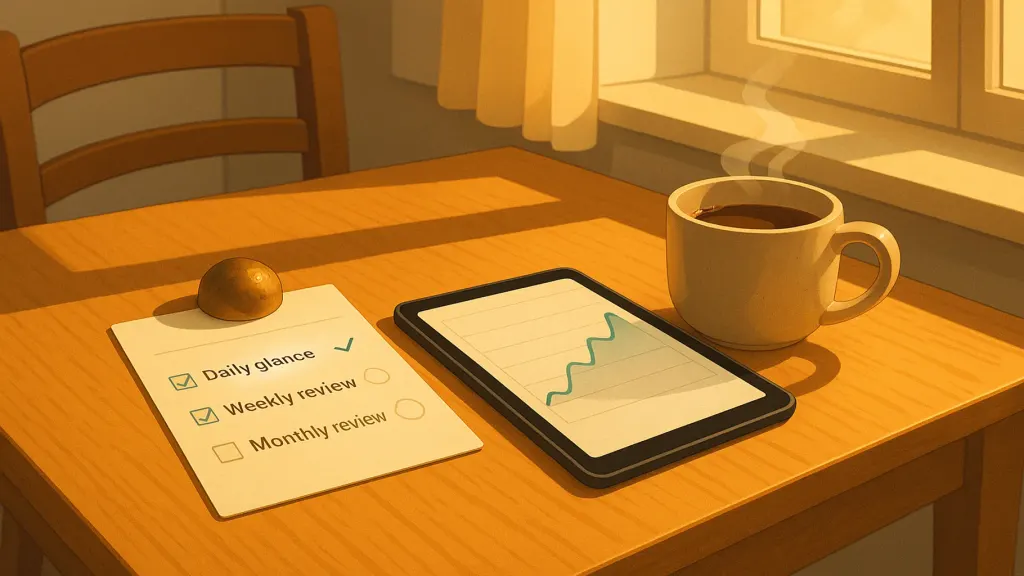
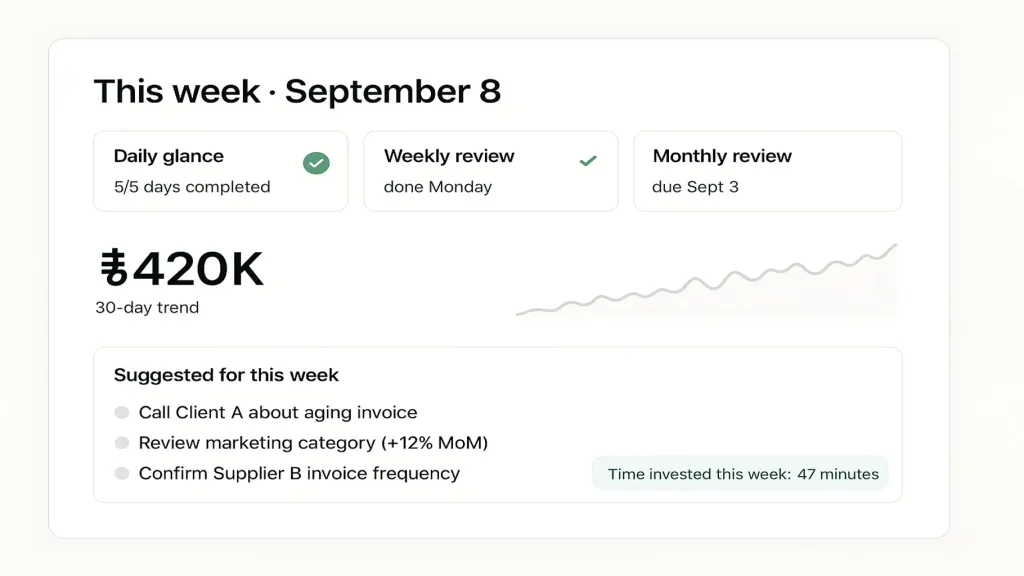
Each habit is small on its own. The value is in the combination — daily, weekly, monthly — each layer catching what the other layer misses.
Habit 1 — The Daily 3-Minute Glance (Monday to Friday)
Every morning, before opening any other app, look at yesterday's spend and today's cash position across all accounts.
Not to analyse. To notice.
What arrived yesterday? What went out? Any category that jumps out? What's the total cash across all your accounts, right now?
If nothing surprises you, you close it. Three minutes.
If something surprises you, that's the value. A subscription that renewed. A payment that came in early. An expense category that's larger than usual. The point isn't to act every day — it's to keep the picture in your head fresh, so nothing accumulates in the dark.
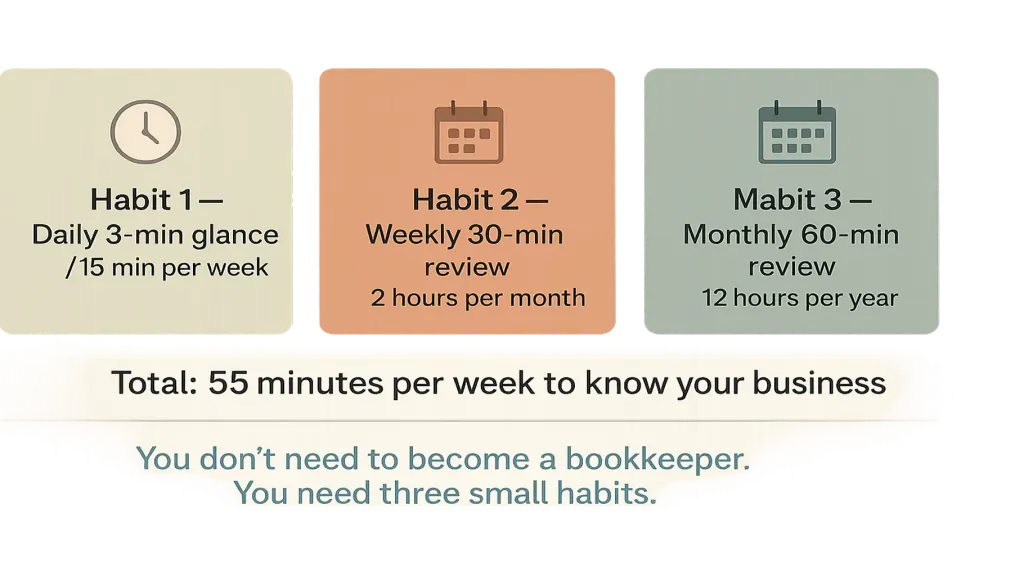
Time: 3 minutes × 5 days = 15 minutes per week.
Habit 2 — The Weekly 30-Minute Review (Monday morning)
Once a week, sit with a slightly deeper view. Same rhythm every Monday. Same 30 minutes, ideally before any meetings.
Look at:
- Cash forecast for the next 30 days. Are there tight days coming? Do I need to act this week to smooth them?
- Receivables aged over 30 days. Anyone I need to call?
- Committed outflows next 14 days. Anything I'd renegotiate or move?
- The one operational metric that predicts your revenue. Bookings for a services business. Footfall for retail. Utilisation for agencies. Pipeline for B2B.
30 minutes. Coffee, phone off, one page or one screen. Not to prepare a report — to be prepared for the week.
Time: 30 minutes × 4 weeks = 2 hours per month.
Habit 3 — The Monthly 60-Minute Review (first Tuesday)
One session per month, slightly longer.
- How did revenue actually land vs plan?
- Which spend categories moved most, in which direction?
- What's my real margin this month vs last month?
- Any pattern I need to act on next month?
Not the accountant's monthly close (that runs on its own timeline). Your own review, in your own language. Once a month, an hour, and you know your business.
Time: 60 minutes × 12 months = 12 hours per year.
Total: About 55 Minutes a Week
Fifteen minutes across the week (daily glance), 30 minutes on Monday (weekly review), and about 15 minutes averaged for the monthly review (one hour, once a month). Fifty-five minutes a week to know your business well.
The founder who installed these habits described it simply: "I'm not a finance person. But I've never felt out of touch with the numbers again."
Where a Platform Makes This Easy Instead of Heavy
Three habits sound simple. They stay simple only if the data is already in one place. Otherwise the "3-minute glance" becomes 25 minutes of opening apps and adding numbers. The "weekly review" becomes an hour of chasing exports. The monthly review becomes a chore nobody looks forward to.
This is where a finance platform helps. Finmap connects to your business bank accounts and reconstructs the picture automatically — starting cash across all accounts, categorised spend, expected inflows, upcoming outflows, forecasts. The morning glance shows yesterday's real numbers. The Monday review is a single view. The monthly review already has the trend data assembled.
The AI layer quietly supports each habit: flagging drift for the weekly review, learning payment patterns for the forecast, surfacing anomalies before you scroll for them. Not because AI is the point — because the goal is to keep the habits at 55 minutes a week for good.
The Numbers Behind Finmap
- 18,000 business clients in 54 countries use Finmap to run their weekly habits.
- 97% of clients stay with Finmap for years — because the habits stay light.
- PMF signal: 56% of users would be "very disappointed" if Finmap disappeared (industry benchmark is 40%).
Three Common Mistakes When Trying to Install This
- Trying to do everything at once. Start with Habit 1. Give it three weeks. Add Habit 2. Give that four weeks. Add Habit 3 when both feel automatic. Gradual installs stay installed.
- Making the daily glance too heavy. If it takes more than 5 minutes, it stops happening. Keep it tight.
- Skipping when things "feel fine". The weeks you skip are the weeks drift starts. Reset the next Monday and continue — don't let one miss break the pattern.
📌 Install the three habits with a platform that keeps them at 55 minutes a week — free for 14 days, no card required. Start your free 14-day Finmap trial → finmap.online/ua
Знаєш що зараз. Бачиш що буде. Знаєш що робити.
Read also
Share valuable content — become a source of insights




Frequently Asked Questions
Do I still need an accountant?

Yes. Bookkeeping and legal compliance stay with the accountant. Your three habits are for you — for daily decisions.
What if I skip a day?
Resume next morning. Value is in the pattern, not the perfect streak.
Can my ops director own these habits instead of me?
The daily glance and weekly review — yes, you can share. The monthly review is usually owner + ops together.
Does this scale as the business grows?
Yes. The habits stay 55 min/week even at ₴50M+ revenue — because the platform absorbs the increased complexity.
Which habit matters most?
Habit 1 (daily glance) is the foundation. Nothing else works if you're not looking daily.
How long until I feel in control?
Most owners describe a shift around week 4–6. The first month is installation. From month two, the pattern feels natural.
Any questions left?
We are ready to answer them.


Finmap support