
Table of Contents

78

14 min

04.08.2025
How Finmap helps construction companies get their finances in order

Kateryna Gulchenko
Senior Customer Support Manager
You can deliver high-quality work, finish on time, even make a profit on paper — and still lose money.
Not because something went wrong on site, but because your finances are still out of control.
In construction, this is a classic problem: the number of projects grows, revenue increases — but at the end of the month, the account is empty, contractors are waiting to be paid, and the numbers don’t add up.
The reason is simple: without structured financial management, the business doesn’t grow — it breaks down into chaotic processes.
So what exactly isn’t working in your construction company’s finances — and how do you fix it? Let’s look at three core problems that destroy profit and show how to solve each one.
Problem 1: No detailed financial control by project
In construction, everything revolves around projects. You invest in materials, crews, equipment rentals — often across several job sites at once. But when you try to close the books, nothing adds up. Revenue seems strong, but the bank balance is zero.
Job costing — assigning costs to each specific project — is essential for creating realistic estimates, analyzing efficiency, and forecasting profitability.
Without project-based financial management, a company quickly loses control:
- It’s hard to say how much it really costs to complete a project.
- There’s no way to spot overruns or mistakes in the budget.
- The business grows, but profitability falls.
- You can’t analyze margins or make data-driven decisions.
According to a study published on MDPI:
25% of construction companies may face bankruptcy after just two or three poorly estimated projects — due to underestimating labor or material costs.
How Finmap turns chaos into a manageable process
With Finmap, you can manage finances by project and subproject — for example, tracking foundation, roofing, or finishing costs separately within the same build.
This gives you a clear view of the financial picture not only for the company as a whole, but for every individual project: where costs are running over, which job is profitable, and which budget needs to be reviewed.
The platform lets you:
- Create a structure with projects and subprojects (for example: build → foundation, finishes, structure, engineering, etc.).
- Record transactions manually or automatically at the right level.
- Generate key reports — especially P&L and Projects — with in-depth financial analysis.
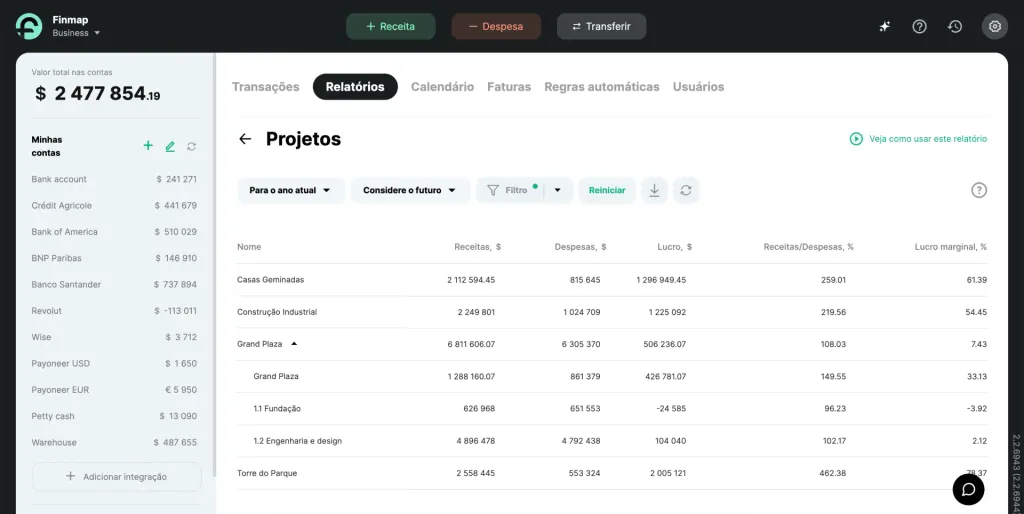
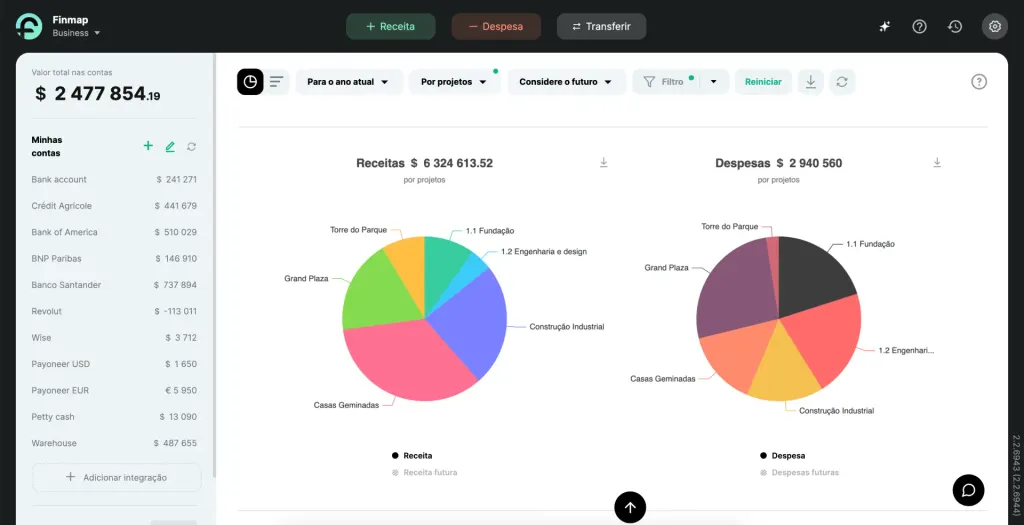
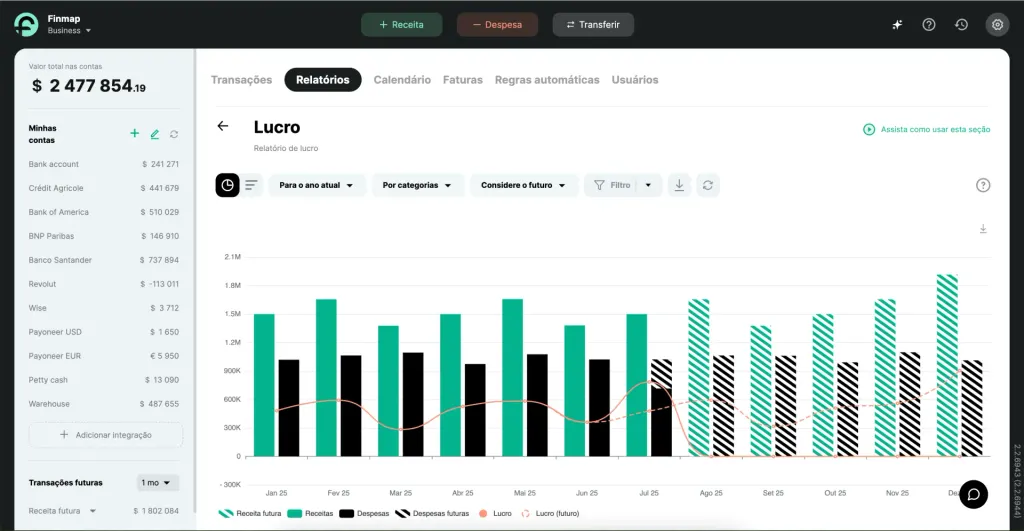
By adapting Finmap’s structure to the way your business actually works, you stop simply tracking costs — and start getting complete financial insight.
The platform generates KPIs at two levels: company-wide and per project. Below are the recommended metrics Finmap helps construction companies track:
Companies that use job costing and data analysis make faster, more accurate decisions: one study shows that implementing this model allows resources to be redirected between projects 42% faster, improving flexibility and agility.
With Finmap, you’re not working in the dark — the platform gives you accurate financial data by project, so profit becomes the result of management, not luck.
Problem 2: Cash flow gaps in construction — how to avoid unexpected crises
In construction, cash flow gaps aren’t the exception — unfortunately, they’re the rule. Costs are high right from the start: supplier deposits, upfront payments to contractors, material purchases.
Incoming payments, on the other hand, usually come later — after milestones are completed, or with delays.
Without proper financial management, this leads to:
- Cash flow gaps even in profitable companies.
- No visibility into the financial load over the next few weeks.
- Unexpected delays in supplier payments and payroll.
- Loss of trust from partners and the team.
According to Entrepreneur:
Up to 82% of construction companies fail because of poor cash flow management — one of the most overlooked risk areas.
Finmap’s solution: what changes when a system is in place
Finmap does more than show account balances — it answers the real question: Will you have enough money to cover your commitments in the coming days?
The main tool for this is the Payment Calendar, which takes into account all future inflows and outflows by day — and warns you in advance about possible cash shortfalls.
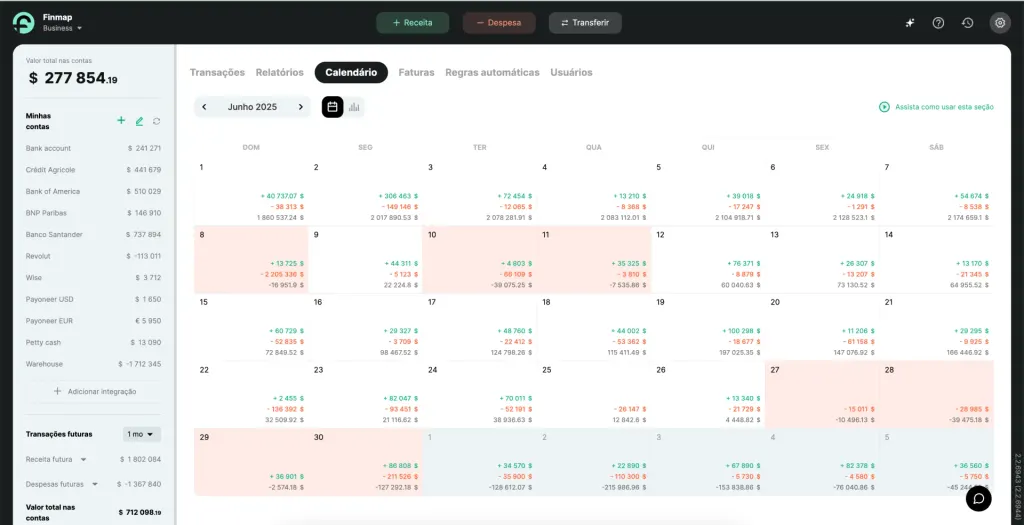
The platform lets you:
- Include already scheduled expenses in financial forecasts;
- Record receivables (milestone payments, customer debts);
- View cash movements by date, account, and project;
- Generate cash flow forecasts and identify risk periods.
Cash flow forecasting is not just another report — it’s an early warning system. Companies that can see their financial position in advance don’t put out fires — they make decisions in time.
In Finmap, this tool works every day — so money doesn’t disappear without warning, but is directed toward growth.
Problem 3: When no one knows who owes what to whom
In construction, financial obligations pile up fast: dozens of suppliers, contractors, advances, partial payments, and cash expenses.
Without a system, this information doesn’t connect — and even the owner doesn’t know:
- How much money is “in transit”;
- What is actually available;
- What is tied up in debts or unrecorded expenses.
Payment delays are common. According to PYMNTs:
71% of construction subcontractors deal with frequent delays — directly linked to a lack of control over obligations.
The effects of poor control over accounts payable and receivable are felt every day:
- No control over what is owed to you and what you need to pay
- No way to measure the company’s real liquidity
- Money “leaking” through team-managed expenses — with no clear reporting
- Pressure on cash flow and the use of reserves, credit, or personal money to cover gaps
Without control over obligations, you’re not managing money — you’re just trying to catch up with it. And the bigger the company, the bigger the chaos.
How Finmap solves this in practice
Finmap lets you manage accounts payable and receivable in an organized way, with dedicated reports and tools for planning, identifying, and linking transactions.
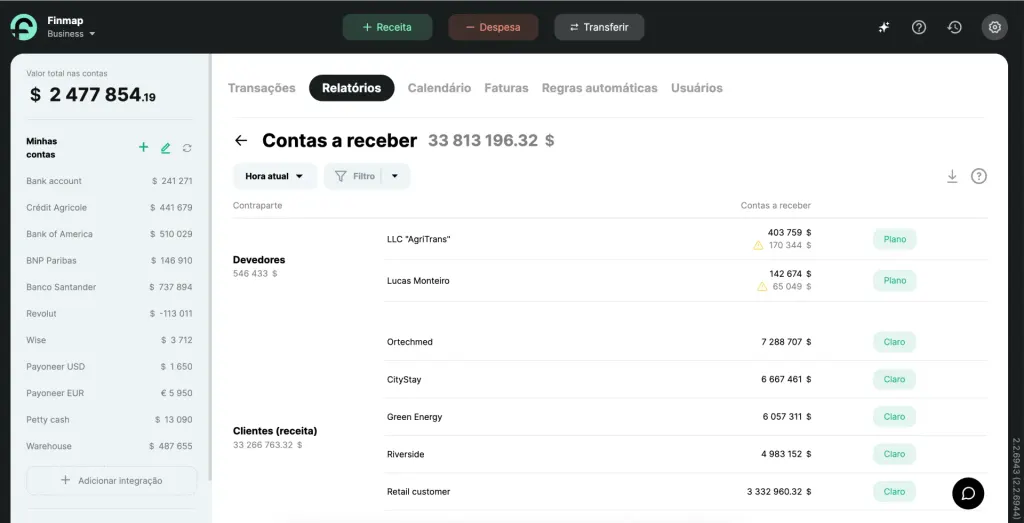
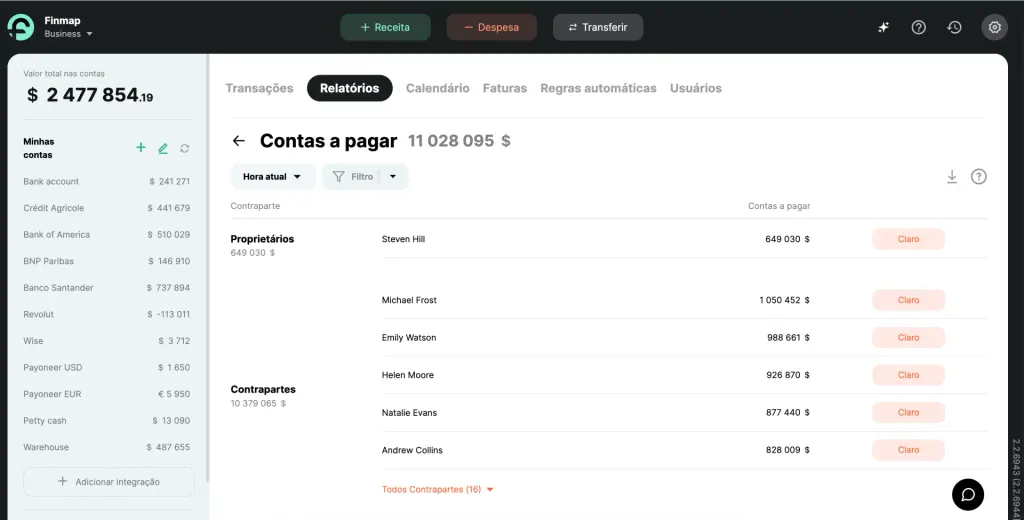
All obligations — future and overdue — stay in one place, linked to suppliers and due dates.
The Payment Calendar already includes these amounts in forecasts, showing not just the balance, but the reality: how much needs to be paid, when, to whom — and with what money.
Practical control over cash expenses in construction
Operational expenses made by crew leaders, buyers, and site supervisors are a “gray area”: they receive cash or transfers for small purchases, transport, or repairs.
Without control, these amounts disappear or are recorded late.
Without an accounting system, these expenses often get lost or are recorded late — and you don’t know how much has already been spent, what is still “in progress,” and what simply hasn’t been returned.
A common situation:
- No receipts, or they’re scattered across WhatsApp, Telegram, or private chats.
- Some expenses are never recorded.
- Cash “disappears,” and no one takes responsibility.
- At the end of the month, it’s impossible to reconcile projects or identify overspending.
Finmap lets you manage these amounts by person — with the amount, purpose, project, and status recorded.
Here’s a step-by-step workflow to organize this process:
If you think operational expenses don’t affect you and that you can rely 100% on employees’ good faith — just look at the data from Business.com:
67% of employees have violated company financial rules at least once, whether through incorrect records or even misuse of funds.
Studies by the ACFE show that, on average, companies lose up to 5% of monthly revenue due to internal errors, abuse, or a simple lack of control over operational expenses.
If your business brings in R$1,000,000 a month, you could be losing R$50,000 without even noticing. What does that add up to in a year? In five years? In ten?
Operational expenses are not a minor detail.
They’re an invisible hole in the budget — one that only grows over time if it isn’t closed with a clear system.
Real case: how an architect became a financial manager with Finmap
Bogdanova Bureau is an architecture studio that delivers full-cycle interior and construction projects, with offices in Kyiv and Switzerland.
Each project requires an individual approach, large budgets ($1–5 million), and responsibility not only for design, but also for deadlines, teams, stages, and finances.

At first, no one managed finances in a structured way. Money was scattered across accounts, cards, and cash boxes. Some transactions were not recorded, and some expenses lived in spreadsheets — or only in someone’s head.
Simple questions had no answers:
- How much profit did we make?
- Can we pay salaries?
- Which project is profitable?
We finish the project — everyone gets paid. But there’s nothing left for us. The money disappeared. And we can’t understand where it went. — Olga Bogdanova, founder of Bogdanova Bureau
The situation got worse when several projects turned unprofitable — $50k, $80k, even $180k losses. Reserves ran out, and a cash flow gap appeared. They had to take out loans — and the company nearly shut down. That was the turning point.
Olga realized: without financial management, a company doesn’t just lose profit — it loses control.
Find out why Olga decided to implement Finmap, how she built a new financial model, and how revenue grew by 173%.
What changed after implementing Finmap:
| Before | After | ||
|---|---|---|---|

|
No profitability calculation: projects looked profitable but generated hidden losses. |

|
Each project now has its own financial model, with cost, profit, operating margin, and fund allocation tracked. |
|
|
Money was spread across different accounts, cash boxes, and currencies — it was impossible to quickly identify balances and available funds. |
|
All accounts were brought together in one financial interface: full transparency over balances and liquidity. |
|
|
Decisions were made on gut feeling — without analysis, regular reports, or planning. |
|
Weekly financial reports, a payment calendar, and ongoing cash flow analysis were introduced. |
|
|
Administrative expenses, bonuses, and PR activity were funded chaotically or “from whatever profit was left.” |
|
A fund system was introduced: reserve, growth, and PR — with a fixed percentage of project profit allocated to each. |
|
|
Strategic plans were made without taking the real financial situation into account. |
|
Management decisions are now based on data: Finmap provides trends, alerts, forecasts, and financial signals. |
Today, Bogdanova Bureau works on fewer projects, but with larger budgets. Financial management has become the foundation for planning, decision-making, and transforming the business model.
My team is a factory that delivers projects. And I need to know exactly how much that factory costs — to make sure we actually make a profit, not just break even. — Olga Bogdanova, founder of Bogdanova Bureau
Now Olga has clarity: where the profit is, where the reserve funds are, and where there’s room to grow. The company moved from gut-feel management to system-based management.
Finance isn’t about numbers in a spreadsheet. It’s about choices, peace of mind, and the ability to act strategically.
Build your business on data — not guesswork
In construction, every number matters — especially the ones you don’t see right away. Running without a financial system is expensive: in time, stress, and money.
Finmap brings structure to the chaos:
- Shows profitability by project;
- Prevents cash flow gaps;
- Controls operational expenses and debts;
- Lets you delegate financial tasks safely.
Don’t wait for the money to run out again — try Finmap now and take back control.
With Finmap, you don’t just build projects — you build a profitable business.
Frequently asked questions
1. Why does construction need project-based control?
Because profitability isn’t measured by the total — it’s measured by each job. Without job costing, you can’t see where the margin is, where waste is happening, or which project is losing money.
2. Why do even profitable companies struggle with cash flow gaps?
Because profit ≠ money in the bank. In construction, payments come later, while expenses come first. Without a payment calendar, you can have dozens of pending bills — and a zero balance.
3. How do you organize supplier and contractor payments?
Structure the data by supplier, due date, and amount. Use Finmap’s Accounts Payable and Accounts Receivable reports to see who owes what to whom. That way, you avoid delays and penalties and maintain trust with partners and your team.
4. What should you do with operational expenses that disappear from view?
In Finmap, you can create accounts for each supervisor, give limited access through the app or Telegram bot, and require receipts. The result: everything is recorded, nothing gets lost, and your cash flow stays healthy.
5. What real results can financial management bring?
Look at Bogdanova Bureau. After adopting Finmap, the company eliminated cash gaps, optimized costs, changed its project model — and grew revenue by 173%. Financial management stopped being a burden and became a strategic growth tool.
Share valuable content — become a source of insights