

Table of Contents

2

23 min

12.10.2026
Coffee shop: five hours out of twelve earn the whole profit

Olena Smolikova
Financial expert at Finmap
“Twelve hours a day, thirty seats, a queue at the door every morning. Revenue close to a million. And the money for a second site — I have been putting it aside for the third year running and still have not” — that is how Dmytro, owner of a 30-seat coffee shop in Kharkiv, opened the conversation.
Sound familiar? In the morning the machine never gets a chance to cool down, at lunch the room is full, and then comes a long stretch when the barista wipes the same counter for the third time. The report shows 912 000 ₴ of revenue and 213 200 ₴ of profit, and not a single line tells you which hour you owe it to.
There is only one reason. A coffee shop pays the same for all 12 hours but earns in them in completely different ways. Until the hour becomes a line with a result of its own, profit looks evenly smeared across the day.
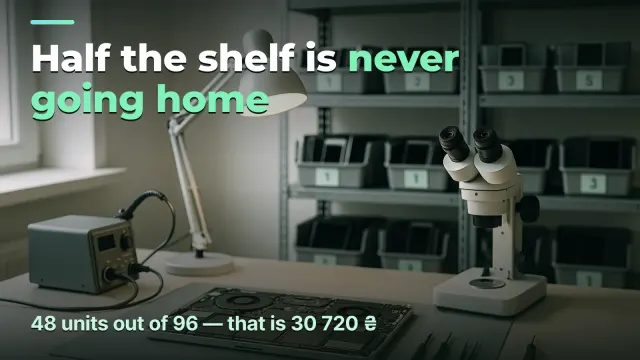
We break the coffee shop down into two units: the cup and the hour with the doors open. And we show why 5 hours out of 12 deliver 127.1% of the profit while the remaining 7 take back 27.1%.
Dmytro's path: from a street window to a 30-seat room
Dmytro started with a service window: one group on the machine and himself behind it from morning till night. His arithmetic was simple: beans and milk cost this much, revenue is that much, the difference is mine.
Five years on there was a room with 30 seats, a dessert display, four baristas and a manager. Revenue grew several times over, the margin looked healthy — 23.4%. And the understanding of where that money came from was gone.
“At the window I knew everything about every cup: who I poured it for, for how much, what part of it was mine. Now there are 9 600 such cups a month, and I cannot tell you in which hour I earned and in which one I paid out of my own pocket.”
Why “twelve hours of trading” says nothing about money
The hour with the doors open is the only product a coffee shop puts on the shelf every day. 12 hours times 30 days is 360 hours a month, and an hour nobody walked into does not carry over to tomorrow.
But in the books all 360 hours are identical: rent accrues at peak and in the deadest stretch of the day alike, and the barista stands behind the counter whether anyone is in front of him or not.
What the owner sees in the monthly report
9 600 cups, an average ticket of 95 ₴, revenue of 912 000 ₴. Beans, milk and the cup — 28 ₴ per drink, 268 800 ₴ in total. Fixed costs of 430 000 ₴. Profit 213 200 ₴, margin 23.4%.
Normal figures. Only none of them answers the question Dmytro asked himself every evening: why, with a margin like that, there is no money for a second site.
Life before the working hour became a line
The state Dmytro lived in for almost three years will be familiar to any coffee shop that grew out of a service window.
- Revenue was totted up by shift, not by hour. The report showed the daily sum — and nothing about how it accumulated.
- Quiet hours were treated as inevitable. “Everyone has them” — and not a single figure for what those hours cost.
- The queue at peak was taken as a good sign. It never occurred to anyone to count the people who turned around and left.
- Fixed costs were seen as a month. 430 000 ₴ as a single figure — and no way to say which hour failed to earn its share.
- The rota was built around shifts, not around flow. Two shifts of six hours, both with the same number of hands.
- Write-offs and staff coffee were recorded nowhere. Soured milk and “try this” cups dissolved into the cost-of-sales line.
Not one of these problems was about coffee. All six were accounting problems — which is why neither the barista nor the bookkeeper could see them.
The fixed 430 000 ₴ that accrue without a single guest
The first thing Dmytro did was split costs not by category but by nature.
- Variable — 28 ₴ per cup. Beans, milk, the cup with a lid. They appear only once the drink has been poured.
- Fixed — 430 000 ₴ a month. The same at 9 600 cups and at six thousand.
| Fixed cost line | Per month | % of revenue |
|---|---|---|
| Premises rent | 120 000 ₴ | 13.2% |
| Wages: baristas and manager | 240 000 ₴ | 26.3% |
| Utilities | 38 000 ₴ | 4.2% |
| Other | 32 000 ₴ | 3.5% |
| Total fixed | 430 000 ₴ | 47.1% |
Almost half the revenue is spoken for before the first guest walks through the door.
And now the main thing. Divide 430 000 ₴ by 360 hours and you get 1 194 ₴. That is what it costs to keep the doors open for one hour: with guests and without them.
The key unit: the contribution of one cup
Fixed costs do not depend on flow. So the value of a cup is measured not by its ticket but by how much it leaves above the costs that would not exist without it.
A ticket of 95 ₴ minus 28 ₴ of variable cost leaves 67 ₴. That is the contribution of one cup: every drink sold brings in 67 ₴ above what the coffee shop spends either way. And every cup there is nobody to pour is a zero against the same 1 194 ₴ an hour.
A check across the month: 9 600 cups at 67 ₴ make 643 200 ₴ of contribution, and minus 430 000 ₴ that gives exactly the 213 200 ₴ in the report.
How many cups cover the month
Divide 430 000 ₴ by 67 ₴ and you get 6 418 cups out of 9 600, that is 66.9% of the volume. Until the coffee shop has poured them, it earns nothing at all.
Per hour that is 17.8 cups. Below that level the hour runs at a loss; above it, every further cup keeps almost all of its 67 ₴.
The day broken into three blocks
Then Dmytro did something he had never done: he allocated the 9 600 cups not across days but across three stretches of the day — the morning peak, lunchtime and the rest of the day. Fixed costs he spread in proportion to hours.
| Block of the day | Hours per month | Cups | Contribution | Share of fixed costs | Result |
|---|---|---|---|---|---|
| Morning peak | 90 | 4 320 (45%) | 289 440 ₴ | 107 500 ₴ | +181 940 ₴ |
| Lunchtime | 60 | 2 400 (25%) | 160 800 ₴ | 71 700 ₴ | +89 100 ₴ |
| The rest of the day | 210 | 2 880 (30%) | 192 960 ₴ | 250 800 ₴ | −57 840 ₴ |
| Total | 360 | 9 600 (100%) | 643 200 ₴ | 430 000 ₴ | 213 200 ₴ |
The same coffee shop, the same staff, the same machine. Three lines — and three different businesses under one sign.
The morning peak: three hours that deliver 181 940 ₴
The peak lasts 3 hours a day, which is 90 hours a month — a quarter of the trading time. In those 90 hours the coffee shop pours 4 320 cups, 45% of the volume.
Contribution is 4 320 × 67 = 289 440 ₴. The share of fixed costs falling on those hours is 107 500 ₴. Result: +181 940 ₴, which is 85.3% of the entire shop's profit. Per hour that is 48 cups — three times the threshold of 17.8.
Lunchtime: two hours and 89 100 ₴
Lunch is shorter: 2 hours a day, 60 hours a month. Cups 2 400, that is 25% of the volume, contribution 160 800 ₴, fixed costs 71 700 ₴. Result — +89 100 ₴, or 1 485 ₴ from every lunch hour.
Per hour that is 40 cups against 48 at peak: weaker, but still more than twice the threshold. Together peak and lunch are 5 hours out of 12 and 70% of all cups.
The rest of the day: seven hours that take away 57 840 ₴
Now the stretch Dmytro simply considered calm. 7 hours a day, 210 hours a month — 58.3% of the trading time. Cups 2 880, that is 30% of the volume.
Contribution 2 880 × 67 = 192 960 ₴. And the share of fixed costs falling here is 250 800 ₴, because this block holds more hours than the other two put together. Result: −57 840 ₴ — about 275 ₴ from every such hour and 1 928 ₴ from every day.
Across the rest of the day roughly 13.7 cups an hour are sold, and the threshold is 17.8. Four cups an hour are missing, and those four are missing for seven hours in a row, thirty days a month.
“I always thought calm hours were just calm hours. When I saw minus fifty-seven thousand, my first thought was: close earlier. It is a good thing I did not rush into it that same week.”
Why a quiet-hour promotion cures nothing
The usual reaction is a discount for the time when there are few people. But for those 210 hours to break even you need to sell not 2 880 cups but 3 743: 863 more.
A discount makes that task harder, because it shrinks the contribution. A drink at 20% off means a ticket of 76 ₴ and a contribution of 48 ₴, so already 5 225 cups instead of 3 743. Quiet hours are cured not by price but by a reason to come in — and by a cheaper hour: a smaller shift behind the counter.
127.1%: how five hours deliver more than the whole profit
Add peak and lunch: 181 940 + 89 100 = 271 040 ₴. Divide by the 213 200 ₴ of profit and you get 127.1%.
This is not a calculation error, and there is no need to correct it to one hundred per cent. 5 hours out of 12 earn 271 040 ₴, the other 7 subtract 57 840 ₴ — and 27.1% of the profit disappears before Dmytro even opens the report. 271 040 minus 57 840 gives exactly 213 200 ₴.
“When I was first shown those one hundred and twenty-seven per cent, I asked for a recount: it does not work like that. It turned out it does. Part of my day is simply in the red, and I had been paying for that red out of my own margin for three years.”
The second trap: at peak the coffee shop runs at its ceiling
If the peak delivers 85.3% of the profit, the logical thought is to sell more at peak. Dmytro got there on his own and ran into a wall that appeared in no report.
Count the physics. One machine and one barista put out a maximum of 48 cups an hour — one cup every seventy-five seconds, including payment, grinding and steaming the milk. The peak lasts 3 hours, so the technical ceiling is 144 cups a day. And in fact 4 320 cups a month go through the peak, that is 144 a day.
| The morning peak ceiling | Value |
|---|---|
| Ceiling of one machine and one barista | 48 cups an hour |
| Peak ceiling per day (3 hours) | 144 cups |
| Actually sold at peak | 144 cups a day |
| Ceiling utilisation | 100% |
| Second service point: gain per day | +72 cups |
| The same gain per month | 2 160 cups |
| Contribution of the gain | 144 720 ₴ |
| Minus the second barista's wage | 24 000 ₴ |
| Full profit gain | +120 720 ₴ |
| Realistically, at 60% capture | +62 832 ₴ |
Why 144 and 144 are not a coincidence
Two identical numbers side by side look like a typo. It is not a typo — it is the ceiling itself: actual peak sales equal the limit precisely because the limit is what determines the sales. The shop pours not as much as is asked for but as much as it has time to pour. 100% of the ceiling, with no headroom at all.
A queue in the morning peak is not proof of popularity but revenue there is nobody to pour. The people who looked at the tail of the queue and walked on make it into no report at all. What limits earnings at peak is not demand but the ceiling.
“I had a queue every morning and I was proud of it. Not once did anyone tell me that a queue is an „undersold“ line that simply never gets printed anywhere.”
What a second service point delivers
The ceiling is the only thing in this article that can be lifted by a single decision. One more group on the machine plus a second barista at peak double the throughput: from 48 cups an hour to ninety-six.
But a doubled ceiling does not mean doubled sales. Dmytro counted the gain cautiously: +72 cups a day, that is 2 160 a month. Contribution — 2 160 × 67 = 144 720 ₴. Minus the second barista's wage of 24 000 ₴ that leaves +120 720 ₴ a month, or 56.6% of the current profit.
Why 60% is more realistic than 100%
The full gain is a limit, not a plan: some of the people in the queue have already found other coffee on the way, some came only once. So not all 2 160 cups will be captured, but 60% of them.
The arithmetic at 60%: contribution of 86 832 ₴ minus the same 24 000 ₴ — +62 832 ₴ a month. Profit rises from 213 200 ₴ to 276 032 ₴, and the margin from 23.4% to 26.7%. Over a year that is more than seven hundred and fifty thousand.
A detail easy to miss: the second barista is needed not for all 12 hours but for the 3 hours of the peak.
Two small items that were not in the report
Once the hour became a line, two more figures surfaced. Both are small against 912 000 ₴ of revenue, and both had existed nowhere before.
Milk write-offs: 7 680 ₴ a month
The shop buys 96 000 ₴ of milk a month. 8% is written off: it soured, an opened carton was not finished, it was overheated while steaming. That is 7 680 ₴ — 3.6% of the profit and the variable cost of 274 drinks nobody ordered.
The sum is not the main point: that 8% can realistically be halved by order in the fridge alone.
Staff and “try this” coffee: 11 760 ₴ a month
The second item looks more innocent: 420 cups a month go to the baristas, to grind calibration and to guests “trying something new”. At 28 ₴ of variable cost each that is 11 760 ₴ in total, which is 4.4% of all cups and fourteen drinks every day.
There is no need to cancel them: a barista who does not taste his own coffee pours worse coffee. But knowing the figure is essential — together the two items come to 19 440 ₴, that is 9.1% of the profit.
“Nine per cent of profit is not what keeps me awake. But while both figures sat in the same line as the beans, I could not even tell whether they were growing or shrinking.”
What changed once the working hour became a line
Dmytro did three things. Cups and revenue started being totted up across the three blocks of the day rather than by shift. The fixed 430 000 ₴ were spread across 360 hours. The ceiling was counted separately from demand.
Two quarters later this is what became visible:
- A second service point at peak added 62 832 ₴ a month. The same room, a second barista for 3 hours, 60% capture instead of the promised hundred. The margin rose from 23.4% to 26.7%.
- The rest of the day stopped being a nameless minus. −57 840 ₴ a month and a threshold of 17.8 cups an hour against an actual 13.7 — that is a problem with given conditions, not “everyone has them”.
- Two small items got a figure. 7 680 ₴ of milk and 11 760 ₴ of staff coffee came out of general cost of sales and became numbers whose trend can be seen.
No new premises, no price rise, no advertising budget was needed. What was needed was to see the working hour as a line with a result of its own.
The takeaway for business owners. If your business is open the same number of hours every day, profit is decided not by the average margin but by which hours bring it in and which eat it. Spread your fixed costs across the hours and find the threshold in units of product per hour — you will see that two different businesses live behind one door. And where an hour has already cleared the threshold with room to spare, check not demand but the ceiling: earnings are most often limited not by the number of people who want in but by the number of hands. This works just the same in a bakery with a display case, a barbershop, a car wash and any business that sells flow.
Closing advice
- Work out the contribution of one cup. Ticket minus variable costs: 95 − 28 = 67 ₴. That is the key number of your coffee shop.
- Divide fixed costs by hours, not by days. 430 000 ₴ over 360 hours is 1 194 ₴ per hour with the doors open.
- Derive the threshold in cups an hour. 1 194 divided by 67 is 17.8 cups. Below that level the hour works for the landlord.
- Allocate the month across blocks of the day. For Dmytro the peak gave +181 940 ₴, lunch +89 100 ₴, the rest of the day −57 840 ₴.
- Count the ceiling separately from demand. 48 cups an hour and 144 a day is a limit, not a plan. If the actual equals the ceiling, you are losing guests.
- Add hands where the ceiling is, not where it is quiet. A second barista for the 3 peak hours gives 62 832 ₴ a month. The same barista in the lull gives nothing.
- Do not treat the lull with a discount before working out the new threshold. Minus 20% off the ticket drops the contribution to 48 ₴ and lifts the threshold from 3 743 cups to 5 225.
The money does not disappear — you simply do not see it
A coffee shop looks like a business where everything is decided by beans, the machine and a spot on the crossroads. In fact that is the entry ticket. The money is decided by something else: how much one cup leaves after variable costs, and how many of the 360 hours you gave a chance to clear the threshold.
These holes do not close by themselves and will not appear in the report, because the report adds up a month while in a coffee shop the money is made by three hours. But as soon as the hour becomes a line, the main thing is visible: 23.4% of margin is not a characteristic of the business but an average between what feeds you and what you top up for every day.
How to see this in your own coffee shop
Everything described above rests on a single table: every working hour is a line showing cups, revenue, variable cost and its share of rent and wages. While the day is added up as one figure, neither the peak hitting its ceiling nor the evening running at a loss is visible. When the same data is collected automatically, you can see which hours feed you and which ones you pay for — which is exactly why small and medium business owners use Finmap: to see the financial picture instead of reconstructing it from memory.
Read also
- Waste in a bakery: what under-baking really costs
- Equipment rental: why utilisation beats the day rate
Topic foundation: Management Accounting Explained: What It Is and Why Owners Need It
Share valuable content — become a source of insights





Frequently asked questions
How do you work out what one cup of coffee really brings in?

Subtract from the ticket only what appears because of that particular drink. In the example from this article: 95 ₴ minus 28 ₴ of variable costs (beans, milk, the cup) leaves 67 ₴. That is the contribution of one cup. Fixed costs do not enter this calculation: the 430 000 ₴ of rent, wages and utilities accrue regardless of how many people were served in a day. That is exactly why the figure of 67 ₴ answers several questions at once. For instance, what an unsold cup costs: exactly 67 ₴, because you have already incurred the cost of that hour. A check across the month: 9 600 cups at 67 ₴ make 643 200 ₴ of contribution, and minus 430 000 ₴ that gives the same 213 200 ₴ of profit as in the report.
How many cups do you have to sell for a coffee shop not to run at a loss?
Divide your fixed costs by the contribution of one cup. In the example 430 000 ₴ over 67 ₴ is 6 418 cups out of 9 600, that is 66.9% of the monthly volume, or about 214 cups a day. It is handier to keep this threshold in hours: 430 000 ₴ over 360 trading hours is 1 194 ₴ per hour with the doors open, and that works out at 17.8 cups every hour. Below that level the hour works for the landlord; above it, every further cup keeps almost all of its 67 ₴. Recalculate the threshold every time you change a price or the make-up of a shift: city averages know nothing about your rent.
Why is there no money for growth in a coffee shop with a 23.4% margin?
Because an average margin glues together the hours that earn and the hours that eat. In the example the morning peak gives +181 940 ₴, lunchtime +89 100 ₴, and the rest of the day −57 840 ₴. Peak and lunch together are 271 040 ₴, that is 127.1% of the whole profit, and the rest of the day takes 27.1% back. The upshot is that 5 hours out of 12 earn everything while 7 hours subtract. The figure of 23.4% is an average between a business with a very good margin and a business running at a loss for seven hours a day, inside the same doors. While you see only the average, there is nothing to base a decision on.
Is it worth closing earlier if the evening hours are loss-making?
Almost never, and this is the commonest mistake after a first calculation like this. In the example the rest of the day gives −57 840 ₴, but if you simply stop trading in those hours, it is not the costs that disappear but the contribution: the 192 960 ₴ those cups do bring in. Of the 250 800 ₴ of fixed costs falling on that stretch, rent and depreciation are not going anywhere; only part of the wages goes. Add one more thing: a guest who twice found you closed stops coming in at peak as well. The right move is different — not to close but to make those hours cheaper: a smaller shift behind the counter, a different staff rota, a different menu. For the rest of the day to break even you need 3 743 cups instead of 2 880.
How do you tell that at the morning peak the coffee shop cannot serve everyone?
Count the ceiling separately from demand. One machine and one barista put out a maximum of 48 cups an hour — one cup every seventy-five seconds, including payment, grinding and steaming the milk. If the peak lasts 3 hours, the technical ceiling is 144 cups a day. In the example the shop sells exactly 144 cups at peak, that is 100% of the ceiling. Two identical numbers are not a coincidence: actual sales equal the limit precisely because the limit is what determines the sales. The signs are the same in any coffee shop: a queue that never breaks up, and peak sales that do not grow for months even though the flow visibly increases. In that situation advertising only adds people to the same queue.
Is it worth adding a second service point and a second barista?
If the peak has hit its ceiling, this is the cheapest growth you have. One more group on the machine plus a second barista double the throughput. In the example the gain was counted cautiously: +72 cups a day, that is 2 160 a month, or 144 720 ₴ of contribution. Minus the second barista's wage of 24 000 ₴ that leaves 120 720 ₴, which is 56.6% of the current profit. Realistically not all of it will be captured: at 60% capture that is 62 832 ₴ a month, and the margin rises from 23.4% to 26.7%. The main thing is to put the second pair of hands where the ceiling is, not where it is quiet: the second barista is needed for the 3 hours of the peak, not for all 12 hours.
Will a discount in the quiet hours help?
On its own, no, because it shrinks the very number everything else is multiplied by. In the example, for the rest of the day to break even you have to sell 3 743 cups instead of 2 880: 863 more. But a drink at 20% off means a ticket of 76 ₴ and a contribution of only 48 ₴, so the threshold jumps to 5 225 cups. In other words the promotion has to add not 863 guests but almost twice as many as it first seemed. A discount in the quiet hours makes sense only when it brings in a person who would not have come to you at full price at all. Otherwise something else works cheaper: a reason to come in, and an hour that is cheaper for you.
How much milk write-off is normal and what does coffee for the staff cost?
Both items usually live in the same line as the beans, so nobody sees them. In the example 96 000 ₴ of milk is bought a month and 8% is written off — that is 7 680 ₴, or 3.6% of the profit and the variable cost of 274 drinks nobody ordered. Staff coffee, grind calibration and tastings for guests come to 420 cups a month, which is 4.4% of all cups and fourteen drinks every day, at 28 ₴ of cost each: 11 760 ₴. Together the two items come to 19 440 ₴ a month, or 9.1% of the profit. There is no need to cancel the second one — a barista who does not taste his own coffee pours worse coffee. But that 8% of write-offs can realistically be halved by order in the fridge and a smaller carton for the quiet part of the day.
Any questions left?
We are ready to answer them.


Finmap support