



Table of Contents
Home
/
Blog
/
She Was Ready to Stop Running the Business Daily. She Wasn't Ready to Stop Knowing How It Was Doing.

236

5 min

02.07.2026
She Was Ready to Stop Running the Business Daily. She Wasn't Ready to Stop Knowing How It Was Doing.

Karine Shevchenko
Financial Expert at Finmap
"I wanted out of the daily operations. I didn't want out of the numbers. And for six months I couldn't articulate what I was actually giving up versus what I was keeping."
An owner of a ₴21M services business — professional services, 22 employees, 12 years old — described the transition she went through when she decided to bring in an operations director and step back from daily execution.
For twelve years she had run everything: sales, hiring, delivery oversight, finance. The business had reached the size where she could afford — barely — to bring in a senior operator to take the day-to-day. The idea was clean: hire operations, keep strategy and finance, work three days a week within a year, focus on two new adjacent products.
The first six months of the transition were harder than expected. Not because the new operator wasn't capable. Because the owner didn't know — in operational detail — what she was actually delegating and what she was keeping. The financial layer especially was uncontrolled surface area. She wanted to "keep the numbers." What did that actually mean? Read the P&L? Approve every transaction? See the dashboard? See the exceptions? She couldn't answer, and the ambiguity was creating friction with the new hire.
Month seven she rebuilt her role explicitly. This article is the framework she used.
The Trap: "Keeping the Numbers" Isn't a Delegation Model
Founders who step back use phrases like "I want to stay across the numbers" or "I need to keep visibility". These are wishes, not decisions. Without specificity, the founder ends up either meddling everywhere (defeating the purpose of delegation) or missing important signals (defeating the purpose of visibility).
The working framework distinguishes three levels of financial engagement, each with a specific scope and a specific cadence.
The Three Levels of Financial Engagement
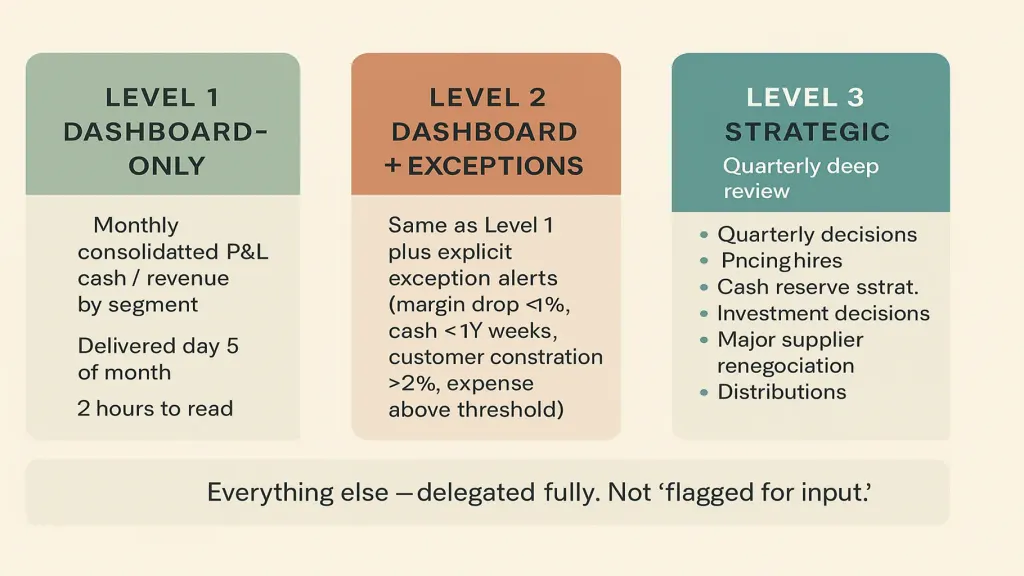
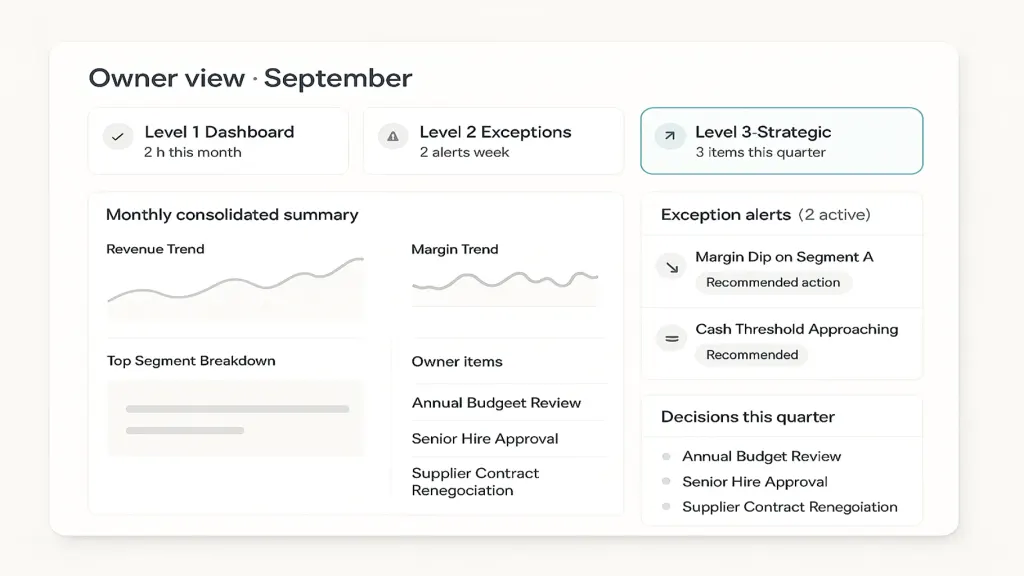
Level 2 — Dashboard + exception review (things the owner sees and asks about). Same dashboard plus explicit exception alerts: margin drop below X%, cash below Y weeks of reserve, customer concentration above Z%, major expense above threshold. Alerts arrive as they happen; owner reviews weekly (30 minutes) plus responds to alerts within 48 hours.
Level 3 — Strategic (things the owner actually decides). Quarterly deep review with the operations director and bookkeeper. Explicit decisions kept by owner: annual budget, senior hires (level 3+), pricing changes above 10%, cash reserve strategy, investment decisions, major supplier renegotiation, distribution to owners.
Everything else is delegated fully to the operations director. Not "flagged for owner input", not "reviewed weekly". Delegated.
What Getting This Wrong Looks Like
The first six months, without explicit levels, the owner had inserted herself into things she thought she was delegating.
- Approving every expense over ₴20K (should have been operations director's decision).
- Reviewing weekly cash forecasts (should have been dashboard-only monthly).
- Sitting in on all hiring interviews (should have been Level 3 only — senior hires).
- Deciding on supplier renegotiations (should have been operations director within limits).
Each of these was pulling her back into daily operations. Each felt "important" in the moment. Cumulatively, she was still working 5 days a week and the operations director was frustrated.
When she made the three-level framework explicit and shared it with the ops director, two things happened: her involvement dropped to about 8 hours per week from 30, and the operations director's confidence rose noticeably because she now knew where her authority ended.
The Weekly and Monthly Cadence That Made It Work
Weekly (Fridays, 30 minutes). Owner reviews exception alerts from the week and any Level 2 items. If nothing has triggered, the meeting is skipped. Attendees: owner, operations director.
Monthly (first Tuesday, 90 minutes). Owner reviews the dashboard, discusses trends, asks questions. Operations director owns the presentation. Attendees: owner, operations director, bookkeeper (as needed).
Quarterly (dedicated half-day). Owner and operations director review the full financial picture, set the priorities for the next quarter, adjust plans. This is the Level 3 conversation. External advisor optionally present.
Annually (full day + prep). Budget setting, strategic direction, major decisions for the year.
Total owner time in finance: ~8 hours/week average across the year. Down from ~30 hours/week under the previous "I'll stay across everything" approach.
📌 Planning to step back from daily operations but unsure exactly which financial decisions to keep and which to delegate? Send us your current role description and business snapshot — we'll produce a one-page three-level delegation framework tailored to your business. Request your free Finmap diagnostic →
Read also
Share valuable content — become a source of insights






Frequently Asked Questions
How do I know if my operations director is competent enough for Level 1/2 delegation?

90 days of shadowing is a fair test. If after 90 days the exception alerts they surface align with what you would have flagged yourself, they're ready.
What about ownership of the bookkeeping — accountant relationship?
Owner keeps direct relationship with the bookkeeper on Level 3 items (audit, tax, structural). Operations director owns the day-to-day accounting relationship.
Should I keep signing authority on the bank account?
For most owners, yes — as a control, not a workflow. Signing authority for wire transfers above a threshold. Everything below is operations.
What if the operations director makes a decision I disagree with?
Below Level 3, the decision stands — you delegated. You can raise it as a coaching conversation for the next similar decision. If you overturn Level 1/2 decisions, the delegation collapses.
How do I know if I've delegated too much?
Warning signs: you're surprised by numbers at the monthly review, exception alerts aren't triggering when they should, dashboard reports feel too tidy. Bring back Level 2 items until you re-establish trust.
Can this scale to multiple entities or a bigger organisation?
Yes — the same three-level model works across scale. Above ~50 employees, add a CFO between the operations director and the owner, and Level 3 items shift to CFO decisions with owner ratification.
Any questions left?
We are ready to answer them.


Finmap support