


Table of Contents
Home
/
Blog
/
The Data Room Was Not the Problem: What a Founder Learned Preparing Her Business for a First Investor

295

5 min

02.07.2026
The Data Room Was Not the Problem: What a Founder Learned Preparing Her Business for a First Investor
.avif)
Oleksandr Solovei
CEO & Co-founder Finmap
"He asked me one question. 'Show me your unit economics.' And I realised in that moment the whole conversation was going to be about what I couldn't say, not what I could."
A founder of a ₴14M education-services business — six-year-old, profitable, three cohorts of alumni — described the first real investor conversation she had, the one that taught her what "ready" actually means.
She had prepared for six weeks. Cleaned up the accounting. Assembled contracts. Wrote a pitch deck. Rehearsed the story of the business, the team, the vision. When the investor showed up — a Ukrainian angel with three earlier education exits — she was ready. She thought.
Twelve minutes in he asked a single question. "Show me your unit economics." She started answering. Cost to acquire a student. Revenue per student. Retention. Then he asked how she computed customer lifetime value. She answered. Then how she attributed marketing spend by cohort. She answered less fluently. Then how her margin structure differed between B2B corporate contracts and B2C individuals. She answered halfway. Then she stopped.
He wasn't testing whether the numbers looked good. He was testing whether she could speak in numbers about her own business at all. She could — approximately. That's not investable.
The conversation ended courteously. He didn't invest. She rebuilt over four months and successfully raised nine months later. This article is what she rebuilt.
What "Investment-Ready" Actually Means
Founders think investors want a fancy pitch deck, a clean cap table, and audited financials. Those are hygiene, not the substance. Investors want three things they rarely say out loud:
One — a founder who speaks fluently in the numbers of her own business. Every number the founder cites without hesitation is worth more than the same number written in a slide.
Two — a financial architecture that generalises. Not the specifics of last year — the shape of how revenue, cost, and cash relate at any scale. Investors are pricing the future business, not the past one.
Three — a data room that reflects an operator, not an accountant. The investor doesn't want tax filings. They want to see how the founder actually looks at the business month to month.
Get those right and the pitch deck almost writes itself.
The Four-Part Financial Architecture Investors Actually Read
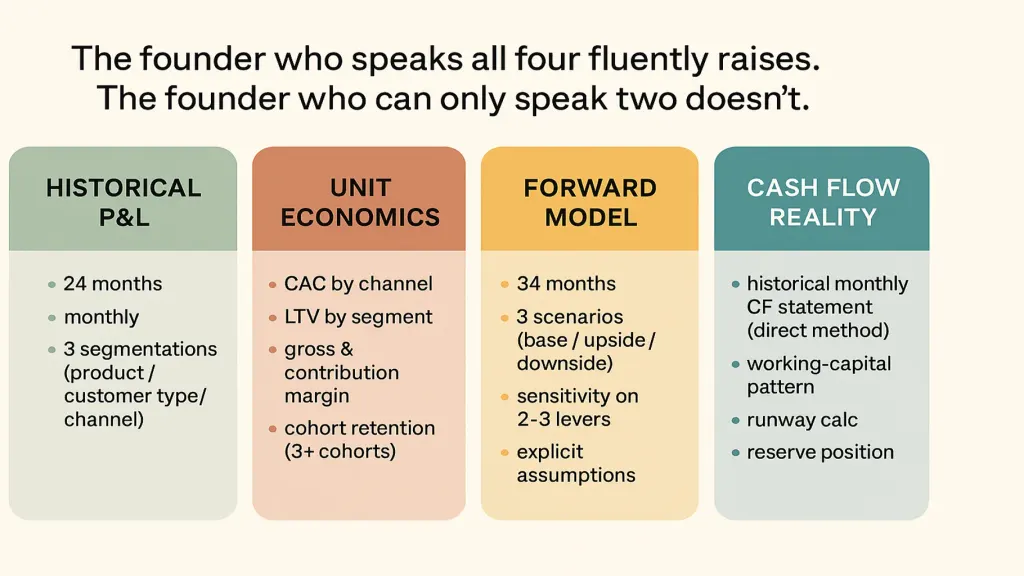
The rebuild she did organised her financial story into four connected artifacts.
Artifact one — Historical P&L, 24 months, monthly granularity, three segmentations. Total P&L. Segmentation by product line. Segmentation by customer type (B2B vs B2C in her case). Segmentation by acquisition channel. Not a summary — the actual numbers, month by month, with sudden movements annotated.
Artifact two — Unit economics, defined and explained. CAC by channel. LTV by segment. Gross margin per unit. Contribution margin per unit. Cohort retention curves for at least three cohorts. Written definitions of every term so there's no ambiguity.
Artifact three — 24-month forward financial model with scenarios. Not a forecast. A model. Three scenarios: base, upside, downside. Explicit assumptions for each. Sensitivity table showing the two or three levers that matter most.
Artifact four — Cash flow reality. Historical monthly cash flow statement. Working capital pattern. Cash runway calculation. Reserve position. This is where investors look for the truth behind the P&L.
Every founder who raises tells this story with these four artifacts, whether they call them that or not. The founder who can't tell it fluently loses the conversation before the pitch deck opens.
What She Actually Did — Four Months of Rebuild
Month 1 — 24 months of historical P&L, rebuilt with segmentation. Took the biggest chunk of time. Her books were bookkeeping-clean but not management-clean. She and her bookkeeper spent three weekends and one weekday per week reconstructing monthly totals by product line, by customer type, by channel. Total: about 60 hours of work.
Month 2 — Unit economics from source data. CAC required rebuilding marketing attribution. LTV required cohort tables. Margin per unit required allocating operating costs by segment. All possible, all painful the first time. About 40 hours.
Month 3 — Forward model. Built in a spreadsheet. Three scenarios explicit. Sensitivity table for four levers (price, retention, CAC, churn). She wrote the assumptions in plain text next to each cell — so an investor could re-run scenarios if they wanted. About 30 hours.
Month 4 — Cash flow statement and data room. Direct-method monthly cash flow, 24 months. Working capital pattern surfaced. Then the data room — organised as an operator, not a lawyer. About 25 hours.
Total: ~155 hours of work over four months, mostly her own. When she went back into raising, she raised in the third conversation.
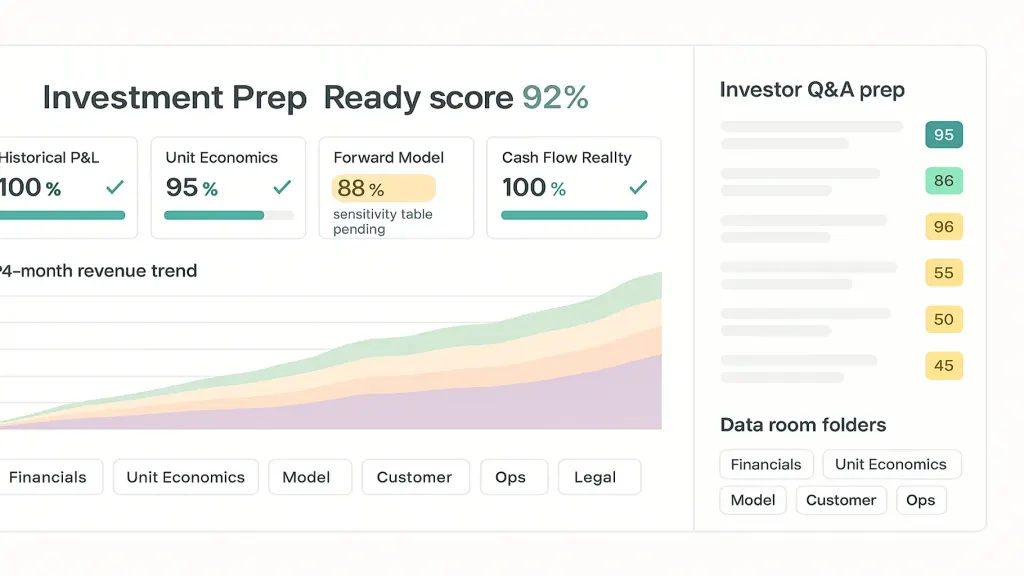
The Data Room Checklist That Actually Matters
- Financials: 24-month monthly P&L (3 segmentations), monthly cash flow statement, balance sheet as of last month-end, latest bank statements.
- Unit economics: CAC and LTV per channel/segment, cohort retention tables (3+ cohorts), margin structure by product line.
- Model: 24-month forward model with three scenarios, sensitivity table, written assumptions.
- Customer: Customer concentration analysis (revenue by top 10), retention/churn history, sample contracts.
- Operations: Org chart, hiring plan for next 12 months, key vendor list.
- Legal: Cap table, corporate structure, existing debt or convertible notes, IP inventory.
The financial layers are 60% of the work. The rest is admin. Founders reverse this ratio and lose four weeks preparing legal docs while the numbers stay ambiguous.
📌 Preparing to raise in the next 6–12 months and unsure whether your financial story is investor-ready? Send us a snapshot of your current P&L and any model you have — we'll produce a one-page readiness assessment showing which of the four artifacts are strong and which will get you rejected in the first conversation. Request your free Finmap diagnostic →
Read also
Share valuable content — become a source of insights




Frequently Asked Questions
How long does it really take?

For a founder who's been running the business for 3+ years: 3–6 months of concentrated part-time work. Less if bookkeeping is already clean and segmented; more if not.
Can I hire someone to do this for me?
Only partially. The historical rebuild can be delegated. The unit economics definitions and the model assumptions must come from the founder — otherwise she can't answer the question that ends the pitch conversation.
What if my bookkeeping is a mess?
Fix that first. There's no shortcut. Two months of cleanup before the four months of investment prep is realistic.
Do I need audited financials?
For most Ukrainian angel and pre-Series-A rounds, no. Clean bookkeeping and internally-produced statements are usually acceptable. Audits become relevant at Series A and above.
Excel or platform for the model?
Excel for the forward model. Investors expect to see the formulas. A platform can host the historicals and cash flow.
What's the single biggest mistake founders make?
Focusing on the pitch deck. The pitch deck is downstream. The four artifacts above are upstream — get them right and the deck writes itself.
Any questions left?
We are ready to answer them.


Finmap support