



Table of Contents

123

12 min

04.07.2025
Revenue Up 173%: How Management Accounting Made a Project-Based Business Profitable
Sergiy Shuldik
Financial Expert at Finmap
Money disappears before you even notice — into deadlines, revisions, and “portfolio” projects. And without a financial system, it’s hard to know where it’s going at all.
This case study tells the story of an architecture studio that refused to work in the dark, implemented financial accounting, and, within a year, increased revenue by 173% and net margin by 286%.
For more than six years, Finmap has been helping the team make data-driven decisions.
It’s not a myth, and it’s not luck — it’s systematic work with finances.
Time to check: are your projects actually profitable, or do they just look good?
Bogdanova Bureau — architecture, design, and creative solutions
Bogdanova Bureau doesn’t just deliver architectural projects — it creates integrated living spaces built around the client. The studio focuses on residential and commercial properties, interior design, product design, and art direction.
The team supports clients at every stage — from idea to execution — with confidence and attention to detail. For founder Olha Bogdanova, creating a space should be an exciting adventure, not a source of stress.

How Finance Became Part of the Architectural Process
In 2018, when Olha left a large architecture firm and started her own business with a small team, she decided to take control of every process.

From the start, she made one thing clear: finances had to work as precisely as technical drawings.
At her previous company, they had already used Finmap for financial accounting — but a dedicated accountant handled it. That experience showed Olha that the service really delivered results, making the choice obvious.
She used the trial period, learned the workflows, and then hired a Finmap financial consultant.
Olha knew that for accounting to become a strategic tool — not just a formality — she needed experienced knowledge and an outside professional perspective.
From her own experience, Olha understood that:
- Without financial accounting, even the most exciting projects can eat up your profit margin.
- Creative freedom, in practice, means financial confidence.
- Making decisions in the dark is not a strategy.
In short projects, allocating finances is easy. In long-term projects, everything gets more complicated: you have to track hours, reconcile balances and cash flows, and record small expenses all the time. — Olha Bogdanova, founder of Bogdanova Bureau
When the basics aren’t enough
Olha already had extensive business experience — the chaotic stage of “everything that comes in is profit” was behind her.
A lot of people don’t like finance, but it’s essential. You have to keep track of it. If you don’t learn to love finance, finance won’t love you back. — Olha Bogdanova, founder of Bogdanova Bureau
She knew that to scale, she needed not only to implement accounting, but to use the numbers as a decision-making tool.
The specific challenges that came up:
- Calculating project costs.
“Sometimes it feels like a project is going really well — especially when there’s great chemistry with the client. But then you look at the numbers, and it’s heartbreaking,” says Olha. It was crucial to understand where and why the business was losing profit, so they could act in time.
- Systematizing expenses.
Identifying overspending, recurring payments, and areas for optimization — so resources could be reallocated and spent wisely.
- Implementing real management accounting. Not just recording money in and money out, but:
- exploring Finmap’s features in depth;
- setting up the system for the studio’s actual operations;
- testing hypotheses and seeing the results in numbers;
- working with a specialist financial consultant.
A new level: why every business needs a financial specialist
Olha started using the service on her own — importing data, setting up integrations, and studying the analytics. But once she saw the insights Finmap could provide, new questions came up. It was time to go deeper.
That’s when she decided to bring in a financial specialist from Finmap.
It wasn’t a “formal upgrade” — it was a logical next step, aligned with the studio’s pace of growth.
When we started working with a specialist, that was the real turning point and the beginning of our friendship with finance. Finmap on its own is great. But with someone helping organize everything, we save money. — Olha Bogdanova, founder of Bogdanova Bureau
From the very first day of that partnership, Olha was able to:
- delegate routine tasks: data entry, reconciliations, categorization;
- focus on strategy — analysis, ideas, and decisions;
- get answers to questions like “if I do it this way, how should I account for it?”;
- discuss hypotheses with a specialist who had seen the finances of many companies and brought fresh ideas and approaches.
What financial solutions work at Bogdanova Bureau
Financial accounting at Bogdanova Bureau stopped being just a control tool — it became part of strategic management. Every new step meets a real business need. Every result is measured in numbers.
1. Hours & Tasks Model: Clear Math, Not Guesswork
To price requests fairly and make sure the work done was paid for accurately, the team decided to break projects down into tasks and hours. This allows them to respond quickly when a client asks for extra changes: they already know how long it will take and how much it will cost.
2. Each Client as a Separate Project in Finmap
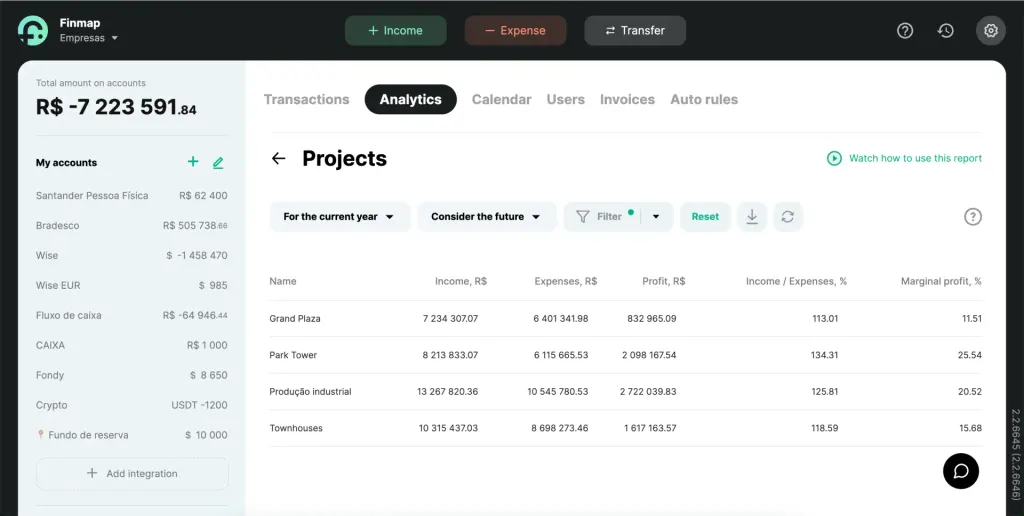
For a project-based business, this is essential: in Finmap, each client is created as a separate project. All income and expenses are recorded separately, and the analytics show the full picture of profitability, margin, and financial results.
3. Funds System: Financial Flexibility and Stability
When the studio switched to remote work, it no longer had the costs of a physical office. To keep those savings from “disappearing” into day-to-day expenses, the team decided to channel the money into an internal fund.
That’s how the first financial reserve was created — followed by other dedicated funds:
- Rent Fund — made it possible to rent the ideal office without stress when the team returned to in-person work.
- Contingency Fund — 2% of every payment received is automatically set aside for mistakes or unexpected situations.
- Development Fund — investments in training, professional travel, and new opportunities.
- Marketing Fund — ensures ongoing investment in promotion and acquiring new clients.
Thanks to this, the team isn’t at the mercy of circumstances — it creates its own reserves, controls how resources are allocated, and makes decisions from a place of stability, not stress.
4. Analytics and Experiments: Data-Driven Decisions
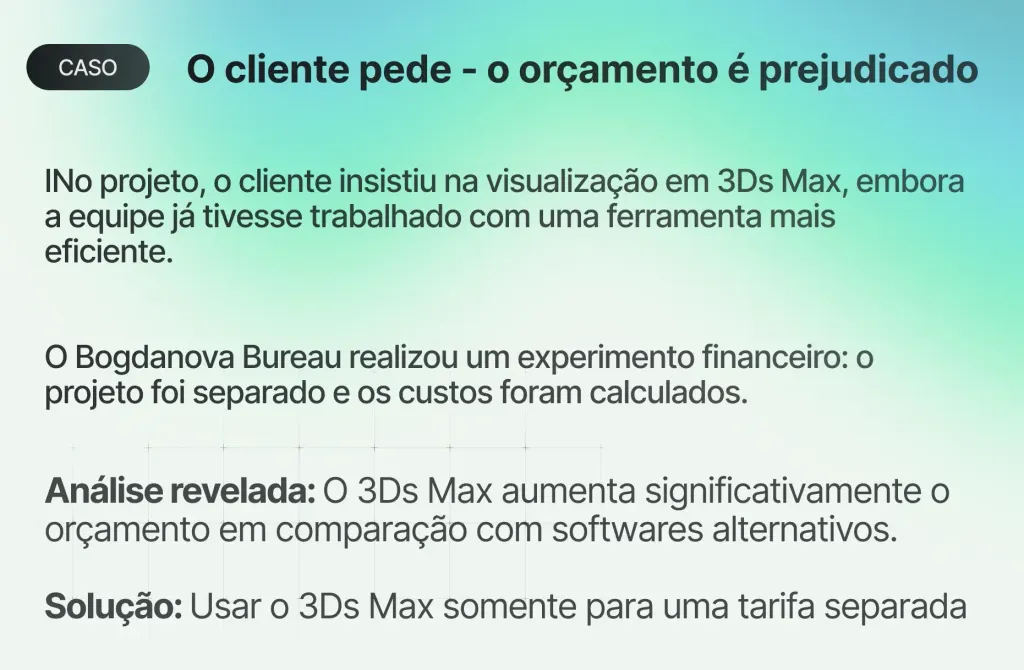
New ideas at Bogdanova Bureau aren’t implemented at random — each one is tested as a financial experiment. This makes it possible to assess not only the creative value, but also the economic viability of every initiative.
5. Recording Even the Smallest Expenses
Regular spending on services, subscriptions, and software often stays “invisible” to a business. On their own, these expenses seem insignificant — but over a year, they add up to a serious amount.
R$40 a month becomes R$480 a year. And it’s not just one tool. In Finmap, this becomes clear — you understand exactly where the budget is going. — Olha Bogdanova, founder of Bogdanova Bureau
Finmap helps you plan your budget accurately and avoid unnoticed financial leaks.
How finance became a source of strength, not stress
Thanks to Finmap, the Bogdanova Bureau team began managing money strategically: accounting, planning, and forecasting.
- Systematic financial accounting. Finance at Bogdanova Bureau stopped being a separate function and became part of the business mindset. All cash flows, income, expenses, and projects are structured and under control.
For me, Finmap isn’t about forecasts; it’s about analysis. It’s when you see the results in front of you, when you understand where you shouldn’t spend more and where we’re losing money. — Olha Bogdanova, founder of Bogdanova Bureau
- Financial modeling and analysis. Olha builds financial models, analyzes profitability, and makes decisions based on data, not assumptions.
- Financial funds — reserve, development, marketing. Thanks to Bogdanova Bureau’s fund system, the company gained financial confidence: money doesn’t sit idle; it works toward specific goals.
- Clear economics for every project. Costs are calculated, pricing is justified, profitability is measured. No more situations where losses from one project are covered by income from another.
Before, we often worked by borrowing from other projects and leaving them in the red. Proper financial accounting helps you see all of this, save money, and find revenue where you didn’t expect it. — Olha Bogdanova, founder of Bogdanova Bureau
- Profit and dividends — without hurting the business. Olha knows exactly when and how much she can withdraw from the company without creating cash gaps or disrupting operations.
- The founder’s personal development. With support from a financial manager and continuous learning, Olha has significantly grown her financial competence — and now makes decisions from a place of expertise.
Over this time, I’ve grown a lot in financial management because the consultant helped me set everything up correctly and systematize it better. — Olha Bogdanova, founder of Bogdanova Bureau
Financial resilience and international expansion with Finmap
Financial accounting isn’t just about spreadsheets — it’s about decisions, systems, and confidence, even when everything around you changes.
The System That Generated 173% Revenue Growth
After implementing Finmap and a comprehensive financial system covering every project, expense line, and forecast, Bogdanova Bureau achieved impressive results.
The team analyzed the profitability of different areas, dropped low-margin projects, and focused on the ones that truly generated revenue.
This not only increased revenue by 173%, but tripled the net margin.
Now we can see profitability before we even start a project. We make proactive decisions based on calculations, not intuition. — Olha Bogdanova, founder of Bogdanova Bureau
The Safety Net That Withstood the Toughest Crisis
The start of the full-scale war brought the economy to a halt. But thanks to the reserve funds created in advance and flexible accounting, the company was able to adapt:
- optimize expenses;
- restructure the team;
- reallocate budgets;
- keep projects moving.
Bogdanova Bureau stayed afloat not by chance, but by design. Its financial safety net bought the time and space to make thoughtful decisions during the most critical period.
Confident Entry into the International Market
The crisis was both a challenge and a catalyst. Based on analytics, projections, and a clear understanding of its strengths, Bogdanova Bureau entered the international market.
Today, it has successful projects outside Ukraine, steady work with foreign clients, and a gradually strengthening position in a new competitive environment.
Our focus now is to have fewer projects, but bigger, more complex, and more profitable ones — with financial control that doesn’t fail even in a crisis. — Olha Bogdanova, founder of Bogdanova Bureau
Change Starts with Decisions
Olha went through the journey from chaos to system — and she did it not by hiring a large finance team, but by using the right tool, expert support, and recognizing the value of financial accounting.
Finmap stopped being just a record-keeping service; it became a financial partner in growth.
You can do the same:
- systematize your accounting,
- identify true profit drivers and leaks,
- stop making decisions based on gut feeling.
And most importantly — you don’t have to do it alone.
Want to get your business finances in order? Send us a request, and our specialist will show you how to adapt everything to your exact processes.
Share valuable content — become a source of insights