

Table of Contents
Most small business budgets die in February. You build a beautiful spreadsheet in January, reality ignores it by the third week, and by spring you're back to steering on gut feel and whatever the bank balance says this morning. So you conclude what a lot of owners quietly believe: "planning is a waste of time — the numbers never match anyway." Or you avoid it because "I don't know if we can afford that hire until the money's already gone, so why pretend?"
Here's the reframe that changes everything: a budget was never supposed to be a prediction you get graded on. It's a decision tool. Its job is to tell you — before you spend — whether you can afford something, and to warn you early when reality is drifting, while a correction is still cheap. A plan that's 80% right and reviewed every month will run circles around a "perfect" plan reviewed never. This guide covers the difference between a budget, a forecast and a financial model, how to build an annual plan in about a day using numbers you already have, and how to keep it alive with a 15-minute monthly habit instead of an annual act of fiction.
Why plan at all, when the numbers never match
They're never supposed to match to the hryvnia. A plan does three jobs, and none of them require being exactly right:
- Affordability. Can we make this hire, buy this machine, run this campaign — and still cover payroll in the thin months? A plan answers this before the money leaves, not after.
- Early warning. When actual results drift from the plan, you find out in week two, when you can still act — not at year-end, when you can only explain.
- Alignment. You, your partner and your team spend against the same set of numbers instead of each improvising their own.
Think of the budget as the guardrails, not the crystal ball. You don't need to predict the road perfectly; you need to know when you're drifting off it.
Budget vs forecast vs financial model
These three get muddled constantly, and the confusion is why so many owners give up. The difference is actually simple:
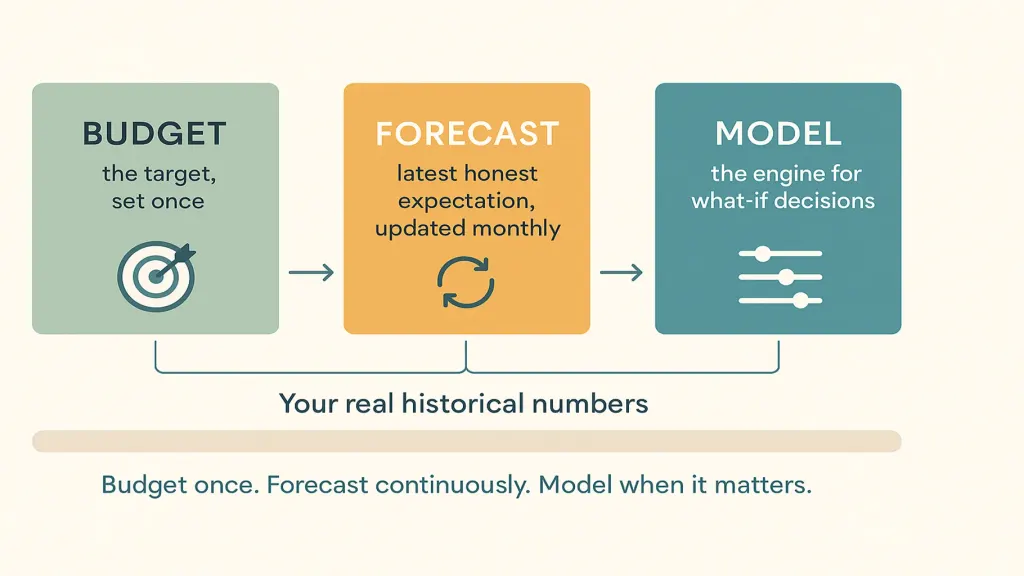
- Budget — the target. What you intend income and costs to be over the year. You set it once and use it as the yardstick you measure against.
- Forecast — your latest honest expectation. You update it as reality comes in: "given what actually happened in Q1, here's where we'll really land by December." The budget stays fixed; the forecast moves.
- Financial model — the engine. The linked logic — drivers, assumptions, formulas — that lets you ask "what if we raise prices 10%, or hire two people, or a big client leaves?" and see the effect ripple through.
The rhythm: you budget once a year, forecast continuously (a few minutes a month), and model when you face a big decision. All three sit on the same foundation — your real historical numbers. A plan built on last year's actuals beats one guessed from a blank page every time.
How to build an annual budget in about a day
You don't need a finance team or a fancy template. You need last year's real numbers and a few focused hours.
1. Start from reality, not a blank page. Pull last year's actual income and costs, month by month. That's your baseline — far more honest, and far faster, than inventing numbers from zero.
2. Plan revenue by month, not as one annual lump. Break the year into twelve so seasonality shows up. A single "₴6M this year" figure hides the exact quarter you'll be dangerously tight; twelve monthly figures reveal it while you can still prepare.
3. Split costs into fixed and variable. Fixed costs (rent, salaries, subscriptions) barely move month to month. Variable costs (materials, fees, per-sale marketing) rise and fall with revenue — so once you've planned revenue by month, they follow it automatically. This one split makes the whole plan react to reality instead of sitting frozen.
4. Leave a buffer and sketch a few scenarios. A base case, a cautious case, a stretch case. Now a slow quarter isn't a crisis you didn't see coming — it's a scenario you already thought through, with a plan B ready.
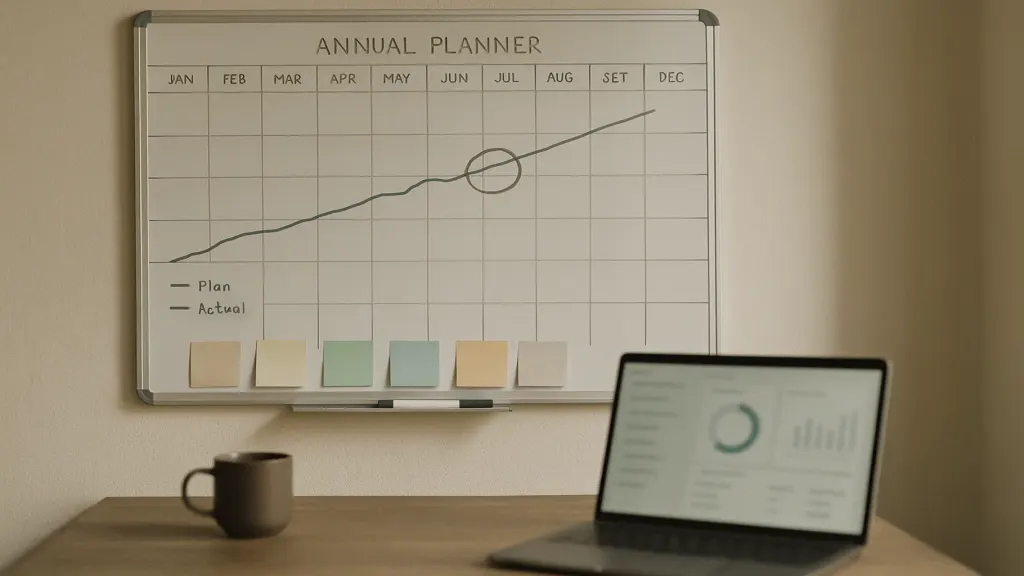
5. Turn it into a monthly plan you can actually check. The budget only earns its keep if you can lay it next to actuals every month and see the gap. A number you never compare against reality is decoration.
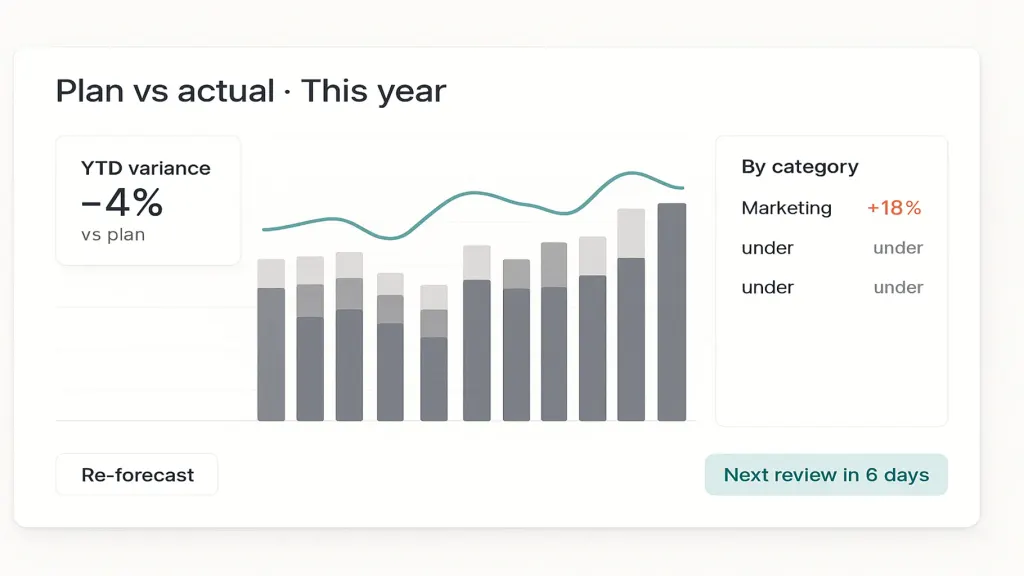
A tool like Finmap helps here because the plan lives right next to the actuals: you set expected income and costs by category and month, the real numbers flow in from your connected accounts, and "plan vs actual" becomes a live view instead of a monthly manual reconciliation you dread and postpone.
Keep it alive: the 15-minute monthly review
A budget isn't a document — it's a habit. Once a month, block fifteen minutes and do three things:
- Compare plan vs actual by category. Where did you drift, and why? Was it a one-off or a trend?
- Re-forecast the rest of the year with what you now know. A single bad month might be noise; three in a row is a signal worth acting on.
- Decide one or two concrete actions. Delay a cost, chase a receivable, pull forward or push back a hire. A review without a decision is just reading.
Fifteen minutes a month is the entire difference between a plan that steers the business and a spreadsheet nobody has opened since January.
Where owners plan differently by business type
The method is the same; the emphasis shifts with what drives your money:
| Type of business | Plan carefully around | Easy to forget |
|---|---|---|
| Seasonal (tourism, retail, events) | Month-by-month swings; save in peaks | Spending a strong month as if it's normal |
| Services / agency | Utilisation and pipeline; hiring timing | Unbilled work and slow-paying clients |
| Product / manufacturing | Inventory and materials purchasing | Cash tied up in stock before it sells |
| Subscription / SaaS | Recurring revenue and churn | Acquisition spent up front, paid back slowly |
Whatever the business, the discipline is identical: plan by month, split fixed from variable, and re-forecast as the real numbers arrive.
The mistakes that kill budgets
- Building it once and never looking again. A plan you don't review is decoration, not a tool.
- One annual number instead of month-by-month. It hides the exact window you'll run tight — usually until you're in it.
- Planning profit but not cash. A profitable plan can still leave you short in a specific month; plan the timing of the cash, not just the yearly total.
- Chasing precision over usefulness. Roughly right and reviewed monthly beats exactly wrong and forgotten in a drawer.
📌 Build a plan you'll actually use. In Finmap your budget lives next to your real numbers, so plan vs actual is a live view and re-forecasting takes minutes, not a dreaded afternoon. See where the money is heading — before it gets there.
In this topic
- Annual Budget for a Small Business: The One-Day Method That Actually Works
- From an Idea to a Million: How a Financial Model Can Make It Happen
- ₴500K in May, ₴160K in July: The Cashflow Discipline Seasonal Businesses Skip
- Weekly KPI Sheet: Seven Numbers the Owner Should See Every Monday in Ten Minutes
- 30-Day Cash Forecast: How a Small Business Owner Sees the Next Month Before It Happens
- Financial Results of the Year: How to Prepare and Analyse Reports
Share valuable content — become a source of insights






Frequently Asked Questions
What's the difference between a budget and a forecast?

A budget is the target you set once for the year and measure against. A forecast is your latest honest expectation, updated as real results come in. You use the budget as the fixed yardstick and the forecast to see where you'll actually land — and to act early when the two diverge.
How do I make a budget for a small business?
Start from last year's real numbers, plan revenue month by month so seasonality shows, split costs into fixed and variable, add a buffer and a couple of scenarios, then compare plan to actuals every month. The first version takes about a day; keeping it alive takes about 15 minutes a month.
How often should I update my financial plan?
Set the budget once a year, but re-forecast monthly — a 15-minute review comparing plan to actual and adjusting the rest of the year. That cadence is what keeps a plan useful instead of obsolete by March.
Do I need a financial model as well as a budget?
Not for day-to-day running — a budget and a monthly forecast are enough for most small businesses. You reach for a financial model when you face a big decision (a price change, a major hire, raising investment) and need to test "what if" scenarios before you commit.
Why do my budgets never match reality?
Because a budget is a decision tool, not a prediction you're graded on — it's not meant to match to the hryvnia. Its job is to tell you what you can afford and to flag drift early, which only works if you review it monthly and re-forecast. A budget you set once and never revisit will always look "wrong"; a budget you review will always be useful.
Any questions left?
We are ready to answer them.


Finmap support