


Table of Contents
It's Friday. Two suppliers are waiting, payroll is Tuesday, and a client who swore they'd pay "this week" has gone quiet. You open your banking app, look at the balance, and do the thing every owner does — you try to hold the whole month in your head and guess whether you'll make it. "I don't actually know where my money is," you think. "We had a good month — so why does the account feel this tight?"
That feeling isn't a discipline problem. It's a cash flow problem, and almost every small business has it long before it has a revenue problem. You can be growing, busy, even profitable on paper, and still lie awake doing mental math about the 25th. The good news: cash flow is learnable and controllable. This guide walks through what cash flow actually is, why profit and cash are not the same thing, how to read a cash flow statement (in Ukrainian — звіт про рух грошових коштів, ОДДС) without an accounting degree, and how to set up a simple system that shows your real money position in real time — so Friday stops being a guessing game.
Profit is an opinion. Cash is a fact.
Here's the sentence that saves owners the most sleepless nights: profit and cash are two different things, and it's cash that pays your bills.
Profit is an accounting result — revenue minus expenses over a period. It's useful, but it's partly a matter of judgement: when you count a sale, how you spread the cost of equipment, what "earned" means. Cash flow is blunter. It's the actual money that moved in and out of your accounts. No opinions, no timing tricks — just the balance going up or down.
A quick, honest example. You close a ₴200,000 project in March and send the invoice. Your profit-and-loss report immediately shows ₴200,000 of revenue and a great-looking month. But the client pays on 45-day terms, so the money lands in mid-May. Meanwhile, in March and April you still pay salaries, rent, taxes and a subcontractor — all in real cash, today. On paper: profitable. In the account: a hole. That gap between earning money and receiving money is exactly where healthy, profitable businesses run out of cash and get blindsided.
This is why "we're profitable" is not the same as "we have money", and why watching only your P&L is like driving while looking only in the mirror.
Why your account never matches your gut
If the money never behaves the way you expect, it's almost always one of these five — and usually several at once:
- Clients pay later than you deliver. You do the work now and get paid in 14, 30, 45 days. The bigger and more "reliable" the client, the longer they often take. Your money sits in their account.
- Costs come before the revenue they create. Materials, prepayments, a hire, an ad budget — you spend first, and the return trickles in afterwards.
- Seasonality quietly moves money between months. A strong May subsidises a thin August — but only if you saw August coming and didn't spend May's cash as if it were normal.
- Personal and business money live in one wallet. You pull cash for a personal thing, top it back "later", and within two weeks nobody — including you — can say how much is actually the business's.
- You watch the balance, not the next 30 days. Today's number tells you nothing about the payroll-plus-tax collision two weeks out. So every large payment arrives as a surprise, even the ones you could have set your calendar by.
None of these mean your business is weak. They mean the timing of money isn't being managed. And timing — not profit, not revenue — is what cash flow management is really about.
What a cash flow problem actually feels like
You'll recognise at least one of these. They're not hypotheticals; they're the everyday texture of running a small business without a cash view:
- On Monday you take ₴30,000 out of Client A's payment to cover an urgent bill for Project B. "I'll put it back Wednesday." By Friday you genuinely can't remember whether you did, and the numbers no longer tie out.
- Payroll lands on the 5th, a big quarterly tax on the 20th, rent on the 1st — and they all sit in the same two-week window with a client who's "just about to transfer".
- The month closes and the accountant says it was profitable. The account, meanwhile, is scraping the bottom, and you're quietly moving money between cards to keep three suppliers calm.
- You want to hire, or buy a machine, or say yes to a bigger order — and you honestly cannot tell whether you can afford it, so you either freeze or gamble.
Every one of these is the same root issue wearing a different costume: you can't see your money clearly enough, early enough, to make a calm decision. It's a visibility problem, not a character flaw.
The cash flow statement (ОДДС), without the accounting textbook
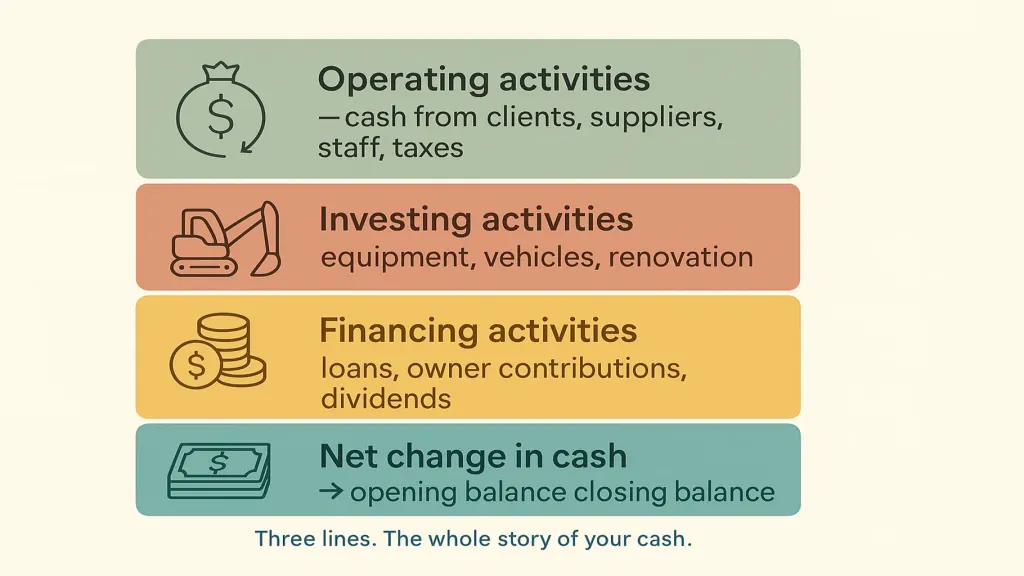
The cash flow statement — звіт про рух грошових коштів, ОДДС — is the one report that answers a very practical question: where did the cash actually come from last month, and where did it go? Forget the formatting; the logic is simple. Every movement of money falls into one of three buckets:
- Operating activities — cash from running the business: money in from clients, money out to suppliers, staff, rent and taxes. This is the number that matters most. Positive, steady operating cash flow means the business funds itself from its own work — the definition of healthy.
- Investing activities — cash tied to longer-term assets: buying equipment or a vehicle, a renovation, occasionally selling one.
- Financing activities — cash between you and lenders or owners: a loan taken or repaid, money you put in, dividends you pulled out.
Add the three together and you get the net change in cash for the period — the bridge that explains how your opening balance became your closing balance. If the account fell even though you "made money", the ОДДС shows you exactly which bucket did it: a client who didn't pay (operating), a machine you bought (investing), or a loan you repaid (financing).
You don't need to produce this by hand. You need to be able to read three lines and know which one is bleeding. Once you can, "we had a good month" and "we have money" stop being the same sentence in your head.
A cash flow system you can run in a morning a week
You don't need a finance hire or a finance degree. You need a routine that turns "guessing on Friday" into "glancing at a screen". Five steps.
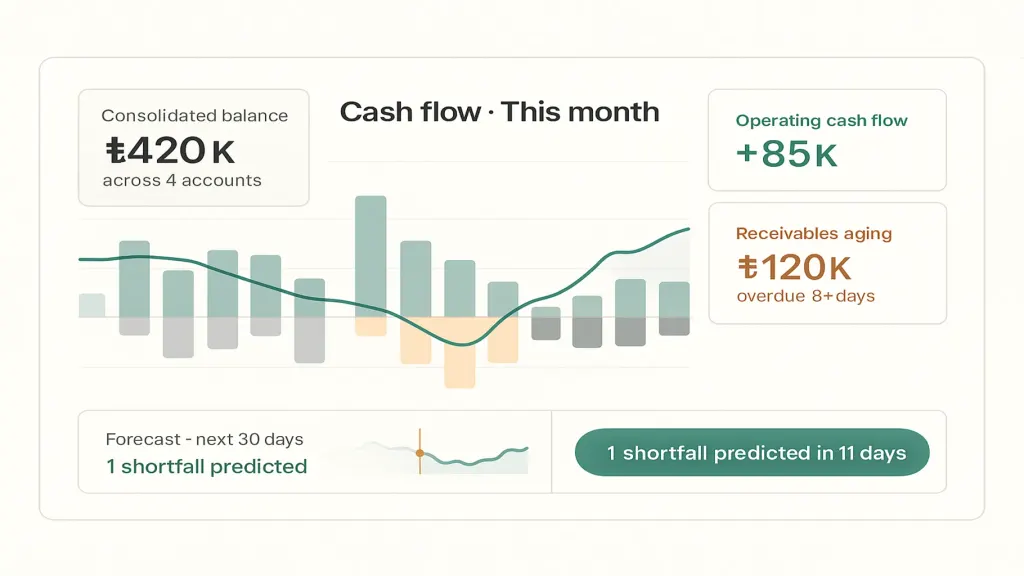
1. Put every account into one honest, live balance. Business account, card, cash box, the ФОП account, the second card you use "just for X" — pulled into a single number that updates itself. This is the foundation, and it's the first thing a tool like Finmap does: connect your accounts and show one real figure instead of ten scattered ones you add up in your head and get wrong.
2. Separate business and personal money — properly. Give the business its own accounts and stop paying for groceries from the same card as suppliers. Until the money is separated, every cash flow number you produce is fiction, and you'll never trust your own reports.
3. Build a rolling 30–60 day forecast. List committed outflows day by day — payroll on the 5th, rent on the 1st, tax on the 20th, the loan payment, the recurring subscriptions. Then add expected inflows, each tagged by confidence: high (signed, invoice sent, reliable payer), medium, low (hopeful). A running-balance line across those days shows you the tight windows before they arrive — while you can still call a client, delay a purchase, or move a payment by a week.
4. Read your operating cash flow once a month. Not just "was it profitable" — was operating cash flow positive and holding up? If you're "profitable" but operating cash flow is negative month after month, that's the early-warning light, not a rounding error.
5. Watch two leading indicators. Receivables aging — who owes you and how overdue — because unpaid invoices are your cash sitting in someone else's account. And runway — how many months you could cover at today's burn if inflows paused. These two numbers predict a cash gap weeks ahead of the balance doing so.
The whole point is to move the month out of your head and onto one screen you can trust — so decisions get made with a glance, not a knot in your stomach.
How this looks in different businesses
The principles are universal; the pressure points differ. A few examples of where cash usually gets stuck:
| Type of business | Where cash hides / leaks | What to watch first |
|---|---|---|
| Services / agency | Long client terms and unbilled work sitting "almost done" | Receivables aging; invoice the day you deliver |
| Retail / e-commerce | Money locked in stock; returns and platform fees | Cash tied up in inventory; real margin after fees |
| Construction / projects | Money mixed between projects; milestone gaps | Cash per project; the payroll-vs-milestone window |
| Manufacturing | Materials and work-in-progress bought long before you're paid | The gap between paying for materials and getting paid |
| Subscription / SaaS | Refunds, failed payments, acquisition spent up front | Net cash after churn; timing of renewals |
Different costumes, same lesson: know your balance today, and know the shape of the next 30–60 days. Everything else is detail.
The mistakes that quietly kill cash
- Managing profit and ignoring cash. The P&L looks fine while the account drains. Watch both, and when they disagree, believe the account.
- No forecast at all. Reacting to today's balance instead of seeing next month coming. A forecast turns surprises into decisions.
- Letting receivables slide. Every overdue invoice is your money financing someone else's business, interest-free. Chase early and politely; it's not rude, it's cash flow.
- Mixing personal and business. It hides the real picture and quietly corrupts every number you look at.
- Treating a strong sales month as a strong cash month. Sales are a promise. Cash is the fact. Spend against the fact.
📌 Stop guessing on Fridays. Connect your accounts in Finmap, see one real-time balance across everything you own, and get a 30–60 day forecast that flags a shortfall before it happens — while you can still do something about it. Set it up in about 20 minutes. If it doesn't make your money clearer, you've lost nothing but the guessing.
In this topic
- Cash Flow Gap: How to Identify It and How to Prevent It
- The Friday Question: Which Supplier Gets Paid This Week?
- ₴500K in May, ₴160K in July: The Cashflow Discipline Seasonal Businesses Skip
- From Seasonal Slumps to Steady Profit: How to Earn All Year Round
- 30-Day Cash Forecast: How a Small Business Owner Sees the Next Month Before It Happens
- Cash Flow and the Cash Flow Statement: What It Is and How to Calculate It
Share valuable content — become a source of insights




Frequently Asked Questions
What is cash flow in simple terms?

Cash flow is the money moving in and out of your business over a period — everything you received minus everything you paid out. If more came in than went out, cash flow is positive and your balance grew. It's about the real movement of money, not accounting results.
What's the difference between cash flow and profit?
Profit is an accounting result — revenue minus expenses — and it can include money you haven't actually received or paid yet. Cash flow is the real movement of money in your accounts. A business can be profitable on paper and still run out of cash because of timing: for example, when you record a ₴200,000 sale in March but the client pays in May, while salaries and rent go out in cash the whole time.
What is a cash flow statement (ОДДС)?
It's the report that shows where your cash came from and where it went, split into operating, investing and financing activities. Together they explain how your opening balance became your closing balance — and, when the account falls despite a "good month", exactly which bucket caused it.
How do I forecast cash flow for a small business?
Start from your current consolidated balance, list committed outflows day by day for the next 30–60 days (payroll, rent, taxes, loans), add expected inflows tagged by confidence, and let a running-balance line reveal where the balance dips. Build it once, then update it in about 15 minutes a week.
What is healthy cash flow?
Consistently positive operating cash flow — the core business funds itself — plus enough buffer to cover committed payments through any tight window, and no need to borrow just to pay routine bills. Growing cash from operations, not from new debt, is the sign that the engine works.
Why is my business profitable but always short on cash?
Almost always timing. You record revenue when you invoice, but the cash arrives weeks later, while costs go out now. Add slow-paying clients, money locked in stock, or mixed personal spending, and the account stays tight even in a profitable month. A forecast and clean, separated accounts fix it faster than more sales do.
Any questions left?
We are ready to answer them.


Finmap support